

A Satirical Inquiry Into a Nation That Keeps Defending Its Own Suffering
By a Concerned Observer of the Human Condition – dirty Gova
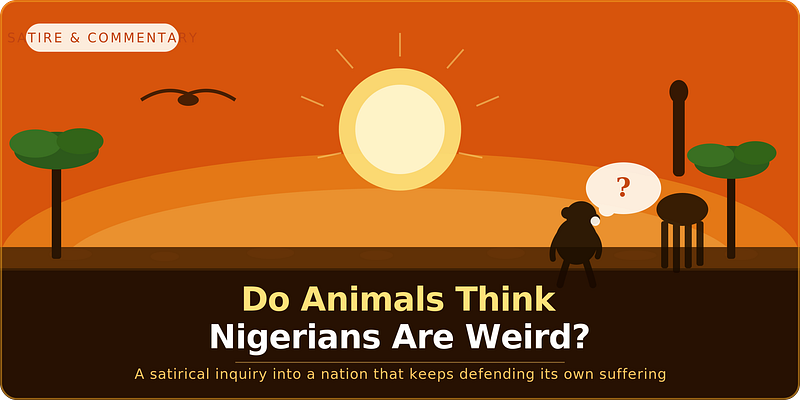
Somewhere in the Yankari Game Reserve in Bauchi State, a baboon pauses mid-scratch, tilts its head, and watches a group of Nigerians debate on their phones. One is a politician defending fuel subsidy removal while filling his generator with premium fuel paid for by the same government he says has no money. Another is an influencer with 2 million followers telling their audience that “suffering builds character.” A third is an ordinary citizen nodding along, repeating the words of a senator who has not spent a single night without electricity in eleven years.
The baboon scratches its head again.
What is wrong with these ones?
## Part One: The Animals Convene a Meeting
Let us imagine, for the sake of intellectual honesty, that the animals of Nigeria — the ones that have not been poached, eaten, or displaced by the same misgovernance their human neighbours endure — decided to hold a town hall meeting. The agenda: “Are Nigerians Okay?”
The eagle, perched high above Abuja, speaks first.
“I have flown over this country for thirty years,” the eagle says solemnly. “I have watched them build roads that wash away after one rainfall. I have watched them elect the same recycled faces and act surprised each time. But what truly confuses me is this — they do not just endure the suffering. They defend it. They celebrate the people causing it.”
Murmurs ripple through the crowd.
A goat raises its hoof. “I once ate a campaign poster,” the goat says. “It tasted better than the promises on it.”
The crowd erupts.
## Part Two: The Curious Case of the Nigerian Political Defender
There exists in Nigeria a remarkable species — not classified by zoologists but perhaps worthy of their attention — known informally as the Defender of the Status Quo. They can be found in three distinct habitats:
1. The Government Appointee’s Living Room
Here, they speak in polished tones about “the complexity of governance.” They invoke GDP figures no ordinary Nigerian recognises in their daily life. They compare Nigeria to war-torn nations rather than to the peers Nigeria aspired to equal in 1960. “At least we are not Somalia,” they say, as if national ambition has a legal floor of not being a failed state.
2. The Influencer’s Comment Section
Here, they are louder. They attack anyone who criticises the government with the ferocity of people whose electricity, water, and security have been personally guaranteed by the president. They call dissenters “unpatriotic.” They share graphics with motivational quotes over pictures of ministers. They have monetised optimism and packaged hopelessness as hustle culture. “God will do it,” they say, because it requires no policy change, no accountability, and most conveniently, no effort from anyone in power.
3. The Roadside Argument
Here, they are perhaps the most baffling. They are the ordinary citizen — underpaid, underserved, unsupported — who has nonetheless appointed themselves the unpaid public relations officer of a government that does not know their name. They will fight you, a fellow sufferer, on behalf of a man who has never once fought for them.
The animals find this last group the most confusing of all.
“Even among wolves,” the alpha wolf says, shaking its magnificent head, “we do not defend the wolf that steals our meat.”
## Part Three: What the Politicians Actually Believe
It would be dishonest to suggest that Nigeria’s political class is populated entirely by villains twirling their moustaches. Many of them believe — genuinely, passionately — in their own innocence. This is perhaps the most dangerous thing about them.
They believe the roads are bad because Nigerians are impatient and do not understand “the long game.” They believe hospitals are underfunded because the people must first learn to take better care of themselves. They believe the economy is struggling because Nigerians are not entrepreneurial enough, industrious enough, disciplined enough — this, said by men who have never woken up before 10am without being called to a commissioning ceremony for a borehole they are about to claim they built.
They travel abroad for medical treatment and return to commission hospitals with no drugs. They send their children to universities in the UK and return to commission schools with no roofs. They live in estates with 24-hour power and return to tell Nigerians that darkness is a temporary inconvenience on the road to progress.
They are not lying, exactly. They simply no longer live in the same Nigeria they govern.
And this, a wise old tortoise once observed, is the real problem.
“A government that does not share your suffering,” the tortoise said slowly, because tortoises are slow and also philosophical, “will never feel the urgency to end it.”
## Part Four: The Influencer Problem — Selling Sand in the Sahara
A new force has entered Nigerian public life: the influencer-apologist. They are different from the politician because they have no official power, and different from the ordinary defender because they have a platform. They occupy a peculiar moral space — informed enough to know better, comfortable enough not to care.
They post aesthetic videos about “building your empire in a broken system” without acknowledging that the system is broken by design, by choice, by corruption — and that not everyone can simply “build an empire” when NEPA takes light, when the naira is collapsing, when the hospital has no oxygen and your mother is asleep in God’s hands before morning.
They perform patriotism without practicing it. They say “Nigeria go better” as a content strategy. They monetise the resilience of people who have no choice but to be resilient, and call it inspiration.
The parrot, known for repeating what it is taught, watched one such influencer and said: “Even I know when a phrase is empty.”
## Part Five: The Resilience Trap
Nigerians are, without question, among the most resilient people on earth. This is stated everywhere — by Nigerians themselves, by foreign correspondents, by economists who marvel at the informal sector that somehow keeps 200 million people alive despite the formal sector’s best efforts to do the opposite.
But resilience has been weaponised.
When a government fails to provide electricity, resilience means buying a generator. When a government fails to provide clean water, resilience means buying a sachet. When a government fails to secure its citizens, resilience means building a fence, hiring a guard, and adding a prayer. When a government fails to fund hospitals, resilience means a GoFundMe page and a medical trip to India.
And every time Nigerians survive the gap between what government owes them and what government delivers, someone in power calls it proof that Nigerians don’t need more. That they are fine. That the suffering is not suffering, just character building.
The animals, watching from the bush, are not impressed.
“I have survived droughts,” says the camel, who has wandered down from the Sahel because this story needed a camel. “But I do not thank the sky for not raining. I simply wait, and I remember, and I do not pretend the drought was good.”
## Part Six: What Would Actually Be Weird
Here is what the animals — our impartial observers — would find genuinely strange, if they thought about it long enough between grazing and surviving their own considerable hardships:
Not that Nigerians suffer. Suffering, the animals know, is the condition of most living things at some point.
What they would find strange is the gratitude for the suffering. The awards given to governors for building things governments are supposed to build. The thanksgiving services held for policies that mostly served the policy-makers. The violent loyalty extended to politicians who have given nothing but speeches.
What they would find strange is the Nigerian who has not had stable electricity in forty years and will still, with full chest, defend the man who promised to fix it and did not.
What they would find strange is the commentator who has studied abroad, returned home to a generator-powered apartment funded by parents in diaspora, and proceeds to tell the Kano market woman that she needs to be more patient with leadership.
What they would find strange is that criticism of a government — any government, anywhere — has somehow been reframed as an attack on an ethnic group, a religion, a region, or the entire nation itself, so that to ask “why is this road not fixed?” becomes, by dark political alchemy, an act of treachery.
## Conclusion: A Nation That Deserves Better Arguments
The baboon in Yankari has gone back to eating fruit. It does not have opinions about politicians. It does not need them. Its life is structured by simpler, more honest forces.
But Nigerians are not baboons. They are something far more complex, far more capable, and — when they choose to be — far more demanding.
The question this article does not answer, because it cannot, is when. When does the extraordinary resilience of ordinary Nigerians become extraordinary refusal? When does the energy spent defending mediocrity redirect itself toward demanding excellence? When does the citizen stop being the unpaid lawyer of the government and become, simply, the citizen — the one the government works for, answers to, fears?
The animals don’t know.
But somewhere in Yankari, a baboon suspects it has to happen soon.
Because even animals, it turns out, know when a situation has gone on long enough.
This is a work of satire and social commentary. All animal dialogue is fictional. The political observations, unfortunately, are true.