

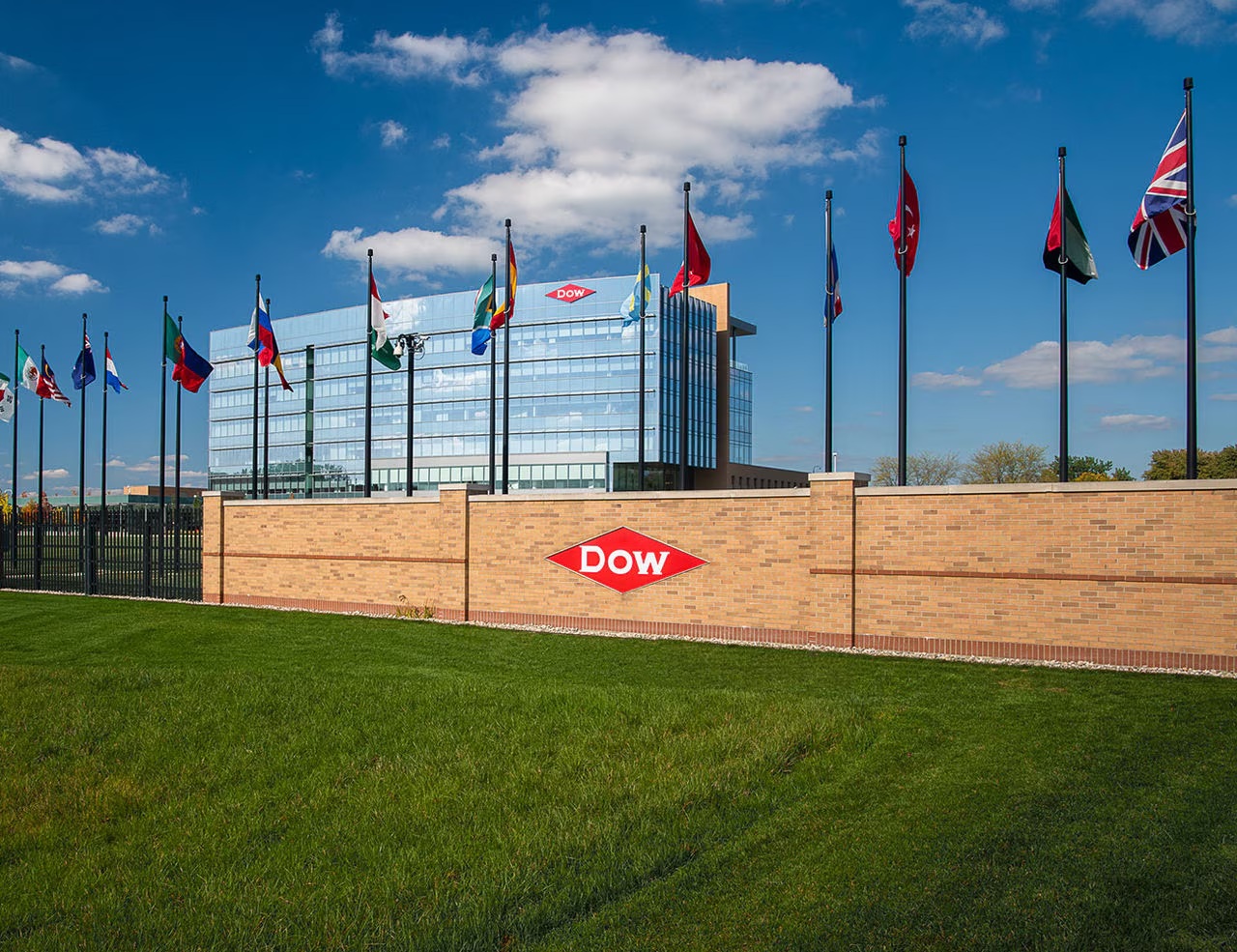
Dow Inc on Thursday reported a smaller-than-expected adjusted loss for the third quarter of 2025, buoyed by cost discipline and the ramp-up of new U.S. Gulf Coast assets that offset the persistent weakness in global chemical prices.
The result, which came amid ongoing macroeconomic sluggishness and pricing pressures across key international markets, sent the chemical giant’s shares surging 10.7% in early trading.
Dow said it posted an adjusted loss of 19 cents per share for the quarter ended September 30, beating analysts’ average estimate of a 29-cent loss, according to data compiled by LSEG. Net sales for the period came in at $9.97 billion, slightly below Wall Street’s expectation of $10.23 billion.
Register for Tekedia Mini-MBA edition 20 (June 8 – Sept 5, 2026).
Register for Tekedia AI in Business Masterclass.
Join Tekedia Capital Syndicate and co-invest in great global startups.
Register for Tekedia AI Lab.
Chief Executive Officer Jim Fitterling credited the company’s cost discipline and operational efficiency for the performance, highlighting the impact of its new polyethylene and alkoxylation assets in the U.S. Gulf Coast.
These assets have expanded Dow’s export capabilities and bolstered its competitive edge in polymer and specialty chemical production, particularly in regions where the company benefits from cheaper U.S. natural gas feedstocks.
The results mark a modest but significant recovery for the Midland, Michigan-based chemical producer, which has spent much of the past two years grappling with falling global demand, inventory gluts, and pressure on margins due to weak industrial activity in China and Europe. The company’s ongoing $6.5 billion near-term cash support plan — which includes $1 billion in capital spending cuts and accelerated cost-reduction initiatives — has now surpassed its halfway mark. Dow said it is on track to meet its targets by the end of 2026.

Chief Financial Officer Jeff Tate, speaking during the company’s earnings call, said the broader macroeconomic landscape “remains largely unchanged,” though early signs from monetary policy shifts could support a mild recovery.
“Recent monetary policy shifts and the beginning of a rate-cutting cycle could start to more positively influence demand,” Tate said.
He, however, cautioned that customer order visibility still points to a cautious operating environment.

Dow has been restructuring its global footprint, particularly in Europe, where energy costs and regulatory hurdles have significantly eroded the competitiveness of heavy manufacturing. The company began a strategic review of several of its European assets in 2024, a move analysts interpret as part of a broader effort to consolidate operations in more cost-advantaged regions such as the United States and the Middle East.
Europe’s chemical sector has been struggling with high gas prices and weak demand, prompting several producers to consider shutdowns or capacity reductions. Dow said that addressing its regional challenges, including European plant shutdowns, is expected to deliver an adjusted core profit uplift of nearly $200 million beginning in mid-2026.
The company also warned of potential pricing pressure in Europe, the Middle East, Africa, and India, as Asian exporters divert volumes away from the U.S. market, where they face anti-dumping duties. This dynamic, Dow said, is reshaping trade flows and intensifying competition in regions already suffering from weak industrial output.
In September, Fitterling noted that the company had observed stable volumes, strong export capabilities, and low-cost positions in the United States during the third quarter, underscoring the relative resilience of the American market compared to Europe and Asia.
Despite the upbeat response from investors, Dow maintained a cautious tone for the remainder of the year, projecting fourth-quarter net sales of $9.4 billion — below analysts’ forecast of $10.14 billion. The company said it expects “challenging conditions to persist,” citing sluggish demand recovery across key end markets, including packaging, construction, and automotive materials.
Dow’s performance points to the shifting balance in the global chemical industry, where U.S. producers are benefiting from cheaper feedstocks and efficiency gains, while European peers face a combination of high energy costs and environmental compliance burdens. The company’s strategy appears increasingly focused on leveraging its U.S. Gulf Coast assets to capture export growth and improve margins, positioning itself more competitively for a potential upturn in global demand.
Still, much hinges on how quickly global monetary easing translates into industrial activity. Analysts believe Dow’s cautious optimism reflects the chemical sector’s broader reality — a slow, uneven recovery where cost control and regional repositioning remain crucial for survival.
Dow’s management has also emphasized its commitment to maintaining liquidity and shareholder returns while continuing to invest in operational efficiency. The company’s recent actions suggest a shift toward greater resilience, balancing short-term cost containment with long-term competitiveness through new production capacity and technological upgrades.