

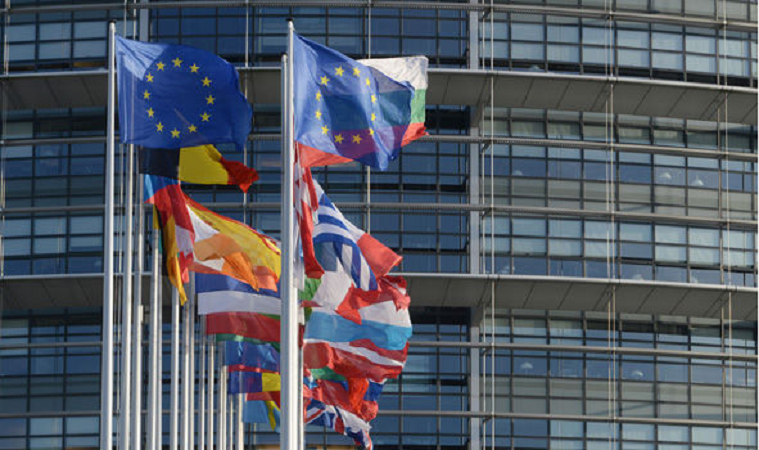
European Union leaders convened in Brussels on Thursday to grapple with a growing consensus that the bloc’s lopsided trade relationship with China has become unsustainable, weighing tougher defensive measures against the risks of further escalation with the world’s second-largest economy.
Diplomats described a gradual alignment among the 27 member states on the problem: a daily goods trade deficit approaching €1 billion ($1.15 billion) that has only widened as Chinese exports flood European markets while Beijing maintains barriers on key imports. The situation has grown more urgent as U.S. tariffs under President Donald Trump shrink access to the American market, leaving European firms with fewer outlets and exposing the bloc’s heavy dependence on China for rare earths and other critical supplies.
The numbers paint a stark picture. China’s goods trade surplus with the EU reached €360.6 billion in 2025, a 15% increase from the previous year, and has continued expanding by around 10% in the first four months of 2026. Chinese companies have ramped up sales of everything from electric vehicles to machinery while importing less from Europe, exacerbating imbalances that many officials now view as strategically risky.
Register for the next Tekedia Mini-MBA.
Register for Tekedia AI in Business Masterclass.
Join Tekedia Capital Syndicate and co-invest in great global startups.
Luxembourg Prime Minister Luc Frieden captured the prevailing mood, calling for continued dialogue but insisting that trade must be fair and reciprocal.
“Trade relations had to be fair and not ‘a one-way street’,” Frieden said.
One EU diplomat put it more bluntly: “We live in a world of wolves now. We no longer live in a world of pink ponies and rainbows.”

Agreement on the Problem, Divisions on the Solution
While there is broad recognition of the challenge, unity fractures when it comes to remedies. France and several like-minded states are pushing for a harder line, including new tools to address over-reliance on single suppliers. Germany, the EU’s export powerhouse, and Spain, which has attracted significant Chinese investment, urge caution to avoid damaging economic ties.
Dutch Prime Minister Rob Jetten reflected the uncertainty ahead of the summit.
“I’m not sure that we can get to an agreement. But it’s good to have an open conversation on, on the one hand, the disbalance in trade with China and, on the other hand,… on how to boost the competitiveness of the European Union itself,” he said.

Last month, France, Italy, the Netherlands, and Lithuania issued a joint paper advocating for new measures, potentially including additional duties or quotas, to limit over-dependence on any single foreign power. Spain initially appeared on the document, but later distanced itself. Spanish Prime Minister Pedro Sanchez struck a pragmatic tone on Thursday.
“We need friends, we need balanced relationships. We need to be pragmatic, and we need to build bridges both with major economies – potential allies such as China – and traditional allies, such as the United States,” he said.
The European Commission, which handles trade policy for the bloc, is expected to receive a mandate to engage Beijing while simultaneously strengthening defenses. Over the past year, the EU has pursued diversification through mineral partnerships and free trade deals with Australia, India, and Indonesia, but leaders appear ready to accelerate those efforts.
Existing Tools Under Strain
The EU already maintains an active trade defense regime aimed heavily at China. Of 21 new anti-dumping and anti-subsidy investigations, 18 target Chinese producers. Additional duties on Chinese-made electric vehicles, imposed since 2024, have had mixed results.
While EV imports initially fell, Chinese manufacturers shifted toward hybrids, and imports rebounded in the first quarter of this year. Beijing retaliated with measures on European dairy and brandy, illustrating the tit-for-tat risks.
Critics argue the current system is too slow and narrow. Investigations often proceed on a first-come, first-served basis, allowing Chinese firms to adjust and circumvent tariffs. The Commission has signaled a broad review of trade defenses in the third quarter, with potential new tools to tackle overcapacity and single-supplier dependence. One idea under discussion would require EU companies in sensitive sectors to secure at least three alternative sources for critical inputs.
China’s dominance in rare earth processing has sharpened the urgency. In April 2025, Beijing imposed export restrictions on rare earths in retaliation for U.S. tariffs under Trump — a move that also disrupted European supply chains for electronics, renewables, and defense equipment.
The debate comes against a backdrop of heightened global tensions. Transatlantic tariffs have complicated Europe’s export picture, while reliance on China for critical minerals leaves the bloc exposed to geopolitical leverage. EU officials repeatedly speak of “strategic autonomy” — the need to reduce vulnerabilities without fully decoupling from a vital trading partner.
For European industry, the costs of inaction are lost market share, eroded competitiveness, and heightened supply risks. Yet aggressive action carries its own dangers — potential Chinese retaliation, higher costs for consumers, and damage to export-oriented economies like Germany’s.
The summit is unlikely to produce dramatic new policies overnight, but it signals a shifting mindset in Brussels. Leaders appear ready to acknowledge the structural problem and task the Commission with developing a more assertive, coordinated response.