

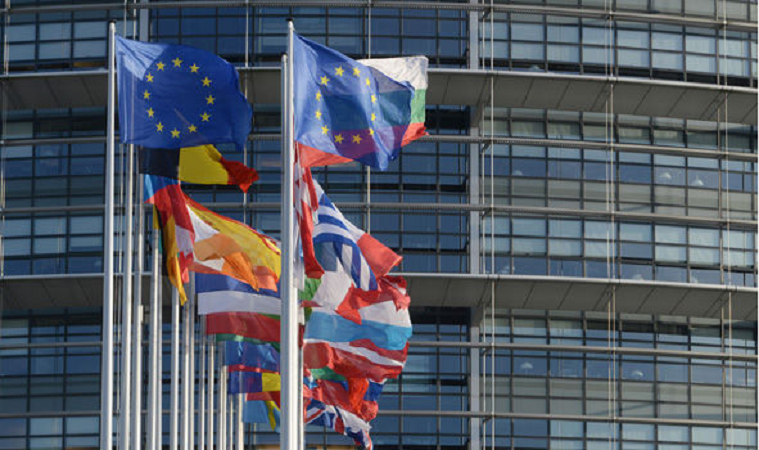
France signaled the EU is prepared to deploy its most powerful trade defenses, including the anti-coercion “trade bazooka”, if Washington’s new 10% global tariff escalates into a broader confrontation.
A fresh transatlantic trade confrontation is taking shape after President Donald Trump imposed a flat 10% global tariff, prompting France to warn that the European Union is prepared to use its most forceful economic countermeasures if necessary.
French Trade Minister Nicolas Forissier told the Financial Times that Paris is coordinating with EU partners and the European Commission to assess the U.S. move.
Register for Tekedia Mini-MBA edition 20 (June 8 – Sept 5, 2026).
Register for Tekedia AI in Business Masterclass.
Join Tekedia Capital Syndicate and co-invest in great global startups.
Register for Tekedia AI Lab.
“Should it become necessary, the EU has the appropriate instruments at its disposal,” he said.
The tariff decision followed a ruling by the Supreme Court of the United States that many of Trump’s earlier duties, imposed under emergency economic powers, were illegal. While the judgment curtailed part of the administration’s prior trade strategy, the new 10% levy signals a recalibration rather than a retreat.
At the center of Brussels’ response calculus is the Anti-Coercion Instrument (ACI), a mechanism designed to deter or counter economic pressure from third countries. Informally dubbed the “trade bazooka,” the ACI is broader and more flexible than conventional tariff retaliation.

Unlike traditional countermeasures that target goods trade, the ACI allows the EU to act across services, investment, and public procurement. Options include:
- Tariffs on services, including digital and financial services.
- Restrictions on market access or licensing.
- Export controls.
- Limitations on foreign direct investment.
- Exclusion of foreign firms from EU public procurement contracts.
French officials indicated that U.S. technology companies could be among those affected if the instrument were activated. That prospect materially shifts the balance of leverage. While the EU runs a goods trade surplus with the U.S., the United States enjoys a significant surplus in services — particularly in technology, digital platforms, and financial services. Any retaliation in those areas would strike at sectors where American firms are highly competitive.
Suspended Tariff Arsenal
Beyond the ACI, the EU maintains a suspended package of retaliatory tariffs covering more than €90 billion ($106 billion) worth of U.S. goods. Originally assembled during earlier disputes over steel, aluminum, and industrial subsidies, that list can be reactivated swiftly.

The products on that roster were chosen not only for economic weight but also for political resonance — a hallmark of EU trade strategy, which often calibrates retaliation to maximize domestic pressure in the opposing country.
The existence of both the ACI and the suspended tariff list gives Brussels layered escalation pathways, from symbolic signaling to systemic economic countermeasures.
French President Emmanuel Macron addressed the developments at the annual agricultural salon in Paris. Referring to the U.S. Supreme Court’s ruling on earlier tariffs, he said, “It is not bad to have a Supreme Court and, therefore, the rule of law. It is good to have power and counterweights to power in democracies.”
Macron’s remarks subtly underscored a broader point: institutional constraints matter in trade governance. At the same time, he emphasized reciprocity as the guiding principle for France and the EU, adding that Europe should not be “subjected to unilateral decisions.”
France’s economic exposure is significant as the United States is a major destination for French agricultural products, luxury goods, fashion, and aeronautical exports. These sectors are not easily substitutable in global markets, making tariff increases economically sensitive.
Legal Reconfiguration in Washington
The Supreme Court’s recent ruling limited the administration’s ability to rely on certain emergency statutes to impose tariffs. However, it did not eliminate presidential authority to levy duties under other trade laws. The new 10% global tariff appears to be grounded in alternative statutory mechanisms, underscoring how executive trade powers can be restructured within constitutional boundaries.
From Brussels’ perspective, this legal pivot complicates strategy. The EU must assess whether the tariff is temporary, negotiable, or a durable policy shift. The degree of permanence will influence whether the EU opts for immediate retaliation or extended negotiations.
The U.S. and EU are each other’s largest trading partners when goods and services are combined. Integrated supply chains mean that tariffs can ripple through manufacturing networks, aerospace production, pharmaceuticals, and advanced technology sectors.
A broad 10% U.S. tariff raises costs for European exporters and could compress margins or redirect trade flows. Retaliation targeting U.S. services could, in turn, disrupt transatlantic investment and digital operations.
Financial markets tend to view transatlantic trade friction as a macro risk factor, particularly when combined with currency volatility or divergent monetary policy. Escalation could weigh on business confidence and capital expenditure decisions.
Strategic Autonomy vs. Managed Interdependence
The episode also intersects with Europe’s push for “strategic autonomy” — reducing vulnerability to external economic pressure while maintaining open markets. The ACI was conceived precisely to counter what Brussels describes as coercive trade practices.
Activating it against Washington would be politically significant. It would mark the first major use of the instrument against a longstanding ally, signaling that the EU is willing to defend its economic sovereignty even within traditional partnerships.
At the same time, EU leaders are aware that a full-scale trade confrontation would undermine growth at a moment when Europe faces structural economic headwinds, including energy transition costs and industrial competitiveness challenges.
Brussels’ messaging suggests a dual-track approach: preparedness paired with restraint. The language from Paris emphasizes capability rather than inevitability. By highlighting the ACI publicly, France increases negotiating leverage without immediately deploying countermeasures.
The coming weeks will likely focus on whether diplomatic channels can narrow differences. If talks stall and the 10% tariff remains in place, the EU may escalate incrementally — beginning with reactivating suspended tariffs before considering broader service-sector measures.