

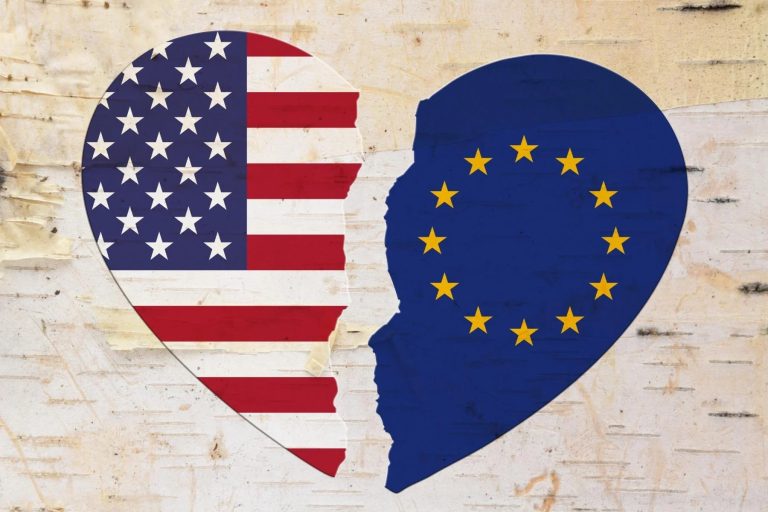
Former European Commission President José Manuel Barroso has issued a stark assessment of transatlantic relations, declaring them at their “lowest moment” since NATO’s founding in 1949.
This comes as President Donald Trump’s disruptive diplomacy—epitomized by his persistent push to acquire Greenland—fuels a profound loss of confidence across the European continent.
In an exclusive interview with CNBC’s “The China Connection” aired Monday, Barroso described the current era as a “rupture phase,” where shared democratic values are giving way to interest-driven interactions, prompting Europe to accelerate its quest for strategic autonomy.
Register for Tekedia Mini-MBA edition 20 (June 8 – Sept 5, 2026).
Register for Tekedia AI in Business Masterclass.
Join Tekedia Capital Syndicate and co-invest in great global startups.
Register for Tekedia AI Lab.
Barroso, who served as EC president from 2004 to 2014 and previously as Portugal’s prime minister, pinpointed Trump’s Greenland ambitions as a catalyst for the erosion of trust. The U.S. president’s threats of military action and escalating tariffs on European goods—initially set at 10% from February 1, rising to 25% by June—have rattled allies, even as Trump partially retreated last week, ruling out force and pausing the levies after talks with NATO Secretary General Mark Rutte.
In a Truth Social post following the meeting, Trump claimed a “framework of a future deal” on Greenland had emerged, though Rutte denied the topic arose, highlighting the opacity and unilateralism that Barroso labeled Trump as “the great disruptor.”
This episode has amplified doubts, extending beyond the EU to the U.K., where public sentiment toward the U.S. has soured markedly. A November 2025 survey by the European Council on Foreign Relations (ECFR), conducted across 12 EU member states and the U.K., revealed that only 16% of Europeans view the U.S. as an ally sharing common values—down from 21% in 2024—with a striking 20% seeing it as a rival or enemy.

In the U.K., the figure plummeted to 25% from 37%, reflecting backlash against Trump’s “America First” policies that Barroso said treat allies more harshly than adversaries.
The poll, part of ECFR’s broader analysis of a “post-Western world,” also showed shifting global perceptions, with many viewing China as ascendant amid U.S. unpredictability.
Barroso emphasized the need for a “more Europeanized NATO,” urging the bloc to bolster its own defense capabilities rather than relying solely on Washington. This call echoes actions at last year’s NATO Summit in The Hague, where members pledged 5% of GDP toward defense and security by 2035, spurred by U.S. demands.

He noted NATO’s strengthening since Russia’s 2022 invasion of Ukraine, including Finland and Sweden’s accession and enhanced eastern flank presence, but warned that the alliance’s future hinges on Europe’s self-reliance.
Outside Europe, a similar conflict has been in play with U.S.-Canada ties at stake. On Saturday, Trump threatened 100% tariffs on Canadian goods if Ottawa pursued a free trade deal with China, prompting Prime Minister Mark Carney to affirm Sunday that Canada has “no intention” of such an agreement.
Carney described recent pacts with Beijing as limited tariff reductions in select sectors, reiterating commitment to the USMCA amid escalating tensions.
This follows Trump’s Thursday withdrawal of Carney’s invitation to the “Board of Peace” for Gaza reconstruction, underscoring the poet Robert Frost’s cautionary lines on walls and offense—often misquoted as endorsing barriers.
Those have triggered market jitters, which were evident Monday, with gold surpassing $5,000 per ounce in Asian trading, while U.S. futures and regional indexes dipped amid geopolitical confluence. Investors brace for a pivotal week: Earnings from Apple, Meta, and Microsoft, plus the Federal Reserve’s rate decision on Wednesday, could sway sentiment.
Barroso, while pessimistic, stopped short of declaring the transatlantic alliance’s end, affirming the U.S.’s enduring role in European security. Yet his warnings resonate as Europe recalibrates, potentially toward greater sovereignty in a multipolar world. However, analysts have noted that Trump’s approach may inadvertently elevate China’s global standing, reshaping alliances in unanticipated ways.