

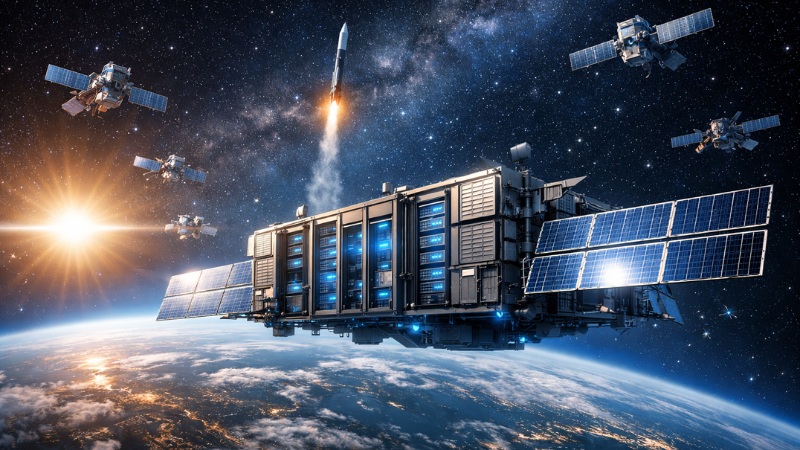
The idea of moving artificial intelligence data centers into orbit has captured the imagination of investors and technology entrepreneurs seeking to overcome mounting constraints on Earth.
But aerospace engineers are warning that the concept remains far from practical, arguing that enormous technical, financial, and operational obstacles make space-based AI infrastructure one of the industry’s most ambitious and controversial proposals.
Demand for AI computing power has exploded over the past two years as companies race to build sophisticated foundation models. That surge has triggered an unprecedented wave of spending on data centers, with major technology companies committing hundreds of billions of dollars to new facilities worldwide.
Register for the next Tekedia Mini-MBA.
Register for Tekedia AI in Business Masterclass.
Join Tekedia Capital Syndicate and co-invest in great global startups.
The rapid expansion, however, is running into growing bottlenecks. Utilities are struggling to provide enough electricity for new AI campuses, aging power grids require costly upgrades, and local communities have become increasingly resistant to large-scale data center developments because of their heavy energy and water consumption.
Against that backdrop, several companies have begun promoting orbital data centers as a long-term solution. Among the most prominent is Starcloud, a startup backed by Y Combinator, which raised $170 million earlier this year to develop space-based data centers with support from SpaceX. The concept envisions massive satellites powered continuously by solar energy, eliminating dependence on terrestrial electricity grids while providing dedicated computing capacity for AI workloads.
Supporters believe that uninterrupted solar power in orbit could eventually offer a cleaner and potentially more scalable source of energy than increasingly constrained land-based infrastructure.

However, a detailed engineering critique released by Irish aeronautical engineer Brian McManus, creator of the YouTube channel Real Engineering, in collaboration with IEEE Spectrum, argues that the proposal dramatically understates the technological barriers involved.
McManus was particularly critical of Starcloud’s technical white paper, questioning both its engineering assumptions and the optimism surrounding the project.
“It really seems like anyone with some renders and a white paper written by someone being gassed up by an overly agreeable AI can get VC funding these days.”

He added, “Billionaires will attempt to pull the rug over your eyes and convince you that this technology makes total sense, but reality is, this technology is dumb.”
The criticism comes at a time when enthusiasm surrounding SpaceX remains exceptionally high following the company’s public listing, which significantly boosted its valuation. Investors now see AI infrastructure, including Elon Musk’s broader vision of orbital computing, as a potential long-term growth driver.
Yet aerospace specialists argue that building industrial-scale computing facilities in space would require breakthroughs across multiple engineering disciplines simultaneously.
One of the most immediate challenges is heat.
Modern AI processors generate enormous amounts of heat even inside conventional data centers, which rely on sophisticated liquid cooling systems, chillers and air-conditioning infrastructure to maintain stable operating temperatures. Cooling becomes significantly more complicated in space because there is no atmosphere to dissipate heat through convection. Instead, thermal energy must be radiated away, requiring extensive cooling systems and massive radiator surfaces.
According to McManus, the quantities involved would be extraordinary. Using conventional coolants such as glycol, each orbital facility would need to circulate more than 150,000 pounds of coolant every second.
He compared the required flow rates to industrial-scale infrastructure.
“Emptying an Olympic swimming pool in 40 seconds,” he said.
He noted that such volumes are typically associated only with gravity-fed hydroelectric dams.
Scale presents another major obstacle.
Starcloud’s proposed facilities would reportedly deliver five gigawatts of computing capacity, placing them among the largest computing installations ever conceived. To generate sufficient electricity, each spacecraft would require solar arrays covering approximately 1.6 square miles, nearly 5,000 times the surface area of the solar panels attached to the International Space Station.
The sheer size would translate into unprecedented launch requirements. McManus estimated that, even before accounting for coolant, pumps, fuel, shielding, structural components, and attitude-control systems, each station would exceed 113 million kilograms.
He described the scale in stark terms.
“More than an aircraft carrier sitting in orbit.”
He continued: “More than six times the total mass launched into space in history.”
Beyond construction, orbital operations introduce additional risks. The Earth’s orbital environment is becoming increasingly congested with satellites and debris. Millions of fragments, ranging from defunct satellites to tiny metal shards, already pose collision hazards.
Large solar arrays spanning square miles would present enormous targets. Even small debris traveling at orbital speeds could puncture cooling systems or damage power-generating panels, necessitating expensive repair missions.
The risks are already familiar to SpaceX.
The company disclosed that its Starlink satellite constellation performed approximately 300,000 collision-avoidance maneuvers during 2025 alone, illustrating the growing congestion in low-Earth orbit.
Radiation represents another challenge.
Unlike terrestrial data centers, computers operating in space are continuously exposed to high-energy particles capable of damaging semiconductor components or corrupting stored data.
McManus warned that these effects could be especially problematic for AI workloads.
“Ionizing particles passing through satellites will burn out a transistor or flip a bit of information stored inside.”
He added: “This would result in the mother of all AI hallucinations without a software constantly checking results.”
To address that risk, spaceborne computers typically perform redundant calculations and continuously compare outputs to detect corrupted data. Systems aboard the International Space Station already employ such techniques, but extending them to AI data centers operating at multi-gigawatt scale would add further complexity and computational overhead.
Maintenance also poses difficult economic questions.
AI chips generally remain commercially competitive for only two to four years before being replaced by newer generations. On Earth, operators can routinely swap processors during scheduled maintenance. In orbit, replacing millions of aging chips would require repeated launch campaigns and robotic servicing technologies that remain largely experimental.
McManus also questioned Starcloud’s financial assumptions.
He argued that the project’s projected launch costs and payload estimates appear overly optimistic given current launch economics and the unprecedented mass involved.
He concluded that Starcloud appears designed more to capitalize on investor enthusiasm surrounding artificial intelligence than to solve near-term infrastructure challenges.
“This is just one early rushed concept to fundraise and move on,” he said.
He added: “In the ever evolving world of tech, first movers are being heavily rewarded.”
While orbital data centers remain a compelling long-term concept for some technologists, experts say terrestrial power grids, advanced cooling systems, and more efficient semiconductor designs are likely to remain the industry’s primary focus for years before computing in space becomes technically or economically viable.
ODCs will cause Additional Problems for DOD, NOAA, USGS, and NASA Satellites
Articles are missing even more serious issues with ODCs in Low Earth Orbit (LEO), including impacts to DOD and NOAA missions that rely on keeping LEO clear of large numbers of large satellites.They will be too bright at infrared and visible wavelengths impacting the above government missions, as well as the sky for astronomers and others. In have written numerous “comments” and “replies” on the FCC website to each of the four companies seeking approval for ODCs – details are on the FCC website that anyone can access by sorting by name.
In summary, signal levels of ICBMs in the infrared are typically hundreds to thousands of kilowatts per steradian during boost, but become far fainter after boost. On the FCC website, I have shown that Space X proposed radiators (which face up to space and down to Earth to reject heat) will radiate over 8 kilowatts/steradian for each ODC in the 8 to 12 micron wavelength band, important for tracking ballistic missiles post-boost Above-The-Horizon (ATH) by ground-based interceptors in Alaska, our new DOD satellites tracking hypervelocity missiles and post-boost reentry vehicles (RVs), and of course infrared astronomical telescopes on the ground. The actual bandpass will likely be slightly different and classified, but the levels in these LWIR bands will nonetheless be similar. This signal is comparable to hypervelocity missiles after boost, and over a thousand times brighter than RVs. This can confuse our DOD missions trying to track targets when one considers up to a million ODCs. Additionally, these signal levels from LEO to ground will be millions of times brighter than stars our infrared astronomical telescopes are trying to see.
In the military MWIR bands, the signal level will be about an order of magnitude lower, but is still in the same ballpark as hypervelocity missiles after boost that the DOD is trying to detect ATH and Below-The-Horizon (BTH).
Their radiators will cause further issues, when the ODCs cross underneath our NOAA LEO weather satellites near the poles. Hundreds of thousands of ODCs will create signal levels that will likely upset weather retrieval algorithms important for forecasting weather – NOAA will have to analyze this effect. My estimates on the FCC website indicate a 100 kW class ODC will be at least 5% of the signal over the arctic that the M15 band of VIIRS is seeing (an instrument on the JPSS satellites looking +/-55 degrees of nadir), and scientists extracting weather data look at extremely small trends in their algorithms. JPSS satellites also fly in sun synchronous orbits, taking data at local afternoon on the sunlit side of the Earth, instead of twilight, but will still cross with polar orbiting ODCs near the poles.
I have shown that Space X proposed solar arrays will radiate over 20 kilowatts/steradian for each ODC in the 8 to 12 micron wavelength band, on each side of the solar array, an even brighter object than the radiators. These will be oriented edge-on to nadir, but can still be seen at off-nadir ground locations which will usually be the case.
In the visible and near infrared, the Space X solar arrays will reflect about 20 kW/sr and much, much higher if specular. Although this will be reflected back into the daylight side of Earth, it is far brighter than small satellites our SBSS satellites are trying to track, and DOD satellites like SBSS can definitely see the front signal from solar arrays. The body of the satellite (the bus) will of course reflect some sunlight to the ground during twilight.
No commercial satellite constellation should ever interfere with DOD and NOAA missions. LEO is where ballistic missiles operate, and these large commercial constellations interfere with these missions, in addition to creating more orbital debris, more deorbiting junk, and will impact the twilight and night sky for everyone on Earth, including birds and animals.
These ODCs should be required to fly in over 8000 km altitude orbits, where radiation drops significantly behind 0.200 inches of shielding, with fewer numbers, despite the higher costs, as it will solve most of the above issues – and the signal levels to ground will be 100 times less (that’s 5 magnitudes fainter objects in the sky). Radiation levels to electronics are excessive between about 1400 km to 8000 km. I would still rather seeing them on the ground in remote areas. They are proposing to fly in “cheap” LEO orbits to maximize their profits, without regard to bad impacts to others and the space environment – just like the early days of gold mining in the American West which had minimal regulations in the 1800s.
Such congestion in LEO will definitely create more orbital debris, and will likely result in space war by competition for the same orbits. We have been putting debris shields on satellites for decades, increasing their cost, but not everything can be protected including solar arrays, antennae, radiators, telescopes, etc.
Sincerely,
Dean Spieth
Aerospace Engineer for over 40 yrs
p.s. There are also a lot of misconceptions from various articles saying how difficult it would be to put them in orbit. Technically, it can be done, but should it? – I say no for the above reasons, let alone cost considerations and the fact that they can operate on the ground.
Since they are not easy to find, links to four of the ODC filings at the FCC website include:
Space X:
https://fccprod.servicenowservices.com/icfs?id=ibfs_application_summary&number=SAT-LOA-20260108-00016
Blue Origin’s Sunrise, who do not understand the high radiation levels in uppper LEO:
https://fccprod.servicenowservices.com/icfs?id=ibfs_application_summary&number=SAT-LOA-20260310-00118
Starcloud, who has no realistic space experience and was initially planning ridiculous 5 GW data centers, with 50,000 times more power and size than Space X’s initial 100 kW ODCs – clearly unqualified:
https://fccprod.servicenowservices.com/ibfs?id=ibfs_application_summary&number=SAT-LOA-20260202-00073
Cowboy Space, which is likewise unqualified, planning 20,000 megawatt ODCs using spent upper stages:
https://fccprod.servicenowservices.com/ibfs?id=ibfs_application_summary&number=SAT-LOA-20260323-00135
It is clear the latter three companies do not know what they are doing, and have no business operating in space with far more important space missions. I do not yet know the link to Orbital’s recent filing.
Orbital Compute’s FCC link for 100,000 orbital data centers per SAT-LOA-20260624-00251:
https://fccprod.servicenowservices.com/icfs?id=ibfs_application_summary&number=SAT-LOA-20260624-00251
If the orbital data center proposals are not bad enough, Space X has now filed with the FCC for 100,000 more Starlink satellites, larger Gen3 variants, in even lower orbits, that will be visible to the naked eye. These too should be flying around 7000 to 8000 km altitude, where they would be 100X fainter (5 magnitudes fainter), requiring only a few dozen for global coverage instead of 100,000 – and with a data latency round trip lime of about 50 milliseconds up and down to ground. GPS satellites fly in a higher radiation environment and only use 31 satellites for global coverage. The FCC link for Gen3 is SAT-LOA-20260630-00264 where anyone can place comments :
https://fccprod.servicenowservices.com/icfs?id=ibfs_application_summary&number=SAT-LOA-20260630-00264