

One Dead, Several Injured as Danish Train Hits Slurry Tanker and Derails in Southern Jutland

Quote from Alex Bobby on August 16, 2025, 3:03 AM
One Dead, Several Injured as Train Collides with Slurry Tanker and Derails in Southern Denmark
A tragic accident in southern Denmark has claimed the life of at least one person and left several others injured after a passenger train collided with a slurry tanker at a railway level crossing, causing multiple carriages to derail. The incident occurred between the towns of Tinglev and Kliplev in southern Jutland on Thursday afternoon, sending shockwaves through the local community and prompting a swift emergency response.
The Collision
According to Danish police, the crash happened at a level crossing on the busy route connecting Tinglev and Sønderborg, near the German border. The passenger train, operated by national rail company DSB, was carrying 95 people at the time of the collision. Among the passengers were pupils from a school in Sønderborg, many of whom were returning from a school trip.
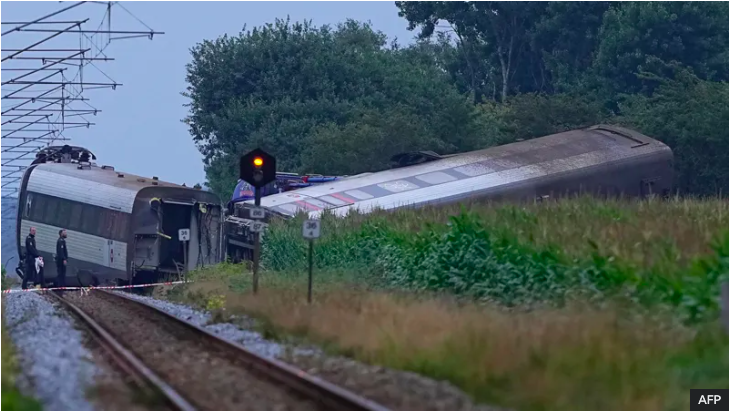
Local broadcaster TV2 reported that the train struck a slurry tanker — a vehicle used to transport liquid manure — as it was crossing the tracks. The impact was severe enough to derail at least two carriages, with one carriage seen lying on its side in the aftermath. Eyewitnesses described a “deafening crash” followed by screams and chaos as passengers scrambled to safety.
Pictures from the scene show the twisted wreckage of the carriage alongside the tracks, with passengers and first responders gathered nearby. The slurry tanker was also heavily damaged, though authorities have not yet released information on the condition of its driver.
Emergency Response
Within minutes of the collision, a large-scale emergency operation was launched. Police, fire services, and medical teams arrived at the site, joined by search and rescue crews. Helicopters were dispatched to airlift the most seriously injured to nearby hospitals. Officials confirmed that two injured passengers were transported by helicopter, while others received treatment at the scene before being taken to medical facilities by ambulance.
A police spokesperson described the scene as “complex and dangerous,” with a combination of injured passengers, damaged infrastructure, and hazardous cargo from the slurry tanker. Emergency teams worked quickly to secure the site, assist the wounded, and prevent any further accidents.
Banedanmark, Denmark’s national rail infrastructure agency, confirmed that the collision occurred at a level crossing and said it had dispatched engineers to inspect the tracks, signalling systems, and safety barriers in the area.
Disruption to Rail Services
In the immediate aftermath of the accident, DSB announced a suspension of rail services between Tinglev and Sønderborg. The closure, which affects a key link near the German border, is expected to last until authorities complete their investigation and repairs to the damaged rail infrastructure are carried out. Replacement bus services are being arranged, but delays and cancellations are likely over the coming days.
For many commuters and local travellers, the disruption is a stark reminder of the vulnerabilities in Denmark’s rail system — particularly at level crossings where road and rail traffic intersect.
Witness Accounts
Some passengers have begun sharing their harrowing experiences. One survivor told TV2 that the train “shook violently” upon impact and that windows shattered instantly, showering passengers with glass. Another passenger said that the carriage tipped to the side within seconds, trapping some people in their seats before others helped pull them out.
Local residents living near the crossing reported hearing a loud crash followed by sirens. “I ran outside and saw smoke and debris,” one witness told local reporters. “People were walking along the tracks, looking stunned. The children seemed especially shaken.”
Possible Causes Under Investigation
Authorities have not yet determined the exact cause of the crash, but early reports suggest that the slurry tanker may have been crossing the tracks when the train approached. Investigators will look into whether the crossing barriers malfunctioned, whether the driver of the tanker ignored warning signals, or if other factors contributed.
In Denmark, railway level crossings are equipped with warning lights, barriers, and bells to alert drivers when a train is approaching. However, accidents still occur — often due to human error or technical failures. The fact that a large and heavy tanker was involved likely amplified the severity of this collision.
Police have cordoned off the area, and forensic teams are gathering evidence. Interviews with witnesses, passengers, and the tanker driver will form part of the investigation. The Danish Transport Authority has also been notified and will oversee the probe alongside local law enforcement.
Safety Concerns and Public Reaction
The incident has reignited concerns over railway safety in Denmark, particularly at rural level crossings. While the country has a strong record of rail safety, collisions involving vehicles at crossings remain one of the most dangerous scenarios for train travel.
Local officials have expressed condolences to the victim’s family and well wishes to those injured. Sønderborg’s mayor described the incident as “a dark day for our community” and pledged support for the affected families.
Rail unions and transport safety advocates have called for a review of level crossing safety protocols. Suggestions include upgrading barriers, increasing driver awareness campaigns, and implementing more advanced train detection systems.
A Community in Shock
As the investigation unfolds, the residents of southern Jutland are left to process the tragedy. Schools in the area are providing counselling for pupils who were on the train, and community centres are opening their doors to offer support for those affected.
For the families waiting for news of their loved ones, the day has been one of anxiety and sorrow. The identity of the deceased passenger has not yet been made public, pending notification of next of kin.
The derailment serves as a sobering reminder of how quickly routine travel can turn into disaster. For those who boarded the train that day — including schoolchildren, commuters, and everyday travellers — it was meant to be an ordinary journey. Instead, it became an ordeal they will never forget.
Final Thought
Tragedies like the Tinglev-Kliplev derailment ripple far beyond the crash site, touching families, communities, and an entire nation’s sense of safety. While investigations will eventually yield answers, the most important legacy of this disaster should be decisive action to prevent it from happening again. Every level crossing is a shared space between road and rail — and in that brief intersection, lives depend on vigilance, technology, and respect for the rules.
Conclusion
The fatal train collision in southern Denmark is a stark reminder of the vulnerabilities that remain in even the most modern transport systems. While the exact cause is still under investigation, the loss of life, injuries, and emotional trauma highlight the urgent need to review and strengthen safety measures at railway level crossings. As authorities work to uncover the truth and restore services, the focus must also remain on supporting the victims, their families, and the shaken community. For those who lived through it, the echoes of this tragedy will serve as a lasting reminder that safety — both on the rails and the roads — can never be taken for granted.
Meta Description:
A Danish passenger train collided with a slurry tanker in southern Jutland, killing one and injuring several. The crash derailed multiple carriages and halted services near the German border.
One Dead, Several Injured as Train Collides with Slurry Tanker and Derails in Southern Denmark
A tragic accident in southern Denmark has claimed the life of at least one person and left several others injured after a passenger train collided with a slurry tanker at a railway level crossing, causing multiple carriages to derail. The incident occurred between the towns of Tinglev and Kliplev in southern Jutland on Thursday afternoon, sending shockwaves through the local community and prompting a swift emergency response.
The Collision
Register for Tekedia Mini-MBA edition 20 (June 8 – Sept 5, 2026).
Register for Tekedia AI in Business Masterclass.
Join Tekedia Capital Syndicate and co-invest in great global startups.
Register for Tekedia AI Lab.
According to Danish police, the crash happened at a level crossing on the busy route connecting Tinglev and Sønderborg, near the German border. The passenger train, operated by national rail company DSB, was carrying 95 people at the time of the collision. Among the passengers were pupils from a school in Sønderborg, many of whom were returning from a school trip.
Local broadcaster TV2 reported that the train struck a slurry tanker — a vehicle used to transport liquid manure — as it was crossing the tracks. The impact was severe enough to derail at least two carriages, with one carriage seen lying on its side in the aftermath. Eyewitnesses described a “deafening crash” followed by screams and chaos as passengers scrambled to safety.
Pictures from the scene show the twisted wreckage of the carriage alongside the tracks, with passengers and first responders gathered nearby. The slurry tanker was also heavily damaged, though authorities have not yet released information on the condition of its driver.

Emergency Response
Within minutes of the collision, a large-scale emergency operation was launched. Police, fire services, and medical teams arrived at the site, joined by search and rescue crews. Helicopters were dispatched to airlift the most seriously injured to nearby hospitals. Officials confirmed that two injured passengers were transported by helicopter, while others received treatment at the scene before being taken to medical facilities by ambulance.
A police spokesperson described the scene as “complex and dangerous,” with a combination of injured passengers, damaged infrastructure, and hazardous cargo from the slurry tanker. Emergency teams worked quickly to secure the site, assist the wounded, and prevent any further accidents.

Banedanmark, Denmark’s national rail infrastructure agency, confirmed that the collision occurred at a level crossing and said it had dispatched engineers to inspect the tracks, signalling systems, and safety barriers in the area.
Disruption to Rail Services
In the immediate aftermath of the accident, DSB announced a suspension of rail services between Tinglev and Sønderborg. The closure, which affects a key link near the German border, is expected to last until authorities complete their investigation and repairs to the damaged rail infrastructure are carried out. Replacement bus services are being arranged, but delays and cancellations are likely over the coming days.
For many commuters and local travellers, the disruption is a stark reminder of the vulnerabilities in Denmark’s rail system — particularly at level crossings where road and rail traffic intersect.
Witness Accounts
Some passengers have begun sharing their harrowing experiences. One survivor told TV2 that the train “shook violently” upon impact and that windows shattered instantly, showering passengers with glass. Another passenger said that the carriage tipped to the side within seconds, trapping some people in their seats before others helped pull them out.
Local residents living near the crossing reported hearing a loud crash followed by sirens. “I ran outside and saw smoke and debris,” one witness told local reporters. “People were walking along the tracks, looking stunned. The children seemed especially shaken.”
Possible Causes Under Investigation
Authorities have not yet determined the exact cause of the crash, but early reports suggest that the slurry tanker may have been crossing the tracks when the train approached. Investigators will look into whether the crossing barriers malfunctioned, whether the driver of the tanker ignored warning signals, or if other factors contributed.
In Denmark, railway level crossings are equipped with warning lights, barriers, and bells to alert drivers when a train is approaching. However, accidents still occur — often due to human error or technical failures. The fact that a large and heavy tanker was involved likely amplified the severity of this collision.
Police have cordoned off the area, and forensic teams are gathering evidence. Interviews with witnesses, passengers, and the tanker driver will form part of the investigation. The Danish Transport Authority has also been notified and will oversee the probe alongside local law enforcement.
Safety Concerns and Public Reaction
The incident has reignited concerns over railway safety in Denmark, particularly at rural level crossings. While the country has a strong record of rail safety, collisions involving vehicles at crossings remain one of the most dangerous scenarios for train travel.
Local officials have expressed condolences to the victim’s family and well wishes to those injured. Sønderborg’s mayor described the incident as “a dark day for our community” and pledged support for the affected families.
Rail unions and transport safety advocates have called for a review of level crossing safety protocols. Suggestions include upgrading barriers, increasing driver awareness campaigns, and implementing more advanced train detection systems.
A Community in Shock
As the investigation unfolds, the residents of southern Jutland are left to process the tragedy. Schools in the area are providing counselling for pupils who were on the train, and community centres are opening their doors to offer support for those affected.
For the families waiting for news of their loved ones, the day has been one of anxiety and sorrow. The identity of the deceased passenger has not yet been made public, pending notification of next of kin.
The derailment serves as a sobering reminder of how quickly routine travel can turn into disaster. For those who boarded the train that day — including schoolchildren, commuters, and everyday travellers — it was meant to be an ordinary journey. Instead, it became an ordeal they will never forget.
Final Thought
Tragedies like the Tinglev-Kliplev derailment ripple far beyond the crash site, touching families, communities, and an entire nation’s sense of safety. While investigations will eventually yield answers, the most important legacy of this disaster should be decisive action to prevent it from happening again. Every level crossing is a shared space between road and rail — and in that brief intersection, lives depend on vigilance, technology, and respect for the rules.
Conclusion
The fatal train collision in southern Denmark is a stark reminder of the vulnerabilities that remain in even the most modern transport systems. While the exact cause is still under investigation, the loss of life, injuries, and emotional trauma highlight the urgent need to review and strengthen safety measures at railway level crossings. As authorities work to uncover the truth and restore services, the focus must also remain on supporting the victims, their families, and the shaken community. For those who lived through it, the echoes of this tragedy will serve as a lasting reminder that safety — both on the rails and the roads — can never be taken for granted.
Meta Description:
A Danish passenger train collided with a slurry tanker in southern Jutland, killing one and injuring several. The crash derailed multiple carriages and halted services near the German border.
Share this:
- Click to share on Facebook (Opens in new window) Facebook
- Click to share on X (Opens in new window) X
- Click to share on WhatsApp (Opens in new window) WhatsApp
- Click to share on LinkedIn (Opens in new window) LinkedIn
- Click to email a link to a friend (Opens in new window) Email
- Click to print (Opens in new window) Print