

Poland, Hungary, and India Send First Astronauts to ISS in Historic Private SpaceX Mission

Quote from Alex Bobby on June 27, 2025, 5:07 AM
International Space Station Welcomes First Astronauts from Poland, Hungary, and India
In a landmark moment for global space exploration, the International Space Station (ISS) has welcomed its first-ever astronauts from Poland, Hungary, and India. The three nationalities made their historic debut aboard the orbiting laboratory on Thursday, after launching a day earlier from NASA’s Kennedy Space Center aboard a SpaceX rocket.
This mission, organised by Axiom Space, marks another step in the ongoing transition from government-led space programs to a new era dominated by private space ventures. With NASA planning to decommission the ISS by 2030, missions like this are helping to lay the groundwork for a commercially operated future in low Earth orbit.
A Historic Arrival
The four-member crew reached the ISS after a smooth docking, greeted warmly by the station’s seven permanent residents. The new arrivals include:
- Peggy Whitson (USA), a record-holding astronaut and mission commander representing Axiom Space
- Shubhanshu Shukla (India), a pilot in the Indian Air Force
- Tibor Kapu (Hungary), a mechanical engineer
- Slawosz Uznanski-Wisniewski (Poland), a radiation expert and ESA project astronaut
This mission is especially significant as none of these countries—India, Hungary, or Poland—have previously had an astronaut visit the ISS. Their participation signals growing international access to space through private partnerships.
“It’s an honour to have you join our outpost of international cooperation and exploration,” NASA’s Mission Control said in a welcome message from Houston shortly after docking.
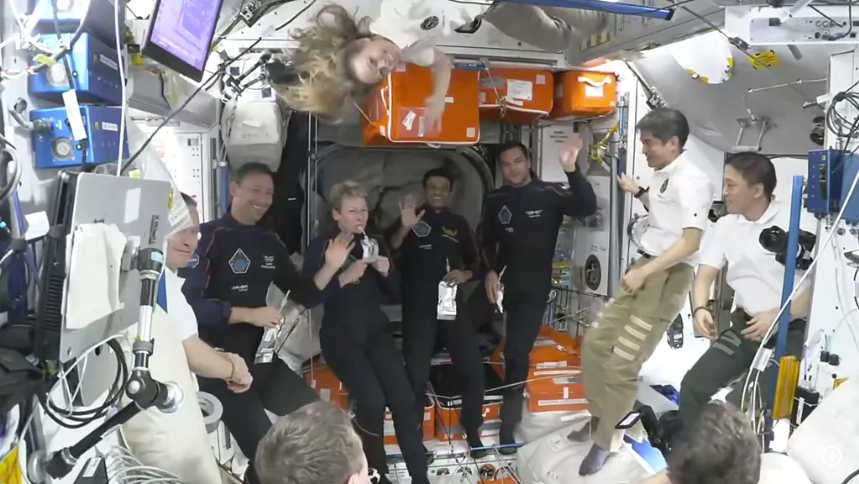
The crew celebrated with handshakes, hugs, and a traditional ISS toast — drink pouches sipped through straws floating in microgravity. With this arrival, six countries are now simultaneously represented on the ISS: the United States, Russia, Japan, India, Poland, and Hungary.
Science and Symbolism
While their mission lasts just two weeks, the astronauts have a packed schedule of scientific experiments, many of which are connected to climate science, space health, and materials research. Each astronaut also brings unique expertise:
- Shukla is contributing data to support India’s growing ambitions in space, including the Gaganyaan human spaceflight programme.
- Kapu is helping develop technologies with Hungary’s growing private aerospace sector.
- Uznanski-Wisniewski, representing the European Space Agency, is focusing on radiation exposure in space, a key area of concern for long-duration missions to the Moon and Mars.
Beyond the scientific mission, this flight is highly symbolic — it demonstrates how smaller countries can now send astronauts into orbit, thanks to partnerships with commercial space companies like Axiom Space and SpaceX.
The Axiom Vision and NASA’s Future Plans
This flight marks the fourth commercial ISS mission sponsored by Axiom Space since 2022. Axiom is among a small group of space companies, including Blue Origin and Sierra Space, developing private space stations set to launch later this decade.
NASA plans to decommission the International Space Station by 2030, ending more than three decades of continuous human presence in orbit. Instead of building a replacement themselves, NASA is actively supporting private companies to build and operate next-generation space stations.
This public-private model, already proven in cargo and crew transport via SpaceX and Northrop Grumman, is expected to become the backbone of future orbital activity, freeing up NASA resources to focus on deep space missions, such as the Artemis lunar programme and eventual missions to Mars.
Overcoming Delays and Precautions
The launch had been delayed multiple times, largely due to a long-running air leak in the Russian module of the ISS. NASA wanted to be sure that recent repairs had resolved the issue before allowing additional crew aboard.
In the meantime, the Axiom crew began quarantine as early as 25 May, enduring an extended isolation period to ensure no illnesses were carried aboard the ISS. Commander Peggy Whitson remarked on the long wait:
“It’s so great to be here finally. It was a long quarantine,” she said, smiling as she floated into the station.
Whitson, the most experienced American astronaut with 665 cumulative days in space, has become a central figure in the commercial space era. Now representing Axiom Space, she’s helping bridge the gap between legacy space agencies and the next generation of space explorers.
Looking Forward: A New Chapter for Global Spaceflight
As the International Space Station moves into its final years, missions like this one point to a bright future for international and commercial cooperation in space. The successful arrival of astronauts from Poland, Hungary, and India signals a new level of inclusivity and access, no longer reserved for just a few powerful nations or space agencies.
With companies like Axiom Space and SpaceX pioneering private spaceflight, we can expect more countries to send their own astronauts into orbit — not decades from now, but in the next few years. These commercial missions will likely serve as testing grounds for future permanent space habitats, scientific advancements, and even space tourism.
As NASA shifts focus to the Moon and Mars, and the ISS nears retirement in 2030, the torch of orbital research and diplomacy is being passed to private hands — and global partners. For young aspiring astronauts in countries like India, Poland, and Hungary, the path to space has never looked more open.
This is just the beginning of a more diverse and globally connected space era — one where space belongs to all of us.
Conclusion: A New Era in Space Exploration
The arrival of astronauts from India, Hungary, and Poland at the International Space Station marks more than a first — it’s a sign of the democratisation of space. As access becomes more open through private ventures, more nations, scientists, and citizens will have the opportunity to take part in humanity’s greatest journey.
As NASA prepares to step back from its historic role in low Earth orbit, companies like Axiom Space are proving that international collaboration in space will not just continue — it will thrive in new and exciting ways. And for Shukla, Kapu, and Uznanski-Wisniewski, this mission may be just the beginning of their countries’ stories among the stars.
International Space Station Welcomes First Astronauts from Poland, Hungary, and India
In a landmark moment for global space exploration, the International Space Station (ISS) has welcomed its first-ever astronauts from Poland, Hungary, and India. The three nationalities made their historic debut aboard the orbiting laboratory on Thursday, after launching a day earlier from NASA’s Kennedy Space Center aboard a SpaceX rocket.
This mission, organised by Axiom Space, marks another step in the ongoing transition from government-led space programs to a new era dominated by private space ventures. With NASA planning to decommission the ISS by 2030, missions like this are helping to lay the groundwork for a commercially operated future in low Earth orbit.
Register for Tekedia Mini-MBA edition 20 (June 8 – Sept 5, 2026).
Register for Tekedia AI in Business Masterclass.
Join Tekedia Capital Syndicate and co-invest in great global startups.
Register for Tekedia AI Lab.
A Historic Arrival
The four-member crew reached the ISS after a smooth docking, greeted warmly by the station’s seven permanent residents. The new arrivals include:
- Peggy Whitson (USA), a record-holding astronaut and mission commander representing Axiom Space
- Shubhanshu Shukla (India), a pilot in the Indian Air Force
- Tibor Kapu (Hungary), a mechanical engineer
- Slawosz Uznanski-Wisniewski (Poland), a radiation expert and ESA project astronaut
This mission is especially significant as none of these countries—India, Hungary, or Poland—have previously had an astronaut visit the ISS. Their participation signals growing international access to space through private partnerships.

“It’s an honour to have you join our outpost of international cooperation and exploration,” NASA’s Mission Control said in a welcome message from Houston shortly after docking.
The crew celebrated with handshakes, hugs, and a traditional ISS toast — drink pouches sipped through straws floating in microgravity. With this arrival, six countries are now simultaneously represented on the ISS: the United States, Russia, Japan, India, Poland, and Hungary.
Science and Symbolism

While their mission lasts just two weeks, the astronauts have a packed schedule of scientific experiments, many of which are connected to climate science, space health, and materials research. Each astronaut also brings unique expertise:
- Shukla is contributing data to support India’s growing ambitions in space, including the Gaganyaan human spaceflight programme.
- Kapu is helping develop technologies with Hungary’s growing private aerospace sector.
- Uznanski-Wisniewski, representing the European Space Agency, is focusing on radiation exposure in space, a key area of concern for long-duration missions to the Moon and Mars.
Beyond the scientific mission, this flight is highly symbolic — it demonstrates how smaller countries can now send astronauts into orbit, thanks to partnerships with commercial space companies like Axiom Space and SpaceX.
The Axiom Vision and NASA’s Future Plans
This flight marks the fourth commercial ISS mission sponsored by Axiom Space since 2022. Axiom is among a small group of space companies, including Blue Origin and Sierra Space, developing private space stations set to launch later this decade.
NASA plans to decommission the International Space Station by 2030, ending more than three decades of continuous human presence in orbit. Instead of building a replacement themselves, NASA is actively supporting private companies to build and operate next-generation space stations.
This public-private model, already proven in cargo and crew transport via SpaceX and Northrop Grumman, is expected to become the backbone of future orbital activity, freeing up NASA resources to focus on deep space missions, such as the Artemis lunar programme and eventual missions to Mars.
Overcoming Delays and Precautions
The launch had been delayed multiple times, largely due to a long-running air leak in the Russian module of the ISS. NASA wanted to be sure that recent repairs had resolved the issue before allowing additional crew aboard.
In the meantime, the Axiom crew began quarantine as early as 25 May, enduring an extended isolation period to ensure no illnesses were carried aboard the ISS. Commander Peggy Whitson remarked on the long wait:
“It’s so great to be here finally. It was a long quarantine,” she said, smiling as she floated into the station.
Whitson, the most experienced American astronaut with 665 cumulative days in space, has become a central figure in the commercial space era. Now representing Axiom Space, she’s helping bridge the gap between legacy space agencies and the next generation of space explorers.
Looking Forward: A New Chapter for Global Spaceflight
As the International Space Station moves into its final years, missions like this one point to a bright future for international and commercial cooperation in space. The successful arrival of astronauts from Poland, Hungary, and India signals a new level of inclusivity and access, no longer reserved for just a few powerful nations or space agencies.
With companies like Axiom Space and SpaceX pioneering private spaceflight, we can expect more countries to send their own astronauts into orbit — not decades from now, but in the next few years. These commercial missions will likely serve as testing grounds for future permanent space habitats, scientific advancements, and even space tourism.
As NASA shifts focus to the Moon and Mars, and the ISS nears retirement in 2030, the torch of orbital research and diplomacy is being passed to private hands — and global partners. For young aspiring astronauts in countries like India, Poland, and Hungary, the path to space has never looked more open.
This is just the beginning of a more diverse and globally connected space era — one where space belongs to all of us.
Conclusion: A New Era in Space Exploration
The arrival of astronauts from India, Hungary, and Poland at the International Space Station marks more than a first — it’s a sign of the democratisation of space. As access becomes more open through private ventures, more nations, scientists, and citizens will have the opportunity to take part in humanity’s greatest journey.
As NASA prepares to step back from its historic role in low Earth orbit, companies like Axiom Space are proving that international collaboration in space will not just continue — it will thrive in new and exciting ways. And for Shukla, Kapu, and Uznanski-Wisniewski, this mission may be just the beginning of their countries’ stories among the stars.
Uploaded files:Share this:
- Click to share on Facebook (Opens in new window) Facebook
- Click to share on X (Opens in new window) X
- Click to share on WhatsApp (Opens in new window) WhatsApp
- Click to share on LinkedIn (Opens in new window) LinkedIn
- Click to email a link to a friend (Opens in new window) Email
- Click to print (Opens in new window) Print