

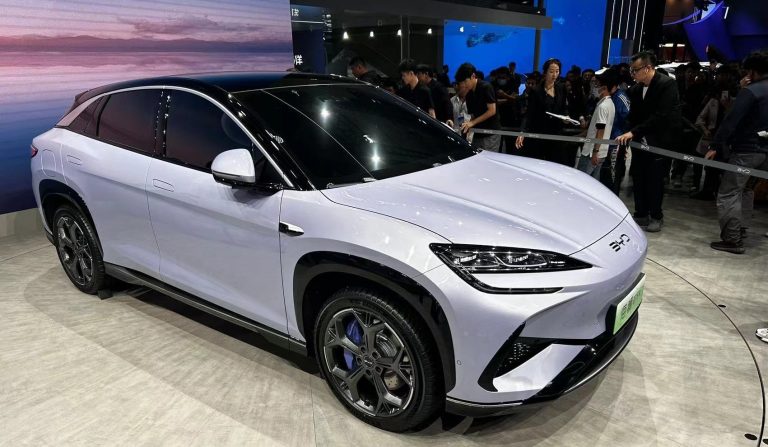
The global electric vehicle race has reached an inflection point, and the balance of power is no longer where it once stood. After years of setting the pace, Tesla has been overtaken — not by a Western rival, but by a Chinese manufacturer that was once openly dismissed by Elon Musk.
BYD has now emerged as the world’s largest seller of battery electric vehicles, overtaking Tesla in 2025 and underscoring how decisively China’s EV industry has matured. The shift reflects more than a single year of sales figures. It marks a structural change in the global EV market, driven by cost advantages, rapid technological iteration, and aggressive international expansion by Chinese manufacturers.
BYD said it sold 2.25 million battery-powered electric vehicles in 2025, a nearly 28% increase from the previous year. Tesla, meanwhile, reported sales of 1.64 million vehicles, an 8.5% decline that puts the company on track for its weakest annual performance since it became the dominant force in electric mobility. The reversal ends Tesla’s seven-year run as the world’s largest seller of battery EVs, a title it had held since 2018.
Register for Tekedia Mini-MBA edition 20 (June 8 – Sept 5, 2026).
Register for Tekedia AI in Business Masterclass.
Join Tekedia Capital Syndicate and co-invest in great global startups.
Register for Tekedia AI Lab.
The headline figures only tell part of the story. When plug-in hybrids are included, BYD had already surpassed Tesla in overall electrified vehicle sales in 2024. In total, BYD delivered about 4.6 million vehicles last year, reflecting a scale Tesla cannot currently match, largely because it does not sell hybrids. That strategic choice has become increasingly costly as consumers in many markets gravitate toward cheaper, more flexible electrified options amid high interest rates and uneven charging infrastructure.
Tesla’s slide comes after a bruising year on multiple fronts. In the United States, the removal of the $7,500 federal tax credit for new electric vehicles in September triggered a sharp slowdown in demand across the industry, hitting Tesla particularly hard. Fourth-quarter sales fell nearly 16% year-on-year, as higher prices and tighter financing conditions pushed many buyers to delay purchases.
Europe has proven even more challenging. Tesla’s sales there have slumped amid intensifying competition and growing consumer backlash linked to Musk’s political statements, which have increasingly spilled into the public perception of the brand. In China, Tesla faces perhaps its toughest test yet: a domestic market saturated with technologically advanced, aggressively priced electric vehicles produced by local rivals.

At the center of that competitive pressure is BYD. Once best known as a battery supplier and later backed by Warren Buffett, BYD has transformed into one of China’s most formidable automakers. Its strength lies in breadth and integration. The company designs and manufactures batteries, power electronics, and vehicles largely in-house, giving it cost control and supply-chain resilience that many rivals lack.
BYD’s product range spans from premium models and performance vehicles priced around $200,000 to ultra-affordable mass-market cars like the Seagull hatchback, which sells for roughly $7,800. That pricing flexibility has allowed BYD to dominate China’s EV market and gain traction overseas, particularly in price-sensitive regions.
Technology has also been central to BYD’s rise. Over the past year, the company has unveiled ultra-fast charging systems capable of delivering a meaningful range in about five minutes, narrowing one of Tesla’s long-held advantages. It has also rolled out advanced driver-assistance and autonomous features at no additional cost, a move that resonates with consumers increasingly wary of expensive software add-ons.

The contrast with Tesla has become sharper. Tesla’s valuation still reflects expectations of dominance in autonomy, software, and AI-driven mobility, yet its core vehicle business is under pressure from falling volumes, rising competition, and limited near-term product refreshes. The company’s reliance on a narrower lineup, led by the Model Y, has left it exposed as rivals flood the market with new designs and features.
Ironically, Musk himself has acknowledged how far BYD has come. A resurfaced video from more than a decade ago shows him laughing off the idea that BYD’s cars could compete with Tesla’s. When the clip went viral again in 2023, Musk responded more soberly, saying, “That was many years ago. Their cars are highly competitive these days.”
But BYD’s ascent has not been entirely smooth. The company has faced intense competition from domestic rivals such as Geely and regulatory pressure from Chinese authorities seeking to curb aggressive price discounting. Its sales fell 10% year-on-year in December, and its share price has dropped about 20% over the past six months, reflecting investor concerns about margins and slowing growth at home.
Yet BYD is increasingly leaning on international markets to sustain momentum. Overseas sales surged in 2025, and the company plans to open as many as 1,000 new retail outlets across Europe. That strategy is already delivering symbolic wins. BYD outsold Tesla in Europe for the first time last May, signaling that its appeal is extending well beyond China.
The broader implication is clear. The global EV market is no longer shaped primarily by Silicon Valley innovation or Western policy incentives. It is being redefined by Chinese manufacturers that combine scale, speed, and affordability, backed by deep domestic supply chains and relentless competition.