

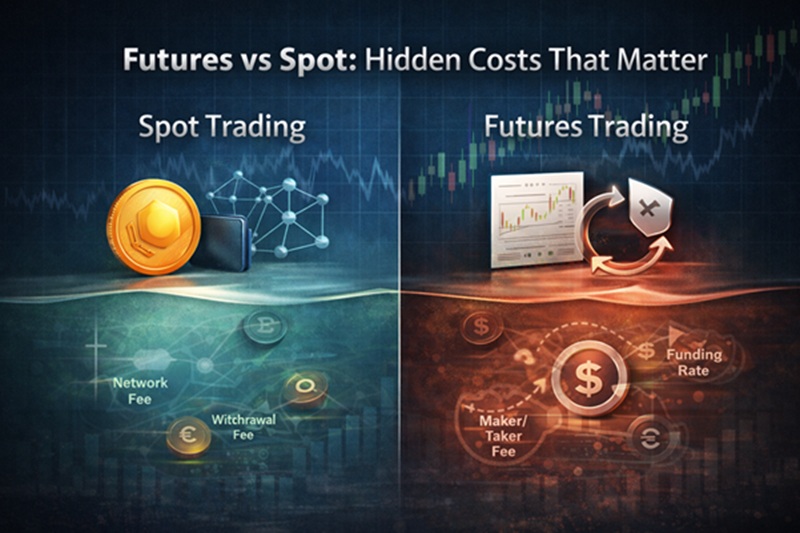
Spot trading and futures trading are two of the most popular ways to participate in crypto markets. Spot trading involves buying and selling digital assets at the current market price, with immediate settlement. Futures trading allows traders to speculate on future prices using contracts that can be leveraged, without owning the underlying asset. Both approaches have their place, but hidden costs often determine which one delivers better results for active traders. Platforms like PrimeXBT offer both spot and PrimeXBT futures, giving users flexibility to choose based on strategy and market conditions. This article compares spot and futures trading, highlighting the hidden costs that can significantly impact profitability.
Spot Trading: Simple but Costly in Practice
Spot trading is straightforward: you buy or sell crypto at the current price, and the transaction settles immediately. You own the asset outright, with no expiry or funding rates. This makes it ideal for long-term holding or simple buy-and-hold strategies.
However, spot trading has hidden costs that many beginners overlook. Withdrawal fees can be substantial, especially for large amounts or less liquid coins. Network fees (gas on Ethereum, transaction fees on other chains) add up when moving assets between wallets or exchanges.
Liquidity can be an issue for smaller altcoins. Wider spreads and slippage during volatile periods reduce effective entry and exit prices. For active traders, these costs can erode small gains quickly.
Futures Trading: Leverage and Flexibility
Futures contracts allow traders to take leveraged positions on crypto prices. Perpetual futures, the most common in crypto, have no expiry date and use funding rates to keep prices close to spot. Leverage ranges from 5x to 100x or more, amplifying both gains and losses.
The main advantage is flexibility. You can go long or short easily, hedge positions, or use margin to increase exposure. Funding rates can even generate income if you hold the right side of the trade.
However, futures come with their own hidden costs. Funding rates are paid every 8 hours, and in strong trends, one side can pay the other significantly. At 0.05% per funding period, this can add up to 0.15% daily in extreme cases.
Hidden Costs Comparison: Spot vs Futures
Spot trading costs are upfront and visible. Exchange fees, withdrawal fees, and network fees are the main ones. There are no ongoing costs for holding, but moving assets incurs charges.
Futures trading costs are more complex. Trading fees (maker/taker), funding rates, and potential rollover costs on dated contracts add layers. Funding rates can be positive or negative, meaning you can earn or pay to hold positions.
The table below summarizes the key cost differences:
| Cost Type | Spot Trading | Futures Trading | Impact on Profitability |
| Trading Fees | 0.1-0.2% per trade | 0.02-0.05% maker/taker | Futures usually cheaper |
| Funding Rates | None | 0.01-0.05% every 8 hours | Can erode or add to profits |
| Withdrawal Fees | Network fees + exchange fees | Minimal or none | Spot more expensive to move |
| Holding Costs | None | Funding rates | Futures can cost or pay |
| Leverage Costs | None | Margin interest (if any) | Futures amplify risk/reward |
When Spot Trading Is Better
Spot trading is preferable for long-term holding or when you want to own the asset for staking or DeFi. There are no funding rates, so you avoid ongoing costs during sideways markets.
It’s also better for low-leverage or no-leverage strategies. You avoid liquidation risk and margin calls, which can be devastating in volatile crypto markets.
Spot is simpler for beginners. No need to understand funding rates or rollover. Just buy and hold or sell when ready.
When Futures Trading Is Better
Futures excel in short-term or directional trading. Leverage allows larger positions with less capital, ideal for capturing 2-5% moves in BTC or ETH.
Short-selling is easy. Profit from downtrends without borrowing assets. This is valuable in bear markets or during corrections.
Hedging is straightforward. Short futures against spot holdings to protect against downside while maintaining long-term exposure.
Funding rates can be an opportunity. In strong trends, one side can earn significant income from funding payments.
Risk Management in Both Approaches
In spot trading, risk comes from price volatility. Use position sizing and diversification to limit exposure. Stop-loss orders help manage downside.
In futures, leverage adds liquidation risk. Use isolated margin, low leverage (5x-10x), and tight stops. Monitor funding rates to avoid high-cost holds.
For both, risk 1-2% per trade. This preserves capital through losing streaks. Diversify across assets and strategies.
Conclusion
Spot and futures trading both have their place in crypto markets. Spot is better for long-term holding and simplicity, with no funding costs. Futures provide leverage, short-selling, and hedging, but funding rates and liquidation risks add complexity. The hidden costs, especially funding rates in futures and withdrawal fees in spot, can significantly impact results. Choose based on your strategy: spot for holding, futures for active trading. Use low leverage, strict risk management, and monitor costs. In volatile markets, the right approach isn’t about choosing one, it’s about using both wisely.