

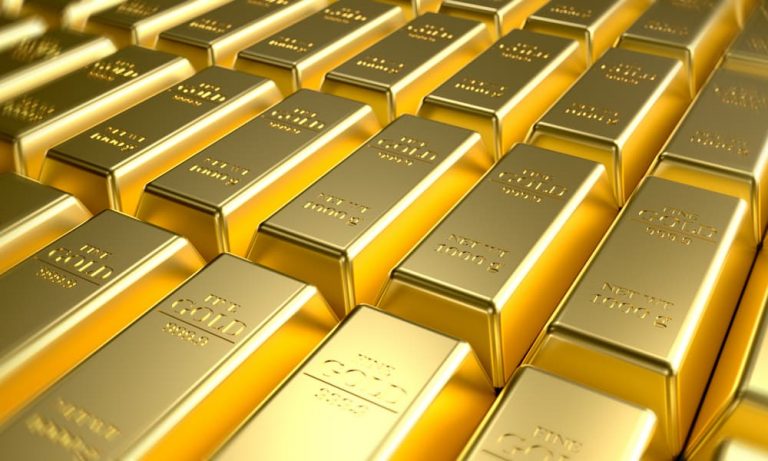
Bank of America Global Research has raised its price forecasts for precious metals, projecting that gold could surge to an unprecedented $5,000 per ounce by 2026, supported by a sustained wave of investment demand and growing geopolitical and economic uncertainty.
The forecast, released on Monday, signals that the bank expects gold’s historic rally to continue, albeit with potential corrections along the way. The outlook also underlines the shifting global economic climate, where fears of trade tensions, inflation, and interest rate uncertainty have reignited gold’s long-standing appeal as a safe-haven asset.
Gold broke new ground on October 8, climbing above $4,000 per ounce for the first time in history. The metal extended its record-setting momentum this week, reaching a fresh high of $4,079.62 on Monday. Analysts say the rally was fueled by renewed tariff threats from U.S. President Donald Trump against China, alongside expectations that the Federal Reserve will cut interest rates in the coming months to cushion the American economy.
Register for Tekedia Mini-MBA edition 20 (June 8 – Sept 5, 2026).
Register for Tekedia AI in Business Masterclass.
Join Tekedia Capital Syndicate and co-invest in great global startups.
Register for Tekedia AI Lab.
“Looking into 2026, a 14% increase of investment demand—similar to what we have seen this year—could lift gold to $5,000 per ounce,” the bank said.
The bank projects that gold will average around $4,400 in 2026, suggesting that while some price volatility is likely, the general trajectory will remain upward. However, it cautioned that a short-term correction could occur as traders consolidate profits from the historic surge.
The Drivers Behind Gold’s Record Rally
Gold’s dramatic rise has been underpinned by a confluence of macroeconomic and political forces. Chief among them is the renewed strain in U.S.-China relations after Trump threatened to reimpose tariffs on Chinese imports, rekindling fears of a global trade slowdown. The announcement rattled equity markets, prompting investors to shift their holdings toward more stable assets like gold.

Adding to that, expectations of an imminent rate cut by the U.S. Federal Reserve have bolstered gold’s outlook. Lower interest rates tend to weaken the dollar and reduce the opportunity cost of holding non-yielding assets like gold, making the metal more attractive to investors.
The Federal Reserve, which has already paused its tightening cycle, is widely expected to pivot toward rate reductions by early 2025 if inflation continues to moderate and labor market growth cools. Such a move could further weaken the dollar, adding momentum to gold’s rally.
The Safe-Haven Surge
Investors have been piling into gold-backed exchange-traded funds (ETFs) and physical bullion purchases throughout 2024 and into 2025, seeking stability amid persistent market volatility. According to the World Gold Council, global holdings in gold ETFs have reached their highest levels since the pandemic year of 2020. Central banks, particularly in emerging markets, have also been heavy buyers, diversifying their reserves away from the U.S. dollar amid fears of sanctions and currency volatility.

In addition, concerns over geopolitical risks—ranging from renewed Middle East tensions to uncertainty in Eastern Europe—have further boosted gold’s appeal. It is believed that this “fear factor” could continue to underpin demand well into 2026, particularly if global conflicts remain unresolved or escalate.
While the rally has lifted gold to breathtaking levels, Bank of America cautioned that the market may experience short-term pullbacks as speculative positioning becomes crowded. Historically, gold prices have tended to retrace briefly after such rapid climbs.
Still, the underlying fundamentals remain robust. The bank’s research indicates that a continued increase in investment demand—particularly from institutional funds and central banks—could push gold higher in the medium term. The projection for a 14% growth in demand mirrors this year’s strong performance, which has already sent shockwaves through commodity markets.
A Broader Precious Metals Rally
Gold’s surge has also lifted sentiment across the broader precious metals complex. Silver and platinum have both recorded notable gains, tracking the momentum of the yellow metal. Bank of America noted that while gold remains the “core anchor” of investor portfolios, silver could benefit disproportionately if industrial demand strengthens alongside investment flows.
However, it is gold’s unique dual role—as both a commodity and a financial asset—that has kept it at the center of investor focus. As global uncertainty deepens, its reputation as a store of value appears stronger than ever.
Looking ahead, if Bank of America’s forecast proves accurate, gold could enter a historic new phase, breaking not just price records but redefining investor behavior in an era of heightened financial instability. Analysts say the key variables to watch will be the trajectory of U.S. interest rates, China’s economic performance, and geopolitical developments in the Middle East and Eastern Europe.
With inflation still elevated in major economies and public debt levels reaching record highs, gold’s narrative as a hedge against both monetary and political risk is gaining renewed legitimacy. Investors, it seems, are betting not only on the metal’s luster but also on the world’s enduring uncertainty.