

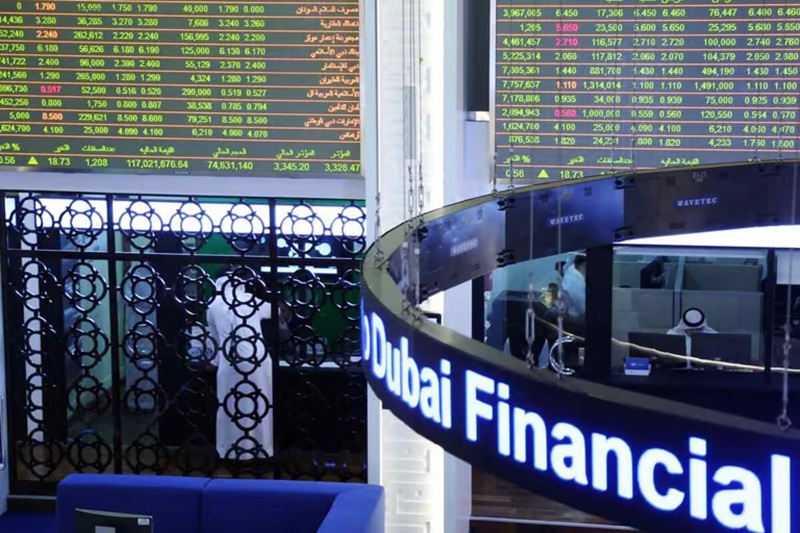
Most Gulf stock markets declined on Sunday as investors weighed the possibility of renewed military confrontation between the United States and Iran after the November 3 US midterm elections, although Qatar’s market surged on energy-sector developments and stronger sovereign credit reassurance.
The regional weakness reflects persistent concerns about the economic and financial consequences of another escalation involving Washington and Tehran. Gulf governments and investors are particularly exposed to the risk of disruption around the Strait of Hormuz, a critical route for global oil and liquefied natural gas shipments.
Countries across the region have been preparing for the possibility that US President Donald Trump could resume military action against Iran after the elections. Tehran has repeatedly warned that any fresh attacks could trigger retaliation against US and Israeli interests in neighboring countries, raising concerns about the security of energy infrastructure, trade routes and regional investment.
Register for the next Tekedia Mini-MBA.
Register for Tekedia AI in Business Masterclass.
Join Tekedia Capital Syndicate and co-invest in great global startups.
Saudi Arabia’s benchmark index fell 0.8%, with nearly all its constituents ending the session lower. Saudi Arabian Mining Company lost 2.6%, while real estate developer Jabal Omar Development plunged 7.3% after reporting a third-quarter net loss of 261.61 million riyals ($69.76 million).
The loss marked a reversal from the 197.85 million riyals in net profit recorded in the same period a year earlier, highlighting company-specific pressure alongside the broader market weakness.
IT solutions provider Elm Co provided a notable exception, rising 9% after reporting a 39% increase in quarterly net profit. The gain indicates that investors continued to respond to corporate earnings and individual company performance even as geopolitical uncertainty weighed on the wider market.

Qatar’s benchmark index rose 4.6%, recovering from the previous session’s decline and recording its sharpest intraday percentage gain in more than eight years.
The rally was supported by QatarEnergy’s efforts to secure long-term liquefied natural gas supplies from the United States and other producers. The strategy forms part of a trading approach intended to protect the country’s revenues if exports through the Strait of Hormuz are disrupted.
The development is notable because Qatar is one of the world’s major LNG exporters, making the security of maritime routes central to its energy trade. Diversifying supply arrangements and strengthening access to alternative sources could provide greater flexibility if regional tensions interfere with established shipping routes.

The market also received support from a sovereign credit assessment. S&P affirmed Qatar’s AA/A-1+ ratings with a stable outlook, citing the country’s substantial liquid, fiscal and external asset buffers amid regional security and trade-flow risks.
The affirmation provided investors with reassurance about Qatar’s capacity to absorb external shocks. Strong fiscal and external reserves can help governments manage disruptions to trade, maintain financial stability and support economic activity when geopolitical risks increase.
Qatar National Bank, the region’s largest lender, advanced 3%, while Industries Qatar, an industrial conglomerate linked to the country’s energy sector, gained 7.9%.
The performance of these companies helped drive the broader market higher, with investors responding to the combination of energy-sector positioning and confidence in the country’s financial buffers.
However, the rally does not remove Qatar’s exposure to regional security risks. Its LNG exports remain dependent on shipping routes, and a prolonged disruption to the Strait of Hormuz could affect deliveries, trade flows and energy revenues. The country’s efforts to diversify supply arrangements are therefore a form of risk management rather than a guarantee against disruption.
Egypt Declines After Interest-Rate Increase
Outside the Gulf, Egypt’s blue-chip index fell 1.7%, with nearly all listed stocks ending lower. Commercial International Bank declined 2.1%, while Talaat Moustafa Group lost 1.1%.
The weakness followed the Central Bank of Egypt’s decision on Thursday to raise its key interest rates by 100 basis points, marking its first increase since March 2024.
The move adds another monetary-policy consideration for investors already navigating regional uncertainty. Higher interest rates can increase borrowing costs for businesses and households, while raising the discount rates used to value future corporate earnings. Banks, property developers and other interest-rate-sensitive companies can therefore face different pressures depending on their funding structures, loan portfolios and pricing power.
Egypt’s market decline also highlights how regional equities are responding to more than the immediate risk of a US-Iran confrontation. Domestic monetary policy, corporate earnings and financing conditions continue to influence individual markets.
Across the region, Sunday’s trading showed that geopolitical risk is not producing a uniform response. Saudi Arabia and Egypt recorded losses, while Qatar advanced sharply on developments linked to its energy strategy and sovereign credit position.