

A British influencer persuaded more than 100,000 people to sign up for a product they had never seen. When she finally unveiled it, her brand reported £250,000 in sales within an hour.
The launch happened on September 2, 2026. The weeks before it did the real work. Isobel Lorna MacDonald spent August handing followers clues, inviting guesses and turning an unknown product into an event. Marketers call this a pre-launch campaign, or warming up an audience: building interest before there is anything to buy.
Agende shows how the machinery runs when several psychological triggers reinforce each other.
Trust Came Before the Teasers
MacDonald started making content at 19 while working night shifts at an Amazon warehouse. Followers watched her build a career, save for expensive purchases and develop a taste for luxury. She talked about goals and discipline, often with a notebook or planner within reach, sometimes working from her car.
She also pulled the audience into that story. A luxury advent-calendar campaign invited followers to share their ambitions and drew nearly 25,000 entries. When she sold her old Ford, the proceeds paid for driving lessons for three followers.
So the relationship existed before the first hint appeared. For followers who recognized their own goals in hers, buying something she made could feel like taking a small piece of that life home.
This is the part of a launch that cannot be manufactured in a fortnight. A creator known for planning and beautiful accessories can plausibly promise a product that combines the two. Had she announced a range of office curtains, the mystery would have needed far more explaining.
A Trail of Clues, With No Product in Sight
On August 13, MacDonald teased a secret brand in an unboxing video that hid what was inside. She described an everyday item she thought could be better. Productivity content appeared more often, burgundy became a recurring visual clue, and she even had her nails painted to match the future brand.
Then came the apparent slip-up. Information meant for her Close Friends list appeared in a public Story, only to be taken down. Whether it was deliberate remains unknown. For followers trying to solve the puzzle, it was one more clue to argue about.
Instead of waiting for an announcement, people could compare theories, hunt for details and come back for the next hint. The audience kept the mystery alive.
About a week before launch, MacDonald revealed the name, Agende, and offered early access through an email list. She later told roughly 90,000 subscribers how an idea dating back to 2020 had evolved from a handbag concept. The product itself stayed hidden.
According to CORQ’s account of the campaign, more than 108,000 people registered before the full reveal.
A place on a waiting list is not a purchase. It is still a bigger commitment than a like on a photograph. It also gave MacDonald a direct line to people who wanted the answer.
When Everybody Else Seems Interested
Visible enthusiasm adds another layer. Someone who missed the earlier clues lands on a post full of reactions and wonders what the fuss is about. Psychologists call it social proof: when we are unsure, other people’s behavior becomes the cue.
Brands can encourage early activity through collaborations, existing customers and advertising. Some also buy Instagram likes through services such as IGComment, which says it uses accounts operated by real people rather than automated ones. Those reactions can lift the visible count. There is no evidence that Agende bought engagement.
MacDonald had something stronger than a busy comment section: a waiting list with more than 108,000 names. Then she disclosed how many units had been produced for the first release.
Just 500.
The stock announcement reportedly drew more than 25,000 Instagram likes. Now the numbers sat side by side: 108,000-plus signups, 500 units, thousands of public reactions. Nobody could assume every name on the list would become a buyer. Anyone weighing a purchase had reason to expect a scramble.
Limited availability makes a product feel exclusive and turns “maybe later” into “I should decide now.” That is FOMO, the fear of missing out, at work. We don’t know whether the small first order was designed to create that effect. Publicizing it certainly intensified the countdown.
Even shoppers who recognize scarcity marketing can still want the item. Knowing the trick does not make the offer personally meaningless. Invented shortages and invented deadlines are a different matter: those erode trust fast.
The Reveal Had One More Surprise
On September 2, the secret turned out to be a calfskin leather A5 planner built to double as a compact handbag, with interchangeable inserts and room for everyday essentials. In an interview with Numéro Netherlands, MacDonald described wanting the practicality of a planner with the look of a luxury accessory.
It fit the identity she had shared online for years. The price divided people: a discounted complete set cost £279. Some followers admired the design. Others questioned the cost, especially given MacDonald’s long history of talking about saving money.
The argument did not stop the orders. Agende reported £100,000 in ten minutes, £250,000 in an hour and £400,000 after six hours, preorders included. The first collection sold out in presale.
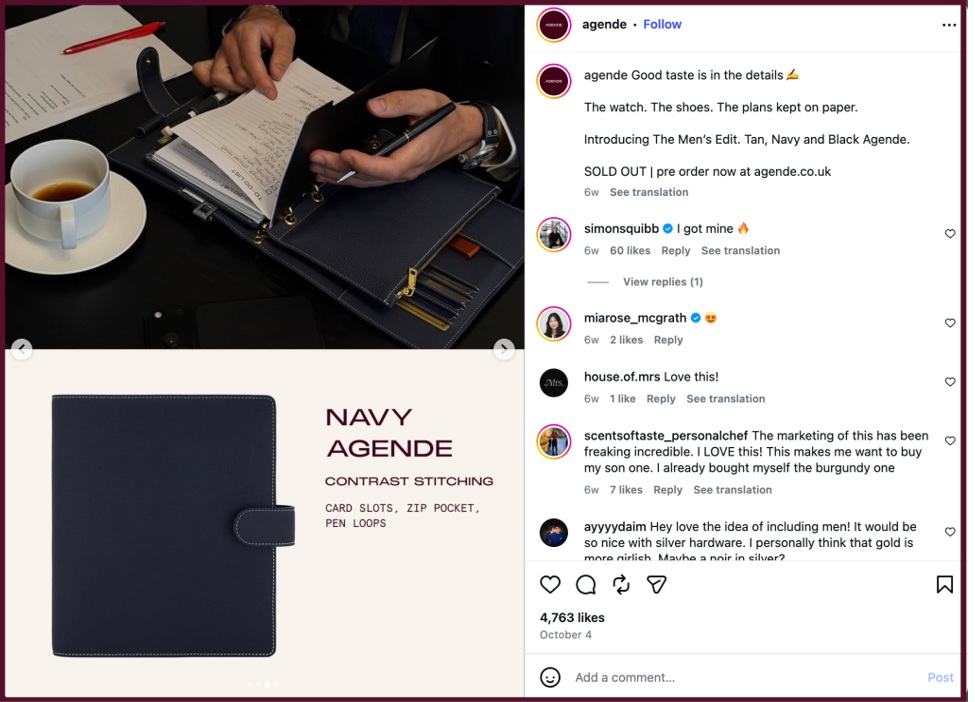
None of that came from a manicure or a few cryptic Stories. The long relationship made people curious. The clues kept them returning. Public reactions made the excitement visible, and limited stock turned interest into urgency. Each part fed the next.
A small brand can borrow the sequence without pretending to be a celebrity. Show the problem behind the product, invite people into its development, build a real list of interested customers, then make buying simple when the moment comes. The story has to fit the audience. Otherwise the cleverest countdown is just a countdown.
MacDonald’s followers knew they were being teased. Many probably recognized the marketing. More than 108,000 signed up anyway, and enough of them bought for the company to report £250,000 in its first hour.
For much of the campaign, none of them had seen what was for sale.