

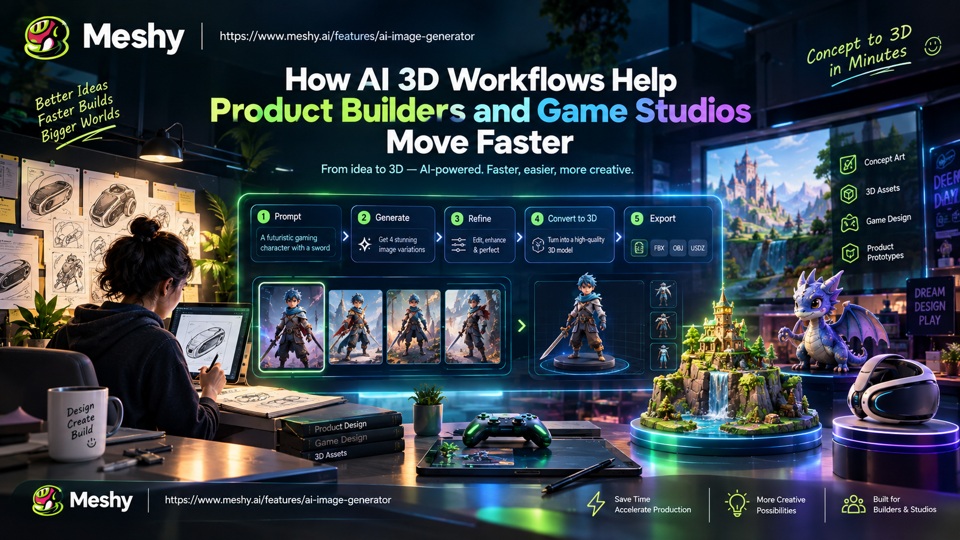
Product builders and game studios face a similar constraint: they need to test ideas before they can justify full production. AI-assisted 3D workflows can shorten the journey from a rough concept to a model that teams can review, prototype, and place in context. This is useful for established studios and for smaller digital businesses working with limited specialist capacity.
The gain comes from faster iteration, not from removing every stage of 3D production. Generated assets still need creative selection, technical cleanup, and testing in the final application.
Explore More Concepts Before Modeling
The first bottleneck is often visual agreement. Product teams may be choosing between forms, materials, or interaction ideas, while game teams are comparing characters, props, and environments. Generative image tools can turn a written brief into several directions that stakeholders can discuss.
An AI image generator for game assets can help establish silhouette, style, and surface details before the team converts a selected reference into 3D. This keeps early experimentation inexpensive and gives the next stage a clearer target.
Move from Approved Image to Draft Model
Once a direction is approved, image-to-3D generation can provide a first mesh and texture set. A product builder might use that model in a visualization or prototype, while a game studio might place it in an engine to judge scale and composition.
The output should be viewed as a working draft. Hidden surfaces are inferred, fine details can be distorted, and the topology may not suit animation or manufacturing. Teams should compare the model with the reference from several angles and identify which areas require manual rebuilding.
Refine Geometry and Materials
The next step is determined by the use case. A game prop may need a lower polygon count, clean UVs, collision, and levels of detail. A character may require retopology and rigging. A product visualization may prioritize accurate proportions, materials, and presentation-quality surfaces.
Physically based materials can improve consistency across lighting conditions, but generated textures still need inspection. Artists should remove baked-in shadows, fix seams, and confirm that roughness, metallic response, and color reflect the intended design.
Check Engine and Platform Compatibility
A fast model is useful only if it works in the destination. Game teams should test imports in Unity, Unreal Engine, Godot, or their internal engine. Product teams should verify the requirements of web viewers, AR platforms, design software, or manufacturing tools.
File format, scale, axis orientation, texture size, naming, pivots, and animation data can all create problems during handoff. Testing a small asset early is safer than generating an entire library before confirming the pipeline.
Cloud Access and Distributed Teams
Because many generative services run in the cloud, creators can begin without a high-end local GPU. This can help startups, freelancers, and distributed teams participate in 3D prototyping. It is also relevant in emerging digital markets where access to specialized hardware may be uneven.
Cloud access introduces other considerations: subscription costs, generation credits, upload speed, service availability, retention policies, and the sensitivity of source images. Teams should evaluate the full operating model, not only the quality of one result.
Build a Repeatable Pipeline
The largest benefit appears when the workflow is documented and repeatable. Teams can define how references are approved, which tool settings are used, what cleanup is mandatory, and how assets are named, stored, reviewed, and exported. Those rules reduce inconsistency as output volume grows.
AI-assisted 3D can help product builders and game studios reach a testable asset sooner. The final advantage depends on what happens next: disciplined refinement, compatibility checks, and human judgment turn a quick generation into something that can support a real product.