

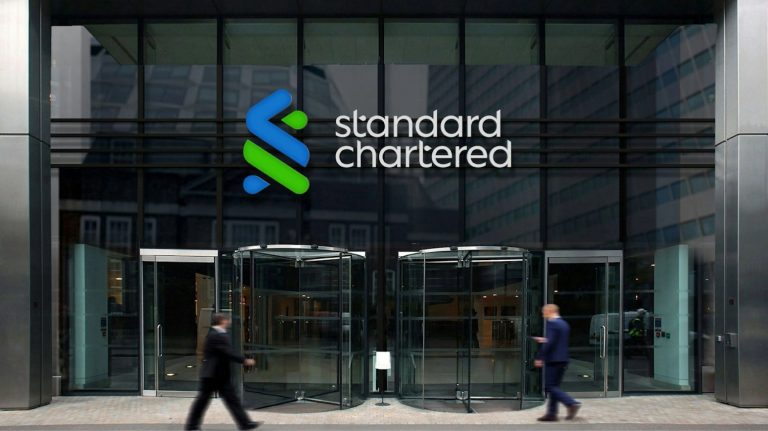
UNI surged more than 10% after Standard Chartered issued an ambitious $100 price target for the token, reinforcing renewed institutional attention toward decentralized exchange governance assets.
The move reflects growing conviction that decentralized finance infrastructure, particularly automated market makers such as Uniswap, may capture a larger share of global trading volumes as liquidity deepens and regulatory clarity slowly improves.
Standard Chartered’s projection positions UNI among a small cohort of exchange-linked tokens that could benefit from structural adoption of on-chain trading and tokenized liquidity pools.
Analysts argue that the $100 target, while aggressive, signals expectations of exponential fee growth and sustained user migration from centralized exchanges toward decentralized platforms. Such projections depend heavily on macro liquidity conditions, interest rate trajectories, and risk appetite in digital asset markets, all of which remain volatile.
Register for the next Tekedia Mini-MBA.
Register for Tekedia AI in Business Masterclass.
Join Tekedia Capital Syndicate and co-invest in great global startups.
The broader market reaction also highlights how rapidly sentiment can shift in response to research notes from major financial institutions. For UNI holders, the rally underscores both opportunity and fragility, as valuation models remain tightly linked to trading activity rather than traditional cash flows.
Standard Chartered’s outlook adds credibility to the narrative that decentralized exchanges are maturing into institutionally relevant market infrastructure. This institutional framing is significant because it contrasts with earlier cycles where decentralized exchange tokens were largely driven by retail speculation and short-term momentum.
Increasingly, analysts are evaluating UNI through the lens of fee capture potential, protocol governance value, and network effects within liquidity provisioning ecosystems. The $100 price target therefore functions less as a precise forecast and more as a signaling mechanism about long-term adoption assumptions.

Market participants will continue to scrutinize on-chain metrics such as trading volume, active addresses, and liquidity depth to validate or challenge this outlook. Volatility around UNI also reflects broader uncertainty in digital asset valuation frameworks, where discounted cash flow models are often replaced by comparative protocol analysis.
The surge triggered by Standard Chartered’s report can be interpreted as both a momentum event and a reassessment of fundamental expectations. The trajectory of UNI will depend on whether decentralized exchanges can sustain growth in user activity and maintain competitive advantages against centralized rivals.
For investors, the key question is whether UNI’s valuation can transition from speculative cycles to durable cash-flow-like metrics derived from protocol fees.
That transition would require sustained volume growth, increased institutional participation, and continued expansion of decentralized finance applications across multiple chains. Absent those conditions, price targets such as $100 may remain aspirational rather than achievable in the near term.

Still, the latest surge reinforces UNI’s position as one of the most closely watched governance tokens in decentralized finance markets. It also demonstrates how quickly narratives can translate into capital flows in crypto markets, particularly when reinforced by reputable financial institutions.
As decentralized exchange infrastructure evolves, UNI’s role as both a governance and value-accrual instrument will remain central to investor debate. Future price action will likely hinge on macro conditions, regulatory developments, and the competitive dynamics among leading automated market makers.
The 10% surge and $100 price projection encapsulate the tension between rapid innovation and uncertain valuation frameworks in digital assets. Whether this tension resolves upward or downward will determine UNI’s medium-term trajectory in increasingly institutionally influenced decentralized finance markets over the coming market cycle across global trading ecosystems broadly.
Shareholder Perspectives on Commerzbank-UniCredit Takeover
The increasingly tense relationship between Italy’s UniCredit and Germany’s Commerzbank has evolved into one of Europe’s most closely watched banking dramas.
What began as speculation over a potential cross-border acquisition has now turned into a public war of words, with executives, politicians, labor representatives, and shareholders exchanging criticisms as the possibility of a takeover moves closer to reality.
The dispute highlights not only the strategic ambitions of major European banks but also the broader challenges of banking consolidation within the European Union.
UniCredit, one of Europe’s largest banking groups, has long expressed interest in expanding its presence across key European markets. Germany, with its large economy and relatively fragmented banking sector, represents an attractive target.
Commerzbank, Germany’s second-largest listed bank, has emerged as a particularly appealing acquisition candidate due to its strong domestic franchise and improving financial performance. However, the prospect of UniCredit taking control of Commerzbank has sparked significant resistance.
German political leaders and labor unions have voiced concerns that a foreign takeover could lead to job losses, branch closures, and a weakening of Germany’s influence over a strategically important financial institution. These concerns have fueled public criticism of UniCredit’s intentions and intensified scrutiny of any potential deal.
UniCredit executives have responded by arguing that consolidation is necessary for European banks to compete globally. They contend that European financial institutions remain smaller and less profitable than many of their American counterparts, making mergers an important tool for achieving economies of scale, increasing efficiency, and enhancing competitiveness.
According to UniCredit, a combination with Commerzbank could create a stronger pan-European banking champion capable of serving customers across borders while generating greater shareholder value.
The debate has increasingly taken on a confrontational tone.
Supporters of Commerzbank have accused UniCredit of opportunistic behavior, suggesting that the Italian lender is seeking to exploit market conditions rather than pursue a genuine long-term partnership. UniCredit, meanwhile, has criticized what it views as protectionist attitudes and resistance to the broader European goal of creating a more integrated banking market.
Many investors are focused primarily on financial returns and may view a takeover favorably if it offers a substantial premium and creates opportunities for future growth. Others remain cautious, questioning whether cross-border banking mergers can successfully deliver the promised synergies while overcoming regulatory, cultural, and operational challenges.
The outcome of the UniCredit-Commerzbank contest could have implications far beyond the two institutions involved. European policymakers have long advocated for greater financial integration, yet progress has been slow. A successful transaction could encourage further consolidation across the continent, potentially reshaping the European banking landscape.
If political resistance derails the deal, it may reinforce perceptions that national interests continue to outweigh broader European ambitions. As negotiations and public debates intensify, the mudslinging between the two sides reflects the high stakes involved. What is being contested is not merely ownership of a bank but competing visions for the future of European finance.
Whether UniCredit succeeds in its pursuit of Commerzbank or not, the battle has already become a defining test of Europe’s willingness to embrace cross-border banking consolidation in an increasingly competitive global economy.