

Online iGaming platforms frequently compete for attention through prominent bonuses, extensive game libraries and claims about rapid payments. Although these features may be easy to compare, they reveal relatively little about the policies that determine a user’s actual experience.
A large welcome offer, for example, may come with detailed wagering requirements, restricted payment methods or a limited withdrawal window. A platform that advertises quick payouts may still require identity verification before processing a request. These conditions are not necessarily unusual, but they should be clearly disclosed and understood before money is deposited.
No comparison process can make gambling risk-free. However, eligible adults can make better-informed decisions by examining verifiable information rather than relying on promotional headlines.
Start with regulatory status and geographic eligibility
The first step is identifying where a platform operates, which jurisdiction it claims to serve and which authority—if any—oversees its activities. A licensing logo should not be treated as sufficient evidence by itself. Readers should check the regulator’s official website and confirm that the operator’s company name, licence number and authorised activities match the information displayed on the platform.
Geographic eligibility also requires careful attention. Gambling and online-money gaming rules can differ between countries and may also vary at state, provincial or regional level. A platform being accessible from a location does not automatically establish that its services are authorised there.
India’s regulatory environment has undergone significant changes, so broad statements claiming that online betting is simply “legal” or “illegal” can be misleading without jurisdiction-specific analysis. Readers and publishers should consult India’s official online gaming legislation and obtain appropriate professional guidance when necessary. The current legal position should always be verified immediately before publication or participation.
Read the terms behind payments, bonuses and withdrawals
Payment information should be assessed before any deposit is made. Important details include accepted payment methods, minimum and maximum transaction amounts, supported currencies, processing periods and possible conversion or service fees.
Readers should also determine whether the platform explains its identity-verification process. Requests for proof of identity, address or payment ownership may affect how quickly a withdrawal can be completed. The relevant requirements should be visible in the terms rather than introduced unexpectedly after a withdrawal request.
Promotional offers deserve the same scrutiny. A large headline bonus may be less valuable when its wagering conditions, qualifying odds, maximum stake rules, expiry periods and withdrawal limits are taken into account. Consumers should therefore compare the complete offer rather than the advertised percentage or monetary amount alone.
Other provisions worth reviewing include inactive-account fees, cancellation policies, account restrictions and the circumstances under which funds or bonuses may be withheld. Phrases such as “instant withdrawal” or “guaranteed bonus” should not be accepted without checking the underlying conditions.
A practical platform-comparison checklist
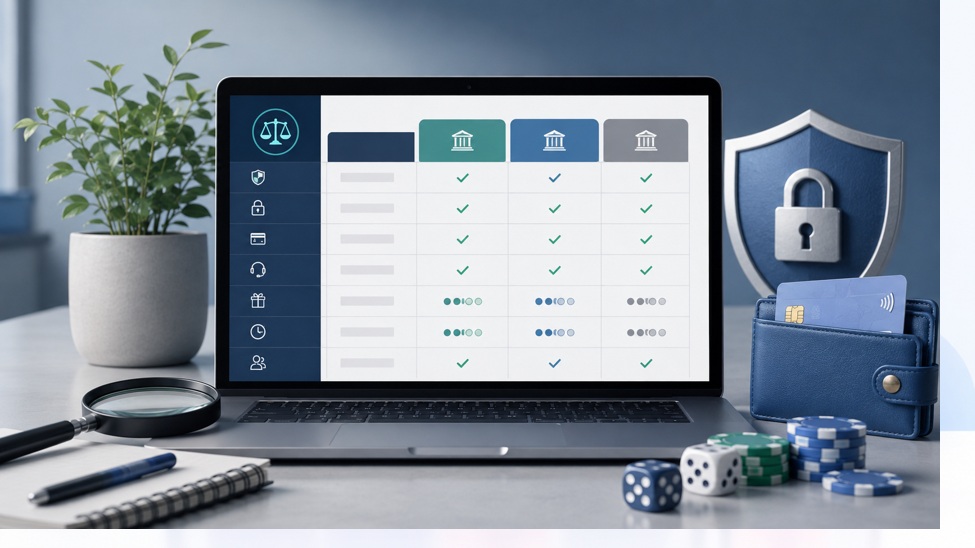
A structured checklist helps readers compare platforms consistently instead of being influenced by whichever feature receives the most prominent advertising.
| Comparison area | What the reader should verify |
| Operator information | Registered company name, contact details, jurisdiction and applicable terms |
| Regulatory claims | Regulator, licence number, authorised activities and geographic restrictions |
| Payments | Supported methods, currencies, fees, limits and published processing periods |
| Bonus conditions | Wagering requirements, expiry dates, qualifying markets and withdrawal restrictions |
| Account controls | Deposit limits, session reminders, cooling-off periods and self-exclusion |
| Security | Encryption information, account authentication and privacy documentation |
| Games and markets | Rules, provider information, settlement policies and dispute procedures |
| Customer support | Contact channels, opening hours and escalation options |
| Complaints | Internal complaint process and independent escalation, where applicable |
Comparison pages can make this research more manageable by presenting commonly advertised features in a consistent format. Nevertheless, important information should still be checked against the operator’s current terms, payment pages and regulatory records.
As a supplementary research resource, ToffeeWeb’s guide to betting sites in India can help readers compare commonly advertised platform features before independently verifying payment rules, geographic eligibility and regulatory information. Inclusion in a comparison does not by itself prove that a platform is legal, licensed, secure or suitable for a particular reader.
Consumers should also record the date on which they complete their checks. Payment methods, bonus conditions, ownership details and platform availability can change, making an older review less reliable than current first-party documentation.
Check whether player-protection tools are visible and usable
Responsible-gaming controls should be treated as core platform features rather than optional additions hidden in a footer. Useful controls can include deposit or spending limits, time reminders, cooling-off periods, self-exclusion, accessible transaction histories and straightforward account-closure procedures.
Visibility matters, but functionality matters more. Readers should check whether limits can be set directly through the account, how quickly they take effect and whether increasing a limit involves a delay. Self-exclusion information should explain its duration, scope and consequences in clear language.
Some operators use automated monitoring to identify changes in deposits, playing time or payment activity. These systems may support early interventions, fraud detection and account-security checks. StreakfortheCash provides additional context on how technology is changing player protection, including the potential role of data analysis and human review.
Automated monitoring is not a substitute for transparent policies or effective support. It also raises questions about privacy, data collection and decision-making. A platform should explain which information it collects, why it is required, how long it is retained and how users can challenge an incorrect account decision.
Most importantly, the presence of responsible-gaming tools cannot eliminate the possibility of financial or psychological harm.
Treat responsible play as a core comparison criterion
Gambling is different from ordinary video gaming because participants risk money or something else of value on an uncertain outcome. Its potential effects can extend beyond an individual account balance.
The World Health Organization guidance on gambling harms identifies consequences that may include financial distress, mental-health problems, relationship breakdown and harm to families and communities. Harm can occur even when a person does not meet the clinical criteria for gambling disorder.
Eligible adults who choose to participate should establish firm limits in advance. Gambling expenditure should come only from a fixed entertainment budget after essential costs have been covered. Borrowing money to gamble, using funds intended for household needs or treating gambling as an income strategy can substantially increase exposure to harm.
Losses should never be chased. Increasing deposits or stakes in an attempt to recover previous spending can turn a limited activity into an escalating financial problem. Regular breaks and transaction-history reviews may help users recognise changes in their behaviour.
A person should stop and seek support when gambling is no longer recreational, becomes difficult to control or begins affecting finances, health, work or relationships. Cooling-off and self-exclusion tools can provide practical barriers, but independent professional support may also be necessary.
Warning signs that a platform comparison should not ignore
A useful comparison should highlight uncertainties as clearly as positive features. Warning signs may include:
- Unclear company ownership or geographic jurisdiction
- Missing, inconsistent or unverifiable licensing information
- Terms that are difficult to locate or understand
- Promises of guaranteed profits or risk-free gambling
- Pressure to deposit immediately
- Unexplained withdrawal restrictions
- No visible responsible-gaming controls
- Customer support that cannot explain essential policies
- Requests for unusual payments or unnecessary personal information
One warning sign may not establish misconduct, but it should prompt further investigation. When basic ownership, payment or complaint information cannot be verified, the cautious response is to avoid depositing until reliable evidence is available.
Final takeaway: compare claims, verify details and control exposure
An effective iGaming comparison should focus on evidence rather than excitement. Regulatory claims, payment rules, bonus conditions, security information and player-protection controls need to be examined separately because strength in one area does not guarantee strength in another.
Comparison resources can organise the research process, but they cannot replace current terms, official regulatory records or personal risk assessment. Eligible adults should verify important details directly, establish strict financial limits and remember that gambling always carries the possibility of loss.