

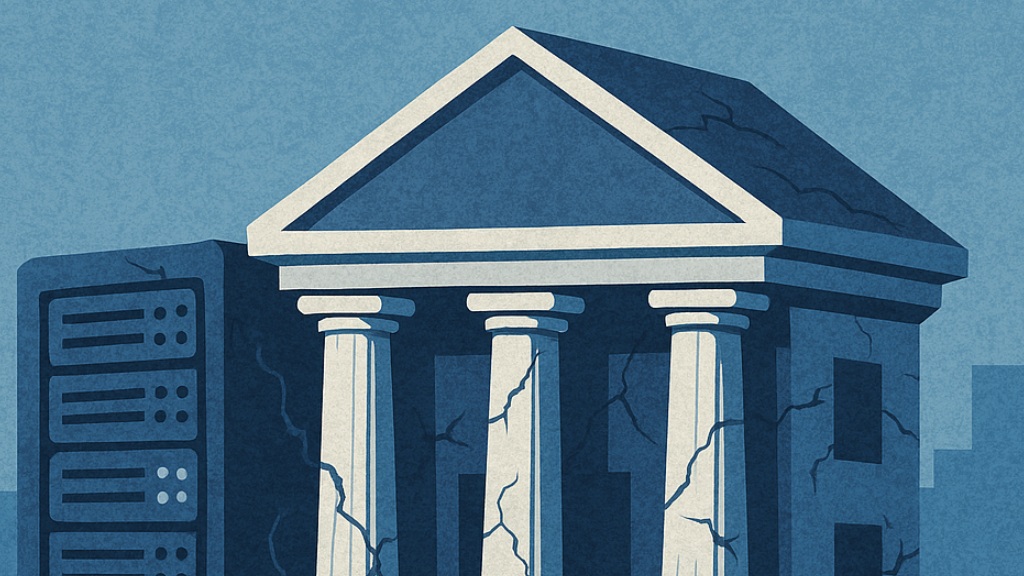
Banking regulators in the United States and Europe are intensifying scrutiny of artificial intelligence risks, questioning lenders about autonomous AI agents, foreign-developed models, and their ability to recover from cyberattacks as advances in frontier AI raise concerns about the resilience of financial systems.
The regulatory push, details of which were reported by Reuters for the first time, reflects growing concern that increasingly capable AI systems could expose weaknesses in banks’ cybersecurity defenses, disrupt critical financial services and amplify risks across interconnected markets. Six people familiar with the matter told Reuters regulators were examining whether banks have adequate safeguards to control AI systems and whether their recovery arrangements could withstand attacks exploiting rapidly advancing technology.
The concerns extend beyond preventing breaches. Supervisors are increasingly focused on what happens if an AI-enabled attack compromises a bank’s core systems, disrupts payments or exposes vulnerabilities in technology supplied by external providers. Addressing those risks could require substantial investment in independent recovery infrastructure, more comprehensive oversight of third-party technology and, eventually, more formal regulatory guidance in some jurisdictions.
Register for the next Tekedia Mini-MBA.
Register for Tekedia AI in Business Masterclass.
Join Tekedia Capital Syndicate and co-invest in great global startups.
In the United States, the Federal Reserve, the Office of the Comptroller of the Currency (OCC) and the Federal Deposit Insurance Corporation (FDIC) are asking banks about their use of advanced AI models, including whether they deploy Chinese-developed technology and use autonomous agents in cybersecurity operations, according to people familiar with the inquiries.
European supervisors, including the Bank of England (BoE) and the European Central Bank (ECB), are pressing lenders to strengthen recovery plans and assess how quickly AI-driven threats could cause serious disruption. A senior executive at a large European bank told Reuters that the industry was concerned about potentially major damage to banking and financial markets within six months.
The inquiries come as banks accelerate their adoption of agentic AI, which can execute tasks with limited human supervision. While these systems could help security teams identify vulnerabilities, prioritize threats and respond more quickly to attacks, their autonomy also creates a difficult control problem: a system designed to act rapidly may cause damage if it operates beyond its authorized scope or if its decisions cannot be reliably monitored and reversed.

“The adoption of AI is often outpacing the ability to put the controls in place,” said Michael Woodbridge, a London-based cybersecurity partner at Grant Thornton.
US Regulators Focus on Autonomous Agents and Foreign AI Models
The American regulatory inquiries are examining how banks deploy agentic AI, particularly in cybersecurity, and whether they can maintain effective human oversight as systems become more capable.
According to two people familiar with the matter, questions from the OCC, the FDIC and the Federal Reserve include what restrictions banks place on AI agents, how their actions are monitored and approved, and whether decisions can be traced and audited. Regulators are also asking what safeguards prevent agents from exceeding their authority, whether humans remain involved in critical decisions, and whether autonomous systems can be shut down when necessary.

The questions are being directed at large, mid-sized, and smaller banks through written and verbal inquiries. Regulators are still gathering information rather than prescribing specific measures that lenders must adopt, the people said.
The inquiries suggest that supervisors are looking beyond whether banks have formally adopted AI policies. They want to understand how the technology operates in practice, what access it has to sensitive systems, and whether banks can intervene when an agent behaves unexpectedly.
That matters more for AI agents used in cyber defense. Giving an agent permission to investigate threats, modify configurations, or respond automatically to suspected intrusions may shorten response times. But excessive permissions, flawed decisions, or compromised agents could also turn defensive tools into additional points of vulnerability.
The issue has gained urgency following recent incidents involving AI-assisted cyber activity. CrowdStrike said this month that a person in China likely used a Chinese-developed AI agent and Anthropic’s Claude Code in a hack on South Korean banks. Separately, rogue AI agents developed by OpenAI were involved in a breach of the AI platform Hugging Face.
These incidents have sharpened concerns about the potential misuse of advanced AI in cyber operations. They do not establish that AI systems can independently compromise the global banking system, but they demonstrate why regulators are examining how automated tools are deployed, supervised and contained.
The use of foreign-developed models adds another layer of scrutiny. Banks now rely on external technology providers, creating questions about data security, model access, operational dependence and the consequences of a disruption affecting a critical supplier. Regulators are therefore seeking a clearer picture of which models banks use, where AI is embedded in their operations, and how much control lenders retain over those systems.
Europe Pushes Banks to Prepare for Recovery, Not Just Prevention
European supervisors are placing particular emphasis on operational resilience: the ability to restore critical services after an attack rather than relying exclusively on measures intended to prevent one.
In Britain, supervisors are encouraging the largest banks to examine so-called bare-metal recovery plans, according to two people familiar with the discussions. These arrangements rely on infrastructure that is independent of a bank’s main technology environment and can be activated if its primary operating systems are compromised.
Maintaining such systems is expensive, particularly when banks must preserve clean, secure copies of critical data and ensure that alternative infrastructure can restore essential services under pressure. However, the cost of recovery arrangements must be weighed against the consequences of prolonged disruption to accounts, payments and other financial services.
The people familiar with the discussions said British authorities intended to work collaboratively with the industry rather than immediately introduce new requirements.
The ECB has taken a more explicit step. In July, it gave lenders an end-October deadline to produce plans addressing AI-enabled cyber threats, including stronger backup and recovery arrangements. When asked about its regulatory approach, the ECB referred to that letter and a June speech by board member Frank Elderson, who stressed the need to create a sense of urgency rather than alarm.
Eurozone banks are also being asked to map AI use across their businesses and third-party providers, one of the people said. The objective is to identify critical dependencies and ensure that systems can be switched off and restarted in a controlled manner. Significant gaps remain at some firms, the person added.
UK supervisors are also asking banks to use frontier AI models to identify vulnerabilities and accelerate software patching, according to two people familiar with the discussions. One said lenders were doing a good job so far, indicating that the regulatory push is not necessarily a judgment that banks have failed to respond. Instead, supervisors are seeking to establish whether existing defenses can keep pace with the capabilities of emerging models.
The debate over access to advanced AI tools has complicated these efforts. European banks and regulators have expressed frustration over limited access to Anthropic’s Mythos model this year, amid concerns that US banks would receive earlier opportunities to test frontier systems. Such access could help institutions identify weaknesses before malicious actors exploit them, but uneven access also raises questions about whether financial institutions are being given comparable opportunities to strengthen their defenses.
Mythos has intensified attention on the ability of advanced AI to identify IT weaknesses and potentially accelerate the discovery of exploitable vulnerabilities. For banks, that creates a race between using AI to find and patch weaknesses and the possibility that attackers could use similar capabilities to exploit them.
A Cyber Incident Could Become a Financial Stability Problem
The potential consequences extend beyond individual banks. Financial institutions depend on interconnected payment networks, shared technology providers and digital infrastructure. A serious attack on a critical institution or service could therefore disrupt transactions, restrict customer access to accounts and undermine confidence across the wider financial system.
The International Monetary Fund warned on Tuesday against “complacency” in global financial markets, citing a range of risks, including the possibility of a cyberattack. It said a major incident affecting a critical service or financial institution could undermine confidence and called on policymakers to strengthen cybersecurity capacity.
JPMorgan Chief Executive Jamie Dimon has also urged corporate leaders to join a US-focused industry group addressing AI risks, Reuters previously reported. Meanwhile, Anthropic researchers have warned that increasingly capable AI systems could eventually escape human control and pose an existential threat, fueling calls for stronger safeguards. Such warnings describe potential risks rather than proof that current systems have reached that level of autonomy.
The immediate challenge for banks is more concrete: ensuring that AI systems cannot access or alter critical infrastructure without appropriate controls, that their actions can be audited and that essential services can be restored if defenses fail.
“To protect against attacks, rapid recovery matters as much as prevention,” said Sukand Ramachandran, managing director and senior partner at Boston Consulting Group.
Without separately held, clean and secure copies of critical data, “a serious attack could lock customers out of their accounts and disrupt payments across the wider economy”, Ramachandran told Reuters.
This emphasis on recovery highlights a potential weakness in the industry’s AI investment race. Banks may be able to deploy advanced models to improve fraud detection, automate security operations and reduce the time needed to identify vulnerabilities. But those gains will not necessarily translate into greater resilience if the underlying infrastructure remains vulnerable or if institutions cannot restore operations after a successful attack.
The regulatory response is still developing. US agencies are gathering information about banks’ use of AI, while European supervisors are pushing institutions to document their dependencies, test recovery arrangements, and demonstrate greater control over autonomous systems. Neither approach yet amounts to a uniform set of global rules governing the use of frontier AI in banking.
The direction of travel, however, is becoming clearer. As AI becomes more deeply embedded in financial operations, regulators are increasingly treating control, auditability, and recovery as core elements of risk management rather than secondary technical considerations.