

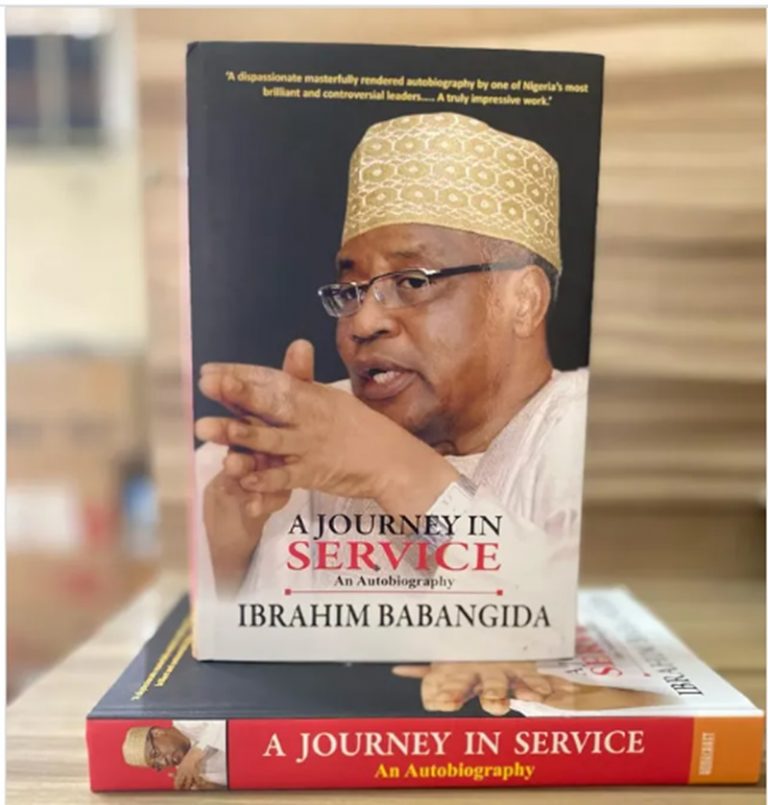
Former Nigeria’s Military Head of State, General Ibrahim Badamosi Babangida (IBB), has challenged the long-standing narrative that the 1966 coup was an “Igbo coup,” arguing that its leader, Major Kaduna Nzeogwu, was more culturally aligned with the Hausa people than with the Igbo ethnic group.
In his newly released memoir, ‘A Journey in Service’, Babangida rejected the notion that the coup was an orchestrated plan by Igbo officers to dominate Nigeria. He emphasized that Nzeogwu, the man at the center of the coup, was raised in Kaduna, spoke fluent Hausa, and was more assimilated into Northern culture than Igbo traditions.
“For instance, the head of the plotters, Major Kaduna Nzeogwu, was only Igbo in name. Born and raised in Kaduna, his immigrant parents were from Okpanam in today’s Delta State, which, in 1966, was in the old mid-western region.
Register for Tekedia Mini-MBA edition 20 (June 8 – Sept 5, 2026).
Register for Tekedia AI in Business Masterclass.
Join Tekedia Capital Syndicate and co-invest in great global startups.
Register for Tekedia AI Lab.
“Nzeogwu spoke fluent Hausa and was as ‘Hausa’ as any! He and his original team probably thought, even if naively, that they could turn things around for the better in the country,” he said.
Babangida’s remarks have reignited conversations on Britain’s role in the post-coup crisis, particularly its influence in labeling the January 1966 coup as an “Igbo coup.” Many historians and commentators say that this was part of British propaganda, widely amplified by the BBC, to justify the British government’s role in the horrific war that followed, which led to the deaths of approximately three million Igbos.
The Coup and Britain’s Alleged Role in Fanning Ethnic Hatred
While previous books, such as “Why We Struck” by Major Adewale Ademoyega, one of the coup plotters, and firsthand accounts of the Nigerian Civil War have upheld Babangida’s story, his version is believed to carry significant weight due to his position as a former military president. His comments have now refocused attention on how the British government, through its control of narratives via the BBC, played a role in escalating ethnic divisions in Nigeria.

Many have long argued that the “Igbo coup” label was a deliberate distortion of events, aimed at, among other things, absolving British colonial officers of any responsibility in the deepening political crisis. The coup, initially driven by dissatisfaction with political corruption, quickly became a tool for ethnic scapegoating, with the British-backed Nigerian leadership presenting it as a calculated attempt by Igbo officers to seize power.
Babangida’s account contradicts this widely held belief, noting that the coup was not just an Igbo-led movement. He pointed out that several non-Igbo officers also played significant roles. He further revealed that another officer of Igbo extraction, Major John Obienu, actually helped in crushing the coup, contradicting the claim that all Igbo officers supported the uprising.
“It should also be remembered that some non-Igbo officers, like Major Adewale Ademoyega, Captain Ganiyu Adeleke, Lts Pola Oyewole and Olafimihan, took part in the failed coup. Another officer of Igbo extraction, Major John Obienu, crushed the coup,” he said.

He also cited the killing of Lt-Col. Arthur Chinyelu Unegbe, an Igbo officer, by his own “brother,” Major Chris Anuforo, as further proof that the coup was not entirely an ethnic conspiracy.
“For instance, my erstwhile Commander at the Reconnaissance Squadron in Kaduna, Lt-Col. Arthur Chinyelu Unegbe, was brutally gunned down by his own ‘brother’, Major Chris Anuforo, in the presence of his pregnant wife, at his 7 Point Road residence in Apapa, for merely being a threat to the revolution.”
A Call for National Apology to the Igbos
Since Babangida’s comments, many Nigerians have taken to social media and public forums to demand that the federal government issue a formal apology to the Igbo people for decades of ethnic hatred and marginalization based on false historical narratives. Some have also urged Britain to acknowledge its role in fueling the war and the atrocities committed against the Igbo population.
“The entire country should be apologizing to the Igbos after this #IBBPage39 revelation,” a social media commenter named Frank said. “Although some of us in the Middle Belt knew the truth about the coup and the sentiments behind why it was tagged “Igbo coup”, most people in the core North and SW genuinely believed this lie and this unconsciously fueled more Igbophobia and hate.”
It is now being widely believed that the “Igbo coup” narrative was a convenient excuse for the ethnic massacres that followed, leading to the 1967-1970 Nigerian Civil War. The war is now seen as partly, a direct consequence of the deep divisions orchestrated by British-backed propaganda, which sought to maintain control over Nigeria’s post-independence affairs.
Ethnic Hatred and the Lingering Consequences of the 1966 Coup
Even more than five decades after the war, Nigeria has yet to fully recover from the ethnic divisions sown by the misrepresentation of the 1966 coup. Babangida’s revelation underscores how the original intent of the coup was twisted into an ethnic conflict, leading to decades of mistrust between different groups in Nigeria.
Many analysts believe that Nigeria’s continued struggles with ethnic tensions, political marginalization of the Igbo, and deep-seated tribal animosities are directly linked to the propaganda narratives that followed the coup. Babangida himself admitted that while the coup’s initial intent may have been patriotic, it was later hijacked by those with ethnic and political agendas.
“From that moment, the putsch was infiltrated by ‘outsiders’ to its supposed original intention, and it took on an unmistakably ethnic coloration, compounded by the fact that there were no related coup activities in the Eastern region,” he said.
With Babangida’s latest account, Nigeria is now faced with the challenge of revisiting its history and confronting the uncomfortable truths about how foreign influence and internal propaganda shaped the country’s trajectory. However, it is not certain whether this will lead to a formal apology to the Igbos or efforts to reconcile and unite the country.