

In today’s contemporary media space, the voices of political, business, and social influencers help shape how Nigerians see themselves and their nation. Their posts, tweets, and statements often carry more weight than formal speeches, acting as signposts for public values, fears, and aspirations.
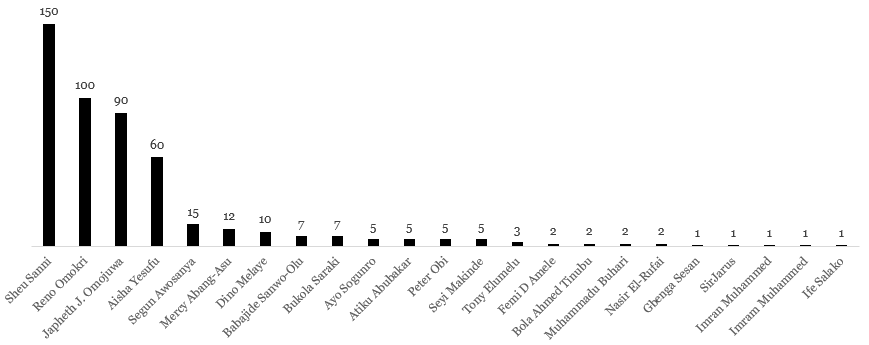
A recent collection of messages posted on Facebook, Twitter, and LinkedIn by Nigerian influencers (see Exhibit 1) between April 23 and July 6, 2025 paints a compelling picture of a country in reflection, resistance, and redefinition. Whether addressing politics, religion, identity, or development, these voices are doing more than reacting. They are actively shaping the national conversation.
Exhibit 1: Selected influencers and number of messages analysed
Register for Tekedia Mini-MBA edition 20 (June 8 – Sept 5, 2026).
Register for Tekedia AI in Business Masterclass.
Join Tekedia Capital Syndicate and co-invest in great global startups.
Register for Tekedia AI Lab.
One of the strongest currents in these messages is politics and democracy. With rising political defections, influencers like former Senate President Bukola Saraki voiced concern over the state of party loyalty and democratic integrity. He argued that the People’s Democratic Party (PDP) is better off with “fewer members who are loyal, sincere, determined, and committed,” rather than those who shift allegiance opportunistically. Similarly, one of the influencers reminded Nigerians that Peter Obi won over 6 million votes in 2023 despite lacking governor support, suggesting that real democratic momentum comes from citizens, not political elites. These interventions highlight growing frustration with transactional politics and a desire for deeper political accountability.
Moral leadership also emerged as a major theme, especially following the death of Pope Francis. Influencers from different sectors offered rich tributes that revealed the Pope’s symbolic power in Nigeria’s moral landscape. President Tinubu called him a “humble servant of God” and “tireless champion of the poor,” while Peter Obi recalled their three personal meetings and praised him as a voice for justice and human dignity. These tributes suggest that many Nigerians are looking beyond their borders for moral clarity, and are eager for leaders, religious or political, who embody compassion, courage, and service.
Beyond politics and religion, influencers are also reflecting deeply on social identity and public behaviour, especially in the digital space. One widely shared post declared, “I don’t simply post, I launch ideas with precision.” This sentiment reflects a growing desire among influencers to be seen as thinkers and change-makers rather than mere entertainers. Others pushed back against online toxicity, warning that “social media and insults is like 5 and 6” in Nigeria today. These voices speak to a broader struggle over how Nigerians relate to one another in public, and the damage that unchecked hostility, trolling, and tribalism can cause.

Cultural pride and heritage were also central to many influencers’ messages. Lagos State Governor Babajide Sanwo-Olu highlighted the importance of the Fanti Carnival, saying it reaffirmed his belief in the role of heritage in shaping “a confident, creative, and united Lagos.” By celebrating indigenous festivals and historical communities like Isale-Eko, Campos, and Olowogbowo, leaders are reinforcing cultural identity as a counterbalance to global pressures and urban erasure.
At the same time, influencers are not shying away from harsh truths about Nigeria’s security and inequality. One commentator noted how lands belonging to historic public schools in Kaduna—built by colonialists or leaders like Ahmadu Bello—have been sold off for private mansions and shopping malls. In another tragic example, Sahara Reporters shared the story of Easter celebrants in Gombe who were killed by a truck in what was suspected to be a terrorist act. These events triggered emotional reactions, with influencers urging better governance and stronger community responsibility.
Despite these challenges, there is a thread of hope and active citizenship woven through many of the messages. One of the most uplifting moments came from the global celebration of chess champion Tunde Onakoya, who broke a Guinness World Record. Influencers like Sanwo-Olu used the occasion to praise perseverance and youth excellence. In the same spirit, Peter Obi made donations to a Catholic orphanage and an Anglican hospital, reinforcing the idea that leadership must be rooted in human service, not just public image.

What do all these voices and messages amount to? They reflect a Nigeria that is in deep search of itself. They show a people who are tired of political gimmicks, yearning for moral leadership, proud of their roots, and eager for a society where kindness, creativity, and justice can thrive.
The power of these messages lies not just in their content but in their collective direction. They are building a public consciousness that challenges both silence and cynicism. When influencers take a stand, share their grief, or celebrate progress, they are not just reacting. They are writing the story of Nigeria’s future.
Editor’s Note: This article is a product of Infoprations’ Communicative Strategies of Nigerian Influencers Project, 2025. The team includes Abdulazeez Sikiru Zikirullah, Moshood Sodiq Opeyemi, Bello Opeyemi Zakariyha, and Oni Oluwaseun.