

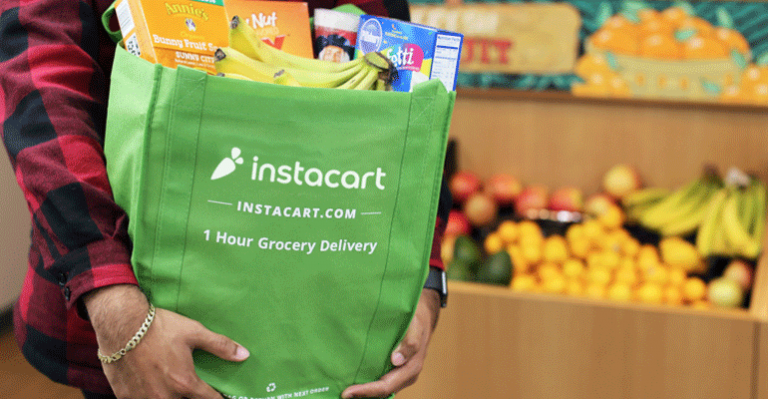
Instacart’s “beat-and-raise” quarter — its strongest GTV growth in three years — helped calm fears that Amazon, Uber Eats, and DoorDash are eroding its competitive moat.
Shares of Instacart surged more than 7% after the company posted stronger-than-expected fourth-quarter results and issued an optimistic outlook, easing concerns that intensifying competition in grocery delivery could undermine its position.
During an earnings call, Chief Executive Chris Rogers pushed back on mounting skepticism around the company’s durability in a crowded field.
“There is definitely a market for us here and we feel good about our points of differentiation,” Rogers said, adding that Instacart monitors competitive threats “extremely closely.” He described concerns about competitive encroachment as “overblown.”
Register for Tekedia Mini-MBA edition 20 (June 8 – Sept 5, 2026).
Register for Tekedia AI in Business Masterclass.
Join Tekedia Capital Syndicate and co-invest in great global startups.
Register for Tekedia AI Lab.
Responding from Wall Street, Bernstein analysts characterized the results as a “solid rebuttal” to competitive and AI-related worries. Analysts at Barclays called it a rare “clean beat-and-raise” in the current internet earnings cycle, noting that Instacart stood out against a backdrop of mixed tech earnings.
Instacart reported 14% growth in gross transaction value (GTV), its strongest quarterly increase in three years. Orders reached 89.5 million, topping a StreetAccount estimate of 87.8 million, indicating continued consumer engagement even as rivals scale their own grocery offerings.
The company projected first-quarter GTV between $10.13 billion and $10.28 billion, above the $9.97 billion estimate from StreetAccount. Adjusted EBITDA is expected to land between $280 million and $290 million, ahead of the $277 million forecast.

The guidance suggests not only sustained demand but also improving operating leverage. Investors have closely watched whether Instacart can balance growth investments with profitability, particularly in a category known for thin margins and high fulfillment costs.
Defending the Moat in a Crowded Field
Instacart operates a marketplace model that partners with grocers rather than owning inventory. This asset-light structure has allowed it to scale nationally without the fixed costs associated with warehouse-based or vertically integrated grocery models.
Still, the competitive environment has intensified. Amazon continues to expand its grocery logistics and same-day delivery footprint, leveraging its Prime ecosystem and physical retail presence. Uber Eats and DoorDash have aggressively integrated grocery into their food delivery apps, using existing courier networks to increase order frequency and cross-sell categories.

The key question for investors has been whether Instacart’s differentiation — retailer partnerships, fulfillment expertise, and a growing advertising business — can offset the scale advantages of these rivals.
Retail media has become central to that argument. Instacart’s advertising platform enables consumer packaged goods brands to promote products within search results and category pages, creating a higher-margin revenue stream that is less dependent on delivery economics alone. As brands shift more ad dollars toward commerce platforms that provide direct purchase data, Instacart’s first-party transaction data becomes strategically valuable.
AI as Both Threat and Opportunity
Artificial intelligence has emerged as another focal point. Investors have weighed whether generative AI tools embedded in search or digital assistants could disintermediate marketplace platforms by enabling consumers to shop directly across retailers.
Instacart is responding by embedding AI into its own ecosystem. The company has introduced AI-driven search enhancements, personalization tools, and retailer analytics capabilities designed to improve product discovery, basket size, and conversion rates.
Management’s commentary suggests that AI is being framed internally as an operational efficiency lever and a customer acquisition tool rather than a structural threat.
Structural Trends in Online Grocery
Online grocery penetration remains lower than other e-commerce categories, partly due to logistics complexity and perishability concerns. However, consumer habits formed during the pandemic have continued to support digital grocery ordering, particularly for convenience-driven and repeat purchases.
Instacart’s latest results indicate that demand has stabilized at levels sufficient to drive double-digit GTV growth. If sustained, that trajectory could signal that online grocery is entering a more mature but steady expansion phase, rather than reverting to pre-pandemic norms.
At the same time, profitability discipline has become more central. Investors are rewarding companies that can demonstrate both growth and margin expansion — a combination that has been scarce across consumer internet names in the current earnings cycle.
The stock’s rally reflects renewed confidence that Instacart can defend its share in a strategically important segment of digital commerce. Grocery spending is frequent, habitual, and resilient relative to discretionary categories, making it attractive for platforms seeking stable transaction volume.
The quarter does not eliminate competitive risks. Larger rivals retain deeper capital resources and broader ecosystems. However, the results suggest that Instacart’s marketplace model, advertising flywheel and technology investments are delivering measurable performance gains.
Overall, investors appear persuaded that the company’s operational execution is outpacing the threats. The “beat-and-raise” quarter provides tangible evidence that Instacart’s moat — long debated on Wall Street — remains intact, at least in the near term.