


The news cycle around banditry now forms a living archive of situational awareness. Each headline, update, and community report contains data points about violence patterns, institutional weaknesses, and public sentiment. Unlike classified intelligence systems that rely on internal reports, media intelligence is built from public observation and institutional discourse. It reveals how incidents are perceived, how state agencies react, and how communities adapt. In this way, Nigerian media function as the connective tissue between security events and public understanding. Their framing and frequency of reporting indirectly shape resource allocation, humanitarian interventions, and policy priorities.
The analysis of coverage between April and July 2025 shows that the media systematically document bandit attacks, government responses, and community resistance. These recurring narratives offer analysts and policymakers a continuous map of insecurity, one that extends beyond formal intelligence channels.
How Media Types Shape the Flow of Intelligence
Each media type (print, broadcast, and online) plays a distinct role in producing actionable intelligence. Print and online newspapers such as Daily Trust, Business Day, and Blueprint provide institutional and policy-oriented intelligence. They report on governance failures, weak security capacity, and economic losses arising from banditry. For policymakers, these stories serve as barometers of political will and public accountability. When newspapers repeatedly highlight poor coordination or inadequate funding for security operations, they offer indirect signals of systemic breakdowns that need strategic correction.
Register for Tekedia Mini-MBA edition 20 (June 8 – Sept 5, 2026).
Register for Tekedia AI in Business Masterclass.
Join Tekedia Capital Syndicate and co-invest in great global startups.
Register for Tekedia AI Lab.
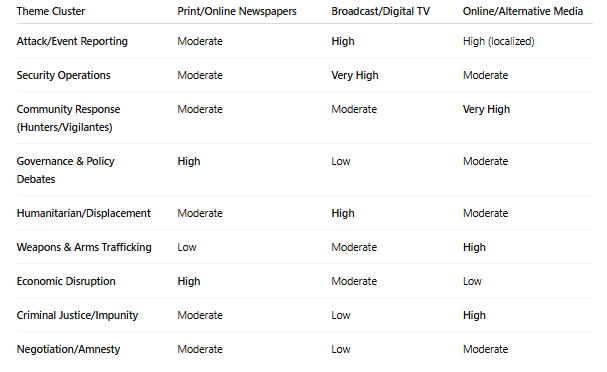
Broadcast and digital television, represented by Channels TV, Arise News, and others, act as the real-time sensors of Nigeria’s security ecosystem. They document incidents of attacks, military raids, and humanitarian crises almost as they unfold. This immediacy gives them high value as situational intelligence sources. Security analysts can detect geographical hotspots and tactical shifts from such reporting long before official figures are published.
Online and alternative platforms, including blogs and citizen-reporting sites, complement the system by covering community-level realities. Their reports on vigilante groups, displaced persons, and illicit trade networks highlight aspects of banditry that mainstream outlets often miss. This digital ecosystem extends the intelligence perimeter by giving visibility to micro-incidents and informal actors that shape the security terrain.
From News to Intelligence: What Stakeholders Learn
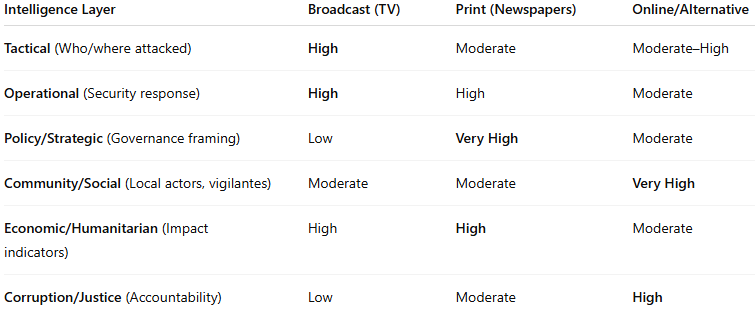
When viewed collectively, Nigerian media outlets form a distributed intelligence network. Print media offer strategic insights into governance and policy patterns, television delivers operational updates, and online channels reveal local dynamics.

For security agencies, this layered reporting provides an open-source complement to field intelligence. The repetition of attack locations across different outlets helps identify emerging clusters. For policymakers, the narratives highlight public dissatisfaction and expose the policy gaps that drive insecurity. Humanitarian organizations rely on displacement and casualty reports to plan relief operations, while researchers and civic groups use media discourse to map power relations and community resilience.
This ecosystem is not without limitations. Information gaps, sensationalism, and political filtering can distort reality. Yet, even biased reporting has analytical value, as it exposes the framing strategies that shape national conversations on insecurity. The diversity of sources allows triangulation and verification, ensuring that decision-makers can extract credible intelligence from the public information environment.
By learning to interpret media data critically, stakeholders can anticipate conflict escalation, assess state responses, and design interventions that reflect both ground realities and public perceptions. In other words, the media not only mirror insecurity but also enable its management through knowledge circulation.

Building a Smarter Intelligence Culture through Media
Treating Nigerian media as an intelligence conduit requires a shift in how stakeholders engage with information. Instead of dismissing news reports as reactive storytelling, they should be integrated into early warning systems and strategic communication plans. The value lies not only in single headlines but in patterns—the recurrence of attacks, the geography of insecurity, and the tone of policy commentary.
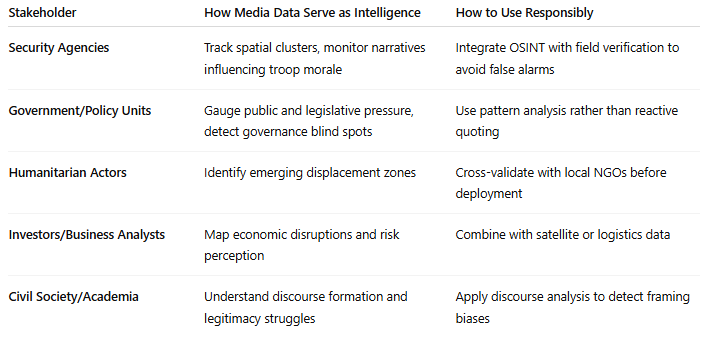
Government communication offices can establish data pipelines that track and analyze media coverage of security incidents. Security agencies can complement this by training analysts to use open-source media data for spatial mapping and community profiling. Humanitarian groups can also develop media dashboards to monitor emerging needs in conflict-affected regions.
Ultimately, Nigeria’s fragmented media system offers a comprehensive and democratic form of intelligence. It distributes visibility across different levels of society and ensures that no single narrative monopolizes the understanding of insecurity. By embracing this potential, Nigeria can transform its media landscape into a structured intelligence resource for managing banditry and strengthening national security.