

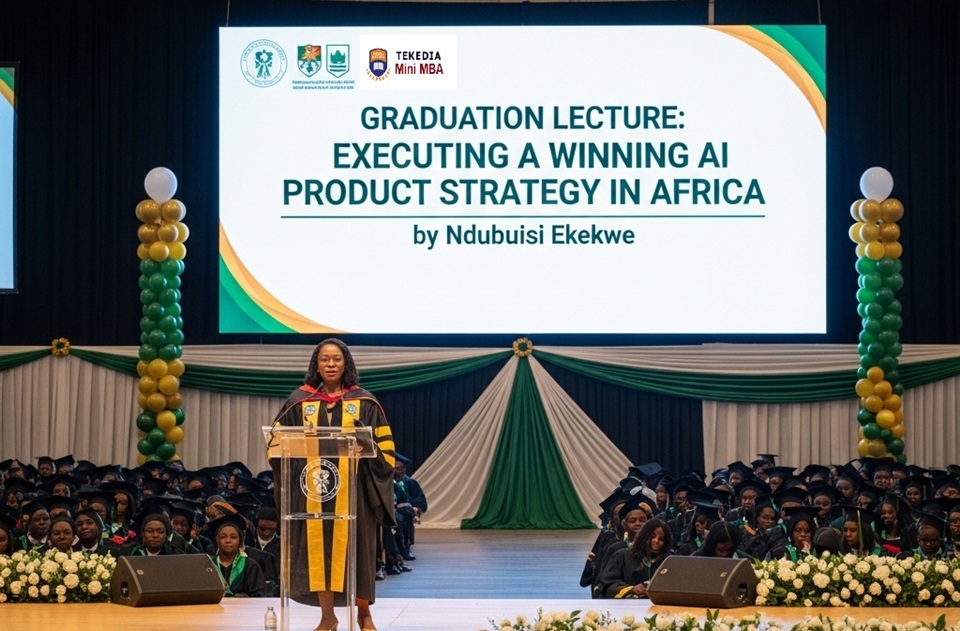
It is Tekedia Mini-MBA Graduation Day, and my Graduation Lecture is titled “Executing A Winning AI Product Strategy in Africa”. The rapid evolution of artificial intelligence (A) has ushered in a new era of product development that operates under a distinct and unforgiving set of rules which do not align with the conventional SaaS business model where digital products benefit from near-zero marginal costs and network effects.
At the heart of this new paradigm lies the brutal economic reality of AI. Unlike traditional software, AI products are built on a foundation of real marginal costs driven by token usage and GPU compute, like what you see in physical products. Simply, the SaaS’ near-zero marginal cost as you grow is replaced by an unpredictable and potentially exorbitant cost of inference. Every prompt is a cost, even as you scale!
My Co-learners, this necessitates an upfront, strategic approach to unit economics and scalable advantages, where profitability must be meticulously designed into the product from its inception. This economic model also dictates a more sophisticated approach to pricing. The Graduation lecture will examine four key pricing frameworks. These are not just pricing options but strategic levers for survival and competitive differentiation.
Register for Tekedia Mini-MBA edition 20 (June 8 – Sept 5, 2026).
Register for Tekedia AI in Business Masterclass.
Join Tekedia Capital Syndicate and co-invest in great global startups.
Register for Tekedia AI Lab.
- Usage-Based: Users pay per action (e.g., per token, per image generated). This aligns cost with value but can lead to unpredictable expenses for users.
- Outcome-Based: Users pay only for a successful result (e.g., a perfect output). This is a strong value proposition but can be difficult to implement and measure.
- Value-Based: Users pay based on the perceived value they receive. This is highly profitable but requires deep understanding of customer needs.
- Subscription with Soft Cap: A hybrid model where users pay a flat fee for a certain level of usage, with additional charges for going over the limit. This provides cost predictability for both the user and the company.
More so, beyond economics, the defining challenge in the AI space is the illusion of moat, something we have discussed extensively in this program. I have provided cases of how ancestral communities were built with the clan holding the kinship living in strategic locations (hills, etc).
In the past, proprietary technology was the key to a defensible position. However, with powerful foundation models now widely accessible, the AI itself is rapidly becoming a commodity. Yes, the true competitive advantage, or moat, is not the AI model but the system built around it.

This AI redesign demands visionaries who can fluidly bridge the worlds of product strategy, AI economics, and technical fluency. Yes, people who can architect a defensible product system, understand the intricate financial models of AI, and possess a foundational understanding of the technology’s capabilities and limitations. With that, whether it is Oriendu Market Ovim or Wall Street trading desk, AI can help companies to deliver alpha.


Sat, Sept 6 | 7pm – 8.30pm WAT | It’s Graduation Day – Executing A Winning AI Product Strategy in Africa – Ndubuisi Ekekwe | Zoom Link
---
Connect via my
LinkedIn |
Facebook |
X |
TikTok |
Instagram |
YouTube