

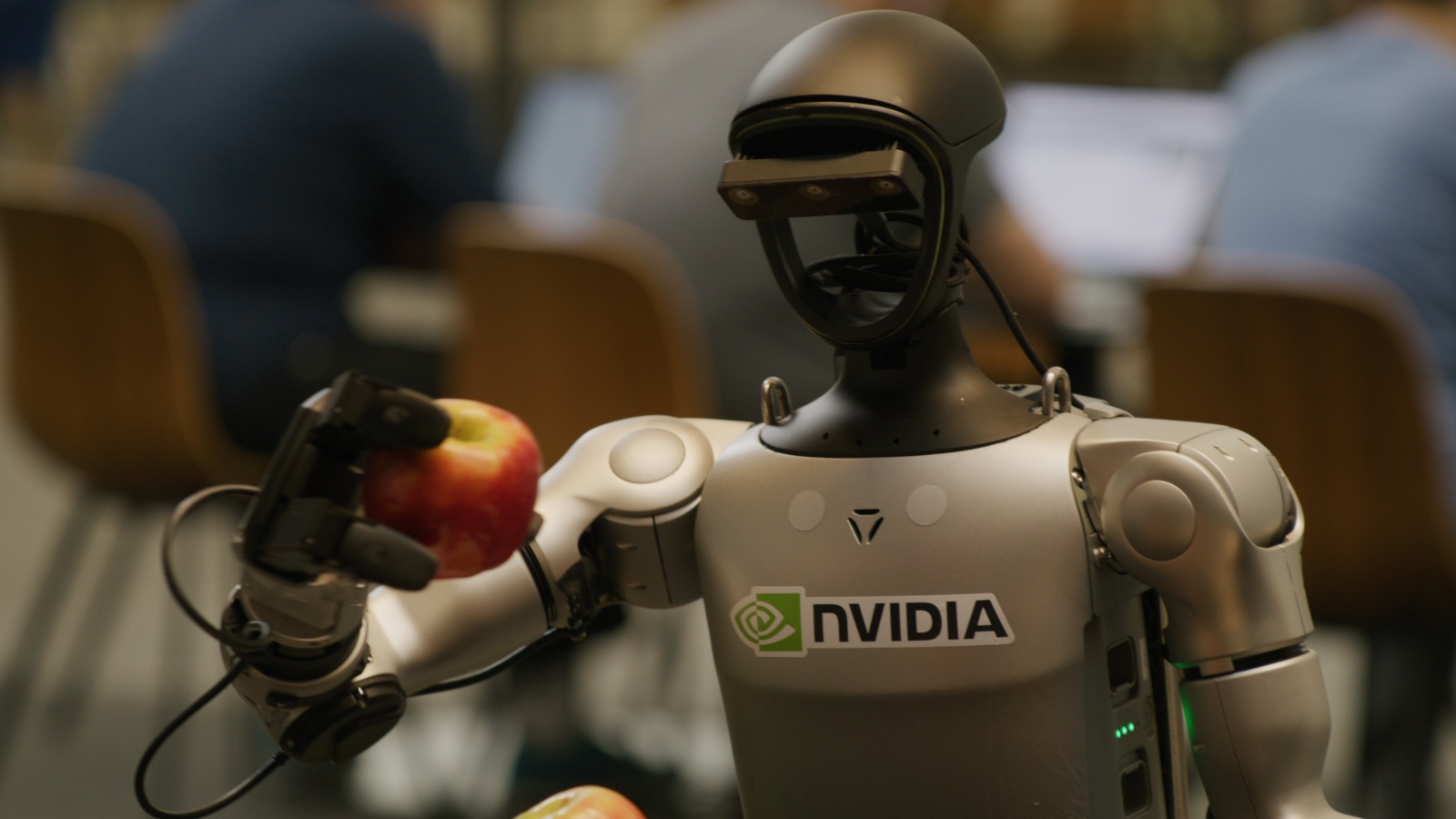
Nvidia CEO Jensen Huang arrived in South Korea on Friday bearing a message that the next major chapter of the artificial intelligence revolution may be written in robotics, and South Korea is uniquely positioned to lead it.
Making his second visit to the country in seven months, Huang used the trip to underscore the strategic role South Korea plays in Nvidia’s global AI ecosystem. While the country has become indispensable to Nvidia’s supply chain through its dominance in advanced memory chips, Huang is indicating that the relationship is evolving into something broader, encompassing robotics, AI factories, industrial automation, and physical AI systems.
“Because Korea is a manufacturing center of the world, we can apply the robotics technology, the physical AI technology that we invent here for the industry,” Huang told reporters after arriving at Gimpo International Airport from Taiwan.
Register for the next Tekedia Mini-MBA.
Register for Tekedia AI in Business Masterclass.
Join Tekedia Capital Syndicate and co-invest in great global startups.
“So we have a great opportunity to partner with the semiconductor companies here as well.”
Having established itself as the dominant supplier of AI chips powering data centers worldwide, Nvidia seems focused on what comes next: embedding AI into physical systems ranging from factories and warehouses to autonomous machines and humanoid robots.
For South Korea, a country whose industrial strength spans automobiles, shipbuilding, electronics, and semiconductors, that transition presents a potentially enormous opportunity.

Huang’s schedule reflects the breadth of Nvidia’s ambitions, meeting with executives from Hyundai Motor, LG, SK Hynix, Samsung Electronics, and Naver during the visit.
Asked whether he had brought any gifts to South Korea, Huang responded with characteristic flair.
“Did I bring any gifts for Korea? I brought a lot of business for Korea,” he said. “I have some surprises.”

Nvidia’s dependence on South Korea has grown substantially as demand for AI infrastructure accelerates. Samsung Electronics and SK Hynix collectively produce roughly 70% of the high-bandwidth memory (HBM) chips used in advanced AI processors, making them critical partners in Nvidia’s growth.
At a dinner in Seoul with LG Group Chairman Koo Kwang-mo, SK Group Chairman Chey Tae-won, and Naver founder Lee Hae-jin, Huang emphasized the mutual benefits of the AI boom.
“We are all booming,” he told attendees.
“My friends here had a very good year, but this is just the beginning.”
He added that Nvidia’s next-generation systems would require substantial quantities of memory chips, reinforcing expectations that demand for Korean semiconductor products will remain strong for years.
That demand is already reshaping South Korea’s economy. The country’s semiconductor exports surged nearly 170% in May, reaching a record level and helping drive the strongest export growth seen in decades. Investors have rewarded the sector accordingly, with Samsung Electronics and SK Hynix each surpassing the $1 trillion market-capitalization threshold amid the AI-driven rally.
However, the significance of Huang’s visit extends beyond memory chips. At Computex in Taiwan earlier this week, Nvidia highlighted robotics as a central pillar of its future strategy. The company sees physical AI, machines capable of perceiving, reasoning, and acting in real-world environments, as the next major computing platform after cloud AI.
South Korea’s advanced manufacturing infrastructure makes it an attractive proving ground for such technologies. Analysts have noted that factories, logistics networks, automotive production facilities, and industrial automation systems provide ideal environments for deploying AI-powered robots at scale. As companies seek to improve productivity amid labor shortages and rising costs, demand for intelligent machines is expected to grow rapidly.
Thus, Nvidia is expanding its footprint in South Korea beyond procurement and partnerships. Huang confirmed the company has begun recruiting for a research and development center in Seoul, signaling a longer-term commitment to the country.
He also addressed concerns about memory supply constraints, noting that Samsung, SK Hynix, and Micron Technology are all producing HBM4 memory for Nvidia’s upcoming Vera Rubin AI platform.
“All three vendors are in production, and they are all racing to support Vera Rubin,” Huang said.
“Of course memory is constrained and so we have to be smart about using it in all of our systems.”
The trip is believed to be a major mark of the growing ties between Nvidia and South Korea. As the AI industry evolves from training models in data centers to deploying intelligence throughout the physical economy, the relationship between the world’s leading AI chip company and one of the world’s most advanced manufacturing nations appears set to deepen further.