

As SpaceX prepares for what could become one of the largest public offerings in history, Elon Musk is personally stepping in to sell one of the company’s most ambitious long-term bets: building a semiconductor manufacturing ecosystem capable of supporting its sprawling artificial intelligence ambitions.
According to internal communications seen by Business Insider, Musk will participate in a virtual fireside chat with ASML Chief Executive Officer Christophe Fouquet during the Dutch chip-equipment giant’s annual technology conference next week. The event will take place just days before SpaceX is expected to make its public market debut.
While investors have traditionally viewed SpaceX through the lens of rockets, satellites, and space transportation, the company’s IPO narrative is centered on artificial intelligence infrastructure and the enormous computing requirements that Musk believes will define the next technological era.
Register for the next Tekedia Mini-MBA.
Register for Tekedia AI in Business Masterclass.
Join Tekedia Capital Syndicate and co-invest in great global startups.
Internal event materials indicate Musk will discuss his vision for AI, robotics, space technology, and semiconductor manufacturing, including the company’s highly publicized Terafab initiative. The project has emerged as one of the most closely watched components of SpaceX’s long-term growth strategy and is expected to feature prominently in investor discussions ahead of the offering.
Terafab is described as a collaboration involving SpaceX, Tesla, and Intel aimed at building a network of giant semiconductor manufacturing facilities capable of producing advanced AI chips at an unprecedented scale. The project is strategically important because much of SpaceX’s future revenue projections are tied not to launch services or satellite broadband, but to artificial intelligence.
According to recent IPO disclosures, the company is pursuing plans that envision the deployment of vast AI computing infrastructure, including orbital data centers that would require enormous quantities of advanced semiconductors.

That vision creates a challenge familiar to every major AI player today: securing enough chips.
As demand for AI accelerators continues to outpace supply globally, companies from OpenAI and Anthropic to Microsoft, Google, and Meta are spending hundreds of billions of dollars securing compute resources. For Musk, controlling semiconductor production could become a competitive advantage that reduces reliance on external suppliers and shields SpaceX from future chip shortages.
What Makes ASML Thick
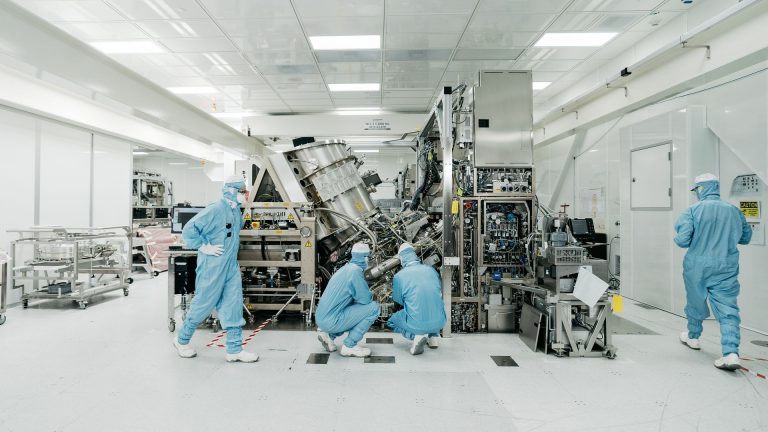
The involvement of ASML is particularly notable because the company occupies a unique position in the global chip industry. ASML is the world’s sole manufacturer of extreme ultraviolet (EUV) lithography systems, the highly sophisticated machines required to produce the most advanced semiconductors used in AI training and inference.

Without ASML’s technology, it is effectively impossible to manufacture leading-edge chips at scale.
That makes the Dutch company a critical bottleneck in the global semiconductor supply chain and an essential partner for any organization seeking to build advanced chip manufacturing capacity.
Fouquet recently acknowledged that he had discussed the Terafab concept with Musk, though he did not provide details. He also warned that the scale of AI infrastructure being proposed by companies such as SpaceX could place significant strain on semiconductor production capacity over the coming years.
The discussion comes as a growing number of technology companies race to secure every layer of the AI stack. Over the past year, major firms have moved aggressively beyond software and AI models into chips, power generation, networking equipment, and data center infrastructure.
Nvidia has invested billions of dollars in photonics companies to improve data-transfer efficiency. Anthropic recently secured one of the largest private credit transactions ever assembled to finance AI infrastructure. SoftBank has announced tens of billions of dollars in AI data center investments across Europe. Meanwhile, governments from the United States to China are increasingly treating computing capacity as a strategic national asset.
Against that backdrop, SpaceX’s Terafab initiative represents an attempt to vertically integrate AI infrastructure on a scale few companies have contemplated.
However, building semiconductor fabrication facilities is among the most capital-intensive industrial undertakings in the world. Leading-edge fabs routinely cost tens of billions of dollars and require years of construction, specialized talent, and highly complex supply chains.
Even established industry leaders such as Intel, Taiwan Semiconductor Manufacturing Company, and Samsung Electronics have struggled with escalating costs and manufacturing challenges.
For SpaceX, investors will likely want answers about funding requirements, production timelines, technology partnerships, and whether projected demand for AI compute can justify such enormous investments.
Those questions have become relevant as some analysts warn that today’s AI infrastructure boom could eventually lead to overcapacity if enterprise adoption fails to keep pace with investment.