

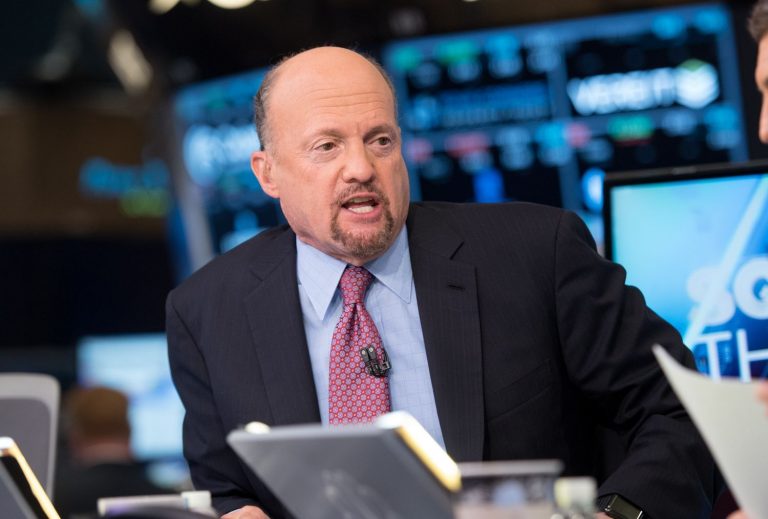
As Anthropic prepares to launch one of the largest technology initial public offerings in history, CNBC host Jim Cramer has questioned whether the artificial intelligence company’s rapid growth can support its proposed valuation of as much as $1.405 trillion.
The developer of Claude plans to price its shares on November 18 and begin trading the following day. In an updated filing submitted on Tuesday, Anthropic outlined plans to offer 825 million shares at between $70 and $78 each. At the upper end of the range, the offering would raise approximately $64.35 billion, valuing the company at up to $1.405 trillion on a fully diluted basis.
The proposed valuation places Anthropic among the world’s most highly valued technology companies, reflecting investor expectations that demand for generative AI and enterprise automation will continue expanding. However, Cramer said the company’s impressive revenue growth and improving profitability do not resolve several questions about the durability of its business model.
Register for the next Tekedia Mini-MBA.
Register for Tekedia AI in Business Masterclass.
Join Tekedia Capital Syndicate and co-invest in great global startups.
He identified three areas that investors should examine before deciding whether to buy into the IPO: the effect of price reductions on revenue, the sources of its next major phase of growth, and whether its commitment to AI safety could become a commercial constraint.
Anthropic has recently reduced prices for several Claude models, prompting questions about whether the company is responding to growing competition and pressure from customers seeking cheaper AI services.
Lower prices could make Claude more attractive to businesses and encourage wider adoption, potentially increasing usage enough to compensate for reduced revenue per unit of computing. The company could also generate additional income by charging customers for faster processing and other premium services.
Cramer said he was encouraged that Anthropic maintained strong revenue growth in October despite the price reductions. However, he wants to establish whether that momentum can continue as the company adjusts its pricing and competes for enterprise spending.
The issue has caught analysts’ attention because Anthropic’s valuation depends not only on attracting more users but also on converting growing usage into revenue and profits. If price reductions stimulate demand, they could strengthen its competitive position. If they mainly reduce what customers pay without generating sufficient additional usage, they could put pressure on margins.
Claude Code May Not Be Enough to Sustain Expansion
Cramer also questioned where Anthropic would find its next $100 billion in revenue, arguing that the company’s current growth drivers may not be sufficient to support its longer-term financial commitments.
Much of Anthropic’s expansion has been driven by Claude Code, its AI coding agent, which has gained traction among enterprise customers. The product has helped establish the company as a major provider of AI tools for software development.
However, Cramer questioned whether demand for Claude Code alone could sustain the growth required to cover Anthropic’s roughly $900 billion in future computing commitments.
Those commitments make the company’s expansion particularly capital-intensive. Anthropic must secure enough computing capacity to develop and operate increasingly powerful models while generating sufficient commercial returns from the infrastructure it uses.
The company is attempting to broaden its revenue base through Claude Cowork, industry-specific AI tools and products designed to compete with Microsoft Office. Cramer also identified cybersecurity, life sciences and robotics as potential areas of expansion.
These markets could give Anthropic access to customers beyond software developers and companies already using its coding products. They could also create additional opportunities to sell specialized AI services to businesses willing to pay for automation and productivity improvements.
But the commercial potential of these markets remains unproven revenue. Anthropic will need to prove that its newer products can attract sustained demand and generate meaningful contributions to its overall business.
AI Safety Could Become a Competitive Advantage or a Constraint
The third uncertainty concerns Anthropic’s commitment to AI safety, which has been key to its corporate identity and product development philosophy.
Chief Executive Dario Amodei has repeatedly warned about the potential dangers of powerful AI systems. The company has built its reputation around developing advanced models while attempting to manage the risks associated with their deployment.
Cramer questioned whether this approach could eventually limit growth if safety considerations lead Anthropic to delay or restrict the release of more advanced models.
In a market where technology companies are competing to develop more capable systems, slower product releases could create opportunities for rivals to attract customers with newer capabilities.
However, the same safety commitments could become commercially valuable as businesses adopt AI agents capable of carrying out more complex tasks with limited human supervision. Companies deploying these systems face operational, legal, and security risks, making reliability and safeguards important considerations when choosing providers.
Therefore, Anthropic’s safety-focused positioning could help it win enterprise customers that are reluctant to deploy autonomous systems without adequate controls.
The commercial question is whether the company can maintain that positioning while releasing products quickly enough to compete and generate the revenue expected by investors.
Cramer has not endorsed buying Anthropic shares when they begin trading. He said he was still assessing the offering and its risks before reaching a final decision.
“For now, I’ll just tell you that I’m wary of doing so,” he said.
His caution points to a broader challenge facing investors in the AI sector. Rapid revenue growth and improving profitability can support ambitious valuations, but companies making enormous commitments to computing infrastructure must also demonstrate that demand, pricing power and new product markets can generate returns sufficient to justify the spending.
Anthropic’s IPO will test how much investors are willing to pay for that growth potential, particularly when the company’s long-term financial obligations and competitive position remain central to its investment case.