


Nigeria’s labour market in 2024 reveals a sobering reality. Public interest in jobs has grown steadily, reflected in rising search activity, but the actual creation of jobs has moved in the opposite direction. For a country with one of the fastest-growing youth populations in the world, this contrast between demand and supply is deeply concerning. It signals not only a strain on the economy but also an urgent challenge for policymakers, businesses, and society at large.
A Year of Early Promise and Rapid Decline
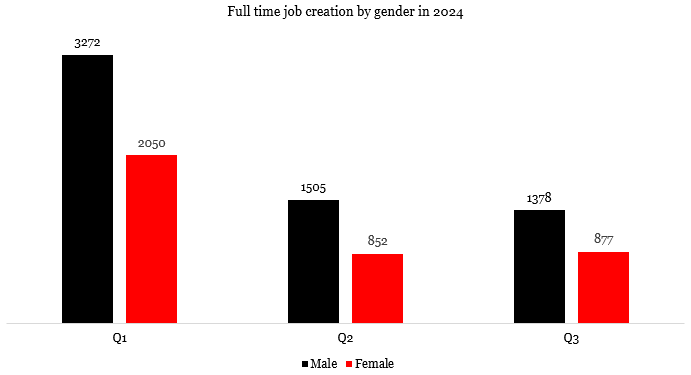
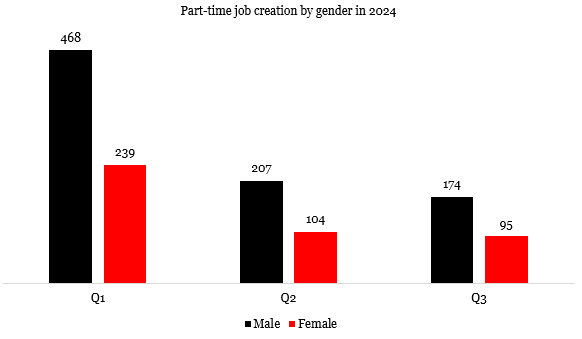
The year began on a hopeful note. In the first quarter, over 3,200 full-time jobs were created for men and just over 2,000 for women. Part-time jobs added another 700 roles across both genders. This surge suggested renewed confidence in the economy, perhaps linked to seasonal factors, fiscal spending, or early private sector expansion.
Unfortunately, this momentum quickly evaporated. By the second quarter, full-time opportunities for men had dropped by more than half to 1,505, while women’s positions fell to 852. Part-time employment followed the same path, slipping to 207 for men and 104 for women. The third quarter brought no recovery, with job creation continuing its downward slide. By then, barely 40% of the jobs created in the first quarter remained.
Register for Tekedia Mini-MBA edition 20 (June 8 – Sept 5, 2026).
Register for Tekedia AI in Business Masterclass.
Join Tekedia Capital Syndicate and co-invest in great global startups.
Register for Tekedia AI Lab.
This pattern reveals a fragile system where bursts of opportunity are not sustained. Without deeper reforms, investments, and consistent growth strategies, the Nigerian labor market risks repeating this cycle of early optimism followed by steep contraction.
Gendered Opportunities in a Shrinking Market
Across all quarters, men secured more opportunities than women, both in full-time and part-time roles. In the first quarter, the gender gap in full-time jobs was wide, with men gaining 1,222 more positions than women. By the third quarter, this gap had narrowed to just over 500. Part-time employment showed a similar trend, with the gap shrinking from 239 in the first quarter to 95 in the third.
At first glance, the narrowing gap might suggest progress toward equality. In reality, it reflects the fact that jobs declined sharply for both genders, leaving less room for disparity. Women are not gaining ground, but rather are falling at the same pace as men. This points to structural vulnerabilities, especially in sectors where women are concentrated, such as services and retail, which often bear the brunt of economic downturns.

A more deliberate effort is needed to improve women’s participation in the labour market. This could include targeted incentives for employers, programmes that build women’s skills in high-demand fields such as technology, and better access to financing for female entrepreneurs. Without such measures, gender inequality will persist even if headline numbers appear to show convergence.
Rising Job Searches, Falling Job Opportunities
Perhaps the most striking observation from 2024 is the growing mismatch between job seekers and available opportunities. Public search interest in jobs rose steadily throughout the year, from 933 in the first quarter to 1,081 in the third. This rise reflects the growing determination of Nigerians to find employment.
Yet as interest increased, actual job creation fell sharply. Thousands fewer jobs were available even as more people actively searched for work. This indicates that unemployment pressures were high, frustration among job seekers was intensified, and the risks of social and economic instability increased during the year.


For Nigeria to address this challenge, policymakers must act decisively. The first priority is to stabilize job creation by investing in industries that can absorb large numbers of workers, such as infrastructure, manufacturing, and energy. The second is to design deliberate measures that reduce gender disparities and expand women’s opportunities. Finally, integrating alternative data sources such as search trends into employment monitoring can give early warnings of distress and allow faster, more responsive policymaking.