

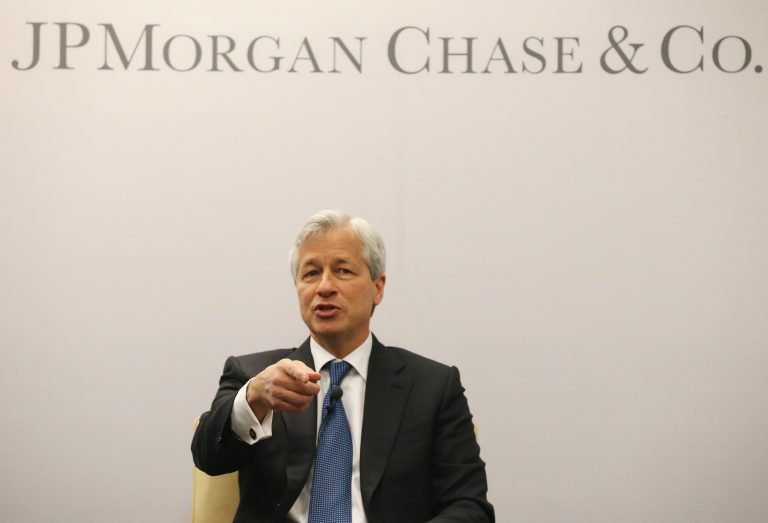
JPMorgan Chase CEO Jamie Dimon has escalated warnings over President Donald Trump’s proposal to impose a one-year cap of 10% on credit card interest rates, arguing that the policy could destabilize consumer credit markets and send shockwaves through the wider U.S. economy, far beyond the banking sector.
Speaking at the World Economic Forum in Davos, Dimon described the proposal as “an economic disaster,” stressing that the fallout would be felt most acutely by households, small businesses, and local governments rather than by large financial institutions. JPMorgan, he said, would survive such a move, but only by sharply shrinking its credit card operations.
“In the worst case, you would have to have a drastic reduction of the credit card business,” Dimon said, adding that the bank’s ability to absorb the shock should not be mistaken for evidence that the policy is viable.
Register for Tekedia Mini-MBA edition 20 (June 8 – Sept 5, 2026).
Register for Tekedia AI in Business Masterclass.
Join Tekedia Capital Syndicate and co-invest in great global startups.
Register for Tekedia AI Lab.
At the core of Dimon’s argument is the structure of the U.S. credit card market. Credit cards are unsecured loans, priced according to risk. Interest rates are higher because lenders must account for defaults, fraud, operational costs, and capital requirements. A hard cap of 10%, Dimon warned, would make it uneconomic to lend to large segments of the population, particularly borrowers with lower credit scores.
He estimated that as many as 80% of Americans could lose access to credit cards if such a cap were enforced. While that figure is not independently verified, it reflects a widely held concern among banks that price controls would force them to ration credit rather than extend cheaper credit more broadly.
Dimon’s critique extended beyond banking balance sheets to the mechanics of the consumer economy. Credit cards play a central role in smoothing household cash flow, supporting discretionary spending, and enabling short-term borrowing for emergencies.

If access were abruptly curtailed, he argued, the effects would ripple outward.
“The people crying most won’t be the credit card companies,” Dimon said.
Instead, he pointed to restaurants, retailers, travel companies, and service providers that depend on consumer spending. He also warned of downstream consequences for municipalities, noting that households under financial strain could miss utility payments and other basic obligations.

“People will miss their water payments,” he said.
To illustrate his point, Dimon jokingly suggested that lawmakers test the proposal by forcing banks in Vermont and Massachusetts to comply and then observe the outcome, a remark that drew laughter but underscored his belief that the impact would be immediate and visible.
The comments build on earlier warnings from JPMorgan’s leadership. During the bank’s fourth-quarter earnings call last week, its chief financial officer said price controls on card interest rates could make the business “no longer a good business,” reinforcing the view that lenders would respond by pulling back credit rather than absorbing losses.
More broadly, the debate highlights a recurring tension in U.S. financial policy: the trade-off between affordability and access. Supporters of the rate cap argue that credit card interest rates, which often exceed 20%, are punitive and contribute to household financial stress, especially for lower-income borrowers. Critics counter that caps ignore risk differentiation and could exclude precisely those consumers the policy is meant to help.
Historical precedents lend weight to that concern. Past experiments with interest rate ceilings, both in the U.S. and abroad, have often resulted in credit contraction, growth in informal lending, or tighter eligibility standards. Banks typically respond by reducing limits, raising fees elsewhere, or exiting higher-risk segments altogether.
Dimon was careful to strike a conciliatory tone toward the administration more broadly. Asked about Trump’s geopolitical moves, including on immigration and NATO, he described them as more qualitative issues whose outcomes would depend on implementation and intent. On credit cards, however, he said he felt compelled to speak out because of his deep familiarity with the issue and its real-world consequences.
“Whatever the president and Congress decide, we’ll deal with it,” Dimon said, adding that JPMorgan plans to release more detailed analysis on the likely economic effects of a rate cap.
He also emphasized that he shares the goal of improving affordability for consumers, but views blunt price controls as the wrong instrument.
Dimon’s intervention signals that the fight over credit card rates is shaping up to be a defining test of how far Washington is willing to intervene directly in consumer finance. From the banking industry’s perspective, the risk is not reduced profitability, but a sudden tightening of credit that could reverberate through everyday economic life across the United States.