

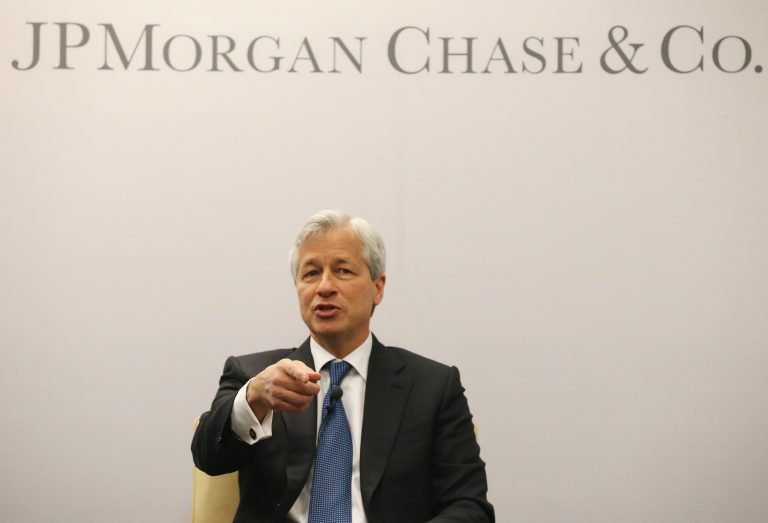
JPMorgan Chase Chief Executive Jamie Dimon has warned Britain’s new government against increasing taxes on banks, adding pressure on Finance Minister John Healey ahead of an Autumn Budget that could include a windfall levy on banks and oil companies.
Dimon met Healey at Downing Street on Wednesday and was also reported to have held talks with newly appointed Prime Minister Andy Burnham, as the government prepares to set out its fiscal plans on Oct. 28.
The meetings come as Burnham and Healey face a difficult balancing act. Britain is dealing with persistent inflation, elevated government borrowing costs and weak economic growth, while the new administration has also pledged to ease living costs, increase defense spending and transfer more political power to local authorities.
Register for the next Tekedia Mini-MBA.
Register for Tekedia AI in Business Masterclass.
Join Tekedia Capital Syndicate and co-invest in great global startups.
Those commitments leave the government searching for additional revenue and spending cuts while remaining within its fiscal rules. Banks, which have generated strong earnings in recent years, are increasingly being viewed by some unions and lawmakers as an attractive source of additional tax revenue.
For the banking industry, however, another tax increase could further raise the cost of operating in one of Europe’s most important financial centers.
British banks already face a substantially higher tax burden than most companies.

They pay the standard 25% corporation tax, alongside a 3% bank surcharge and a separate bank levy on balance sheets ranging from 0.05% to 0.1%. Banks also face broader business taxes, including National Insurance contributions on employee wages, sales taxes and business rates on commercial properties.
According to industry body UK Finance, the combined tax rate on banks’ U.K. operations was 46.4% in 2025.
The prospect of a further windfall tax has therefore triggered a coordinated response from the industry, which argues that policymakers risk prioritizing short-term revenue at the expense of longer-term investment and competitiveness.

David Postings, chief executive of UK Finance, wrote to Healey last month opposing a bank windfall tax. He warned that increasing taxes could “ultimately risk undermining the very tax base the government seeks to protect and grow” while damaging Britain’s international competitiveness.
Postings also highlighted the tax gap between London and competing financial centers including Frankfurt, Dublin and New York.
The argument has gained attention because financial services are one of the industries in which Britain retains a globally important competitive position. Higher taxes may not immediately cause banks to leave London, but they can influence decisions about where new operations, technology investment, senior functions and future capital are allocated.
Antony Jenkins, founder and chief executive of 10x Banking and former Barclays chief executive, told CNBC’s “Squawk Box Europe” that high taxes “act as a disincentive” to investment and growth.
He said financial services, technology, creative industries and higher education were among Britain’s strongest sectors and should be encouraged to expand because of their wider contribution to the economy.
“We’re a world leader in a number of industries: financial services, technologies, creative arts, higher education,” Jenkins said. “These are industries that we need to be supporting and encouraging to grow, to act as a dynamo for the rest of the economy, so obviously there’s a set of very difficult political choices to be made.”
Jenkins also cautioned against creating the perception that successful industries can be taxed without consequences.
“There are no free rides. If you put taxes on industries, that’s going to have a consequence,” he said.
The Political Appeal of Taxing Banks
The government’s dilemma is that the banking sector is also an obvious political target. British lenders have enjoyed bumper profits in recent years, helped in part by higher interest rates and stronger net interest income, the difference between what banks earn on assets such as loans and what they pay on deposits and other liabilities.
That has created a perception among unions and some lawmakers that banks benefited disproportionately from the higher-rate environment and should contribute more to public finances. A windfall tax can therefore be politically attractive because it allows the government to raise revenue from highly profitable companies without directly increasing taxes on households at a time when the cost of living remains a major concern.
But the economic effects are less straightforward.
Banks can respond to higher taxes through a combination of lower shareholder returns, reduced investment, changes to lending prices, lower deposit rates or the relocation of certain activities. The extent to which the burden falls on shareholders, customers or employees would depend on the design of the tax and competitive conditions in the market.
That creates a difficult calculation for Healey. A tax that generates substantial revenue in the short term could become less attractive if it reduces investment or weakens the profitability of the sector that generates billions of pounds in existing tax receipts.
The issue is especially sensitive for JPMorgan.
Dimon has repeatedly made clear that Britain’s tax treatment of banks is a concern for the U.S. lender as it expands its London operations. In May, he said JPMorgan could reconsider its planned 3 million-square-foot tower in London’s Canary Wharf financial district if a new government proved “hostile” toward banks.
Asked whether political instability could change the bank’s view of the project, Dimon said that if a new government was “hostile to the banks, then yes.”
In July, he again criticized Britain’s banking taxes during an appearance on “The Master Investor Podcast with Wilfred Frost,” saying he had “always thought [Britain’s taxes on banks] was wrong.”
“It may sound great, ‘tax the banks’, but it’s $5 billion that my shareholder’s paid on that extra tax,” Dimon said, arguing that such measures could produce adverse consequences.
His intervention ahead of the October budget gives the banking industry’s lobbying effort a particularly prominent voice. JPMorgan is one of the largest global financial institutions and has committed heavily to its London presence, making its investment decisions an important signal for other international banks.
For Burnham and Healey, the challenge is to raise enough revenue to fund their spending priorities without weakening the tax base itself.
Britain’s fiscal position leaves little room for error. Higher borrowing costs increase the cost of servicing government debt, while weak economic growth limits the revenue available from existing taxes. Defense spending adds another pressure at a time when the government is already struggling to reconcile its commitments with its fiscal rules.
That makes a bank windfall tax tempting. But it also makes the potential consequences more punitive.
Against this backdrop, analysts say the major issue facing the government is not simply how much additional tax it can extract from banks in the next budget, but whether the measure can raise meaningful revenue without discouraging investment, reducing London’s competitiveness or prompting banks to shift profitable activities elsewhere.
The banking industry is clearly betting that the answer is no. With Dimon now personally making the case to Britain’s new leadership, the pressure on Healey ahead of Oct. 28 is intensifying.