

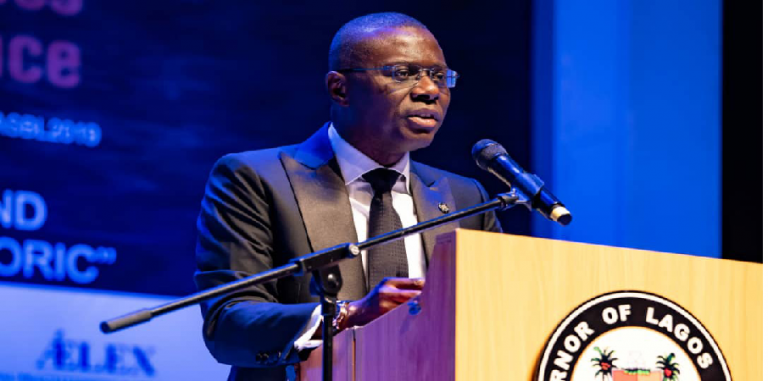
Lagos State has solidified its status as an economic powerhouse, with its Gross Domestic Product (GDP) hitting $259 billion based on Purchasing Power Parity (PPP), making it the second-largest economy on the African continent, behind only Cairo, Egypt.
This milestone, announced during the official launch of the Lagos Economic Development Update (LEDU) 2025, underscores the city’s growing influence as Nigeria’s economic hub.
The LEDU report, executed under the Ministry of Economic Planning and Budget (MEPB), lays out strategies for economic resilience, fiscal sustainability, and revenue mobilization, reflecting the state’s long-term vision for development.
Register for Tekedia Mini-MBA edition 20 (June 8 – Sept 5, 2026).
Register for Tekedia AI in Business Masterclass.
Join Tekedia Capital Syndicate and co-invest in great global startups.
Register for Tekedia AI Lab.
Speaking at the launch, Ope George, Commissioner for Economic Planning and Budget, emphasized the importance of the 2025 LEDU, stating that it provides critical insights to guide Lagos’ economic policy decisions. He reiterated the government’s commitment to fiscal sustainability, economic diversification, and infrastructure development, aligning with Governor Babajide Sanwo-Olu’s ‘Budget of Sustainability.’
This year’s LEDU, themed ‘Lagos Economic Outlook: Charting a Resilient Path Towards a Sustainable Future,’ highlights the state’s dedication to evidence-based policymaking and inclusive development, with a focus on strengthening its revenue base.
The Lagos economy saw significant expansion in the first half of 2024, growing to N27.38 trillion, a substantial increase from N19.65 trillion in 2023. This growth is a testament to the city’s resilience amid Nigeria’s economic reforms and ongoing infrastructure investments.

However, despite its rapid economic expansion, Lagos continues to struggle with a low tax-to-GDP ratio of just 2.3%, highlighting an urgent need for improved revenue mobilization. While the state remains Nigeria’s economic nerve center and top investment destination, its ability to generate revenue falls far behind its economic potential.
Projected Growth and Economic Outlook
The Lagos GDP is expected to grow from N54.77 trillion in 2024 to N66.47 trillion in 2025, with real GDP growth projected between 5.02% and 6.49%.
The service sector is expected to remain the primary driver of this growth, supported by improvements in agriculture and industrial production. Additionally, economic stability is forecasted to be aided by a decline in petrol prices and a stable naira-to-dollar exchange rate, offering some relief amid economic turbulence.

For 2025, the Lagos State Government aims to generate N2.79 trillion in revenue but to achieve this target, the state must implement aggressive fiscal reforms and diversify its revenue base.
The Need for a More Robust Revenue Generation Strategy
During the keynote address titled ‘Bridging the Revenue Gap in Lagos: Innovative Pathways to Enhanced Revenue Mobilisation,’ Chairman of the Presidential Fiscal Policy and Tax Reforms Committee, Taiwo Oyedele, stressed the need for Lagos to align its revenue generation with its economic ambitions.
“Lagos is big, but its revenue is small, collecting less than 2% of GDP. While some progress has been made, we still have big room for improvement, and the time to change this narrative is now,” Oyedele stated.
He outlined three key strategies to boost Lagos’ revenue collection:
- Property Taxation: Leveraging real estate assets to increase property tax revenue.
- Expansion of Personal Income Tax Base: Using technology to identify high-income earners and ensure compliance.
- Tax Harmonisation: Eliminating multiple taxation issues that hinder business growth.
Oyedele emphasized a business-friendly taxation approach, stating, “A better approach to taxation is not to tax the seed, but the fruit. Let businesses grow, and tax them fairly on their successes.”
Furthermore, he called for the formalization of the informal economy, particularly in sectors such as digital entrepreneurship, content creation, and event planning, which currently remain untapped revenue sources.
Oyedele urged Lagos to draw inspiration from global success stories such as Dubai and Singapore, highlighting their strategic economic policies that transformed them into leading financial centers.
He argued that with the right reforms, Lagos could generate up to N5 trillion annually in Internally Generated Revenue (IGR), positioning it as an economic powerhouse not just in Africa, but globally.
Infrastructure Deficits and the Urgent Need for Investment
Despite its rising GDP, Lagos continues to struggle with severe deficits in basic infrastructure, particularly in housing and electricity supply. Experts have urged the state government to intensify efforts in providing affordable housing, clean water, and stable electricity, as these are critical to sustaining economic growth.
The housing deficit in Lagos is estimated to be over 3 million units, making affordable homes out of reach for the majority of residents. This challenge is exacerbated by the rapid population growth, fueled by an influx of people seeking economic opportunities in the state. The cost of renting or purchasing a home remains prohibitively high, putting pressure on low- and middle-income earners.
Additionally, Lagos faces a major energy deficit, which continues to place an enormous financial burden on residents and businesses. According to a newly released report, the energy shortfall adds an estimated N5.3 trillion annually to the cost of doing business in the state. The Lagos Economic Development Update (LEDU) 2025 reveals that while the state requires approximately 9,000 megawatts (MW) of electricity, it receives only 1,000 MW from the national grid—just 11 percent of its demand.
As a result, more than 80 percent of Lagos’ population and businesses rely on off-grid power solutions, predominantly petrol, diesel, or fuel oil generators. This dependence significantly increases the cost of operations for businesses, discouraging investment and limiting the potential for industrial growth.
With its economic advantage attracting more people to Lagos, the government has been urged to take urgent steps to provide affordable housing, pipe-borne water, and a reliable power supply. Economists have warned that the state’s failure to address these pressing concerns could stifle economic progress and widen social inequality, threatening the very foundation of Lagos’ economic expansion.