

In Nigeria, politics often revolves around who controls power at the center. Governors, ministers, and federal lawmakers dominate headlines while the tier of government closest to the people, the local government, has often been treated as an afterthought. Yet, in recent years, the debate over local government autonomy has moved from the margins to the mainstream. By 2024, it had become one of the loudest political conversations in the country, stirring emotions across regions and drawing the attention of citizens, activists, and policymakers alike.
Between 2010 and 2015, conversations around local government autonomy were scarce. A handful of states such as Lagos, Adamawa, and Kano hinted at the problem of councils being financially dependent on governors, but the issue lacked national traction. At the time, the central debate in Nigerian politics centered on federal allocation and resource sharing. Local councils, though important for basic services like education, sanitation, and rural roads, were overshadowed.
That silence began to break after 2016. Civil society organizations, journalists, and some state legislators started to demand a stronger voice for councils. By 2017, the issue was no longer confined to a few states. From Lagos in the South West to Benue in the North Central and Delta in the South South, stakeholders began openly challenging the practice of joint state–local government accounts, which often left councils powerless. The tone of the debate shifted from quiet complaints to a coordinated push for reform.
Register for Tekedia Mini-MBA edition 20 (June 8 – Sept 5, 2026).
Register for Tekedia AI in Business Masterclass.
Join Tekedia Capital Syndicate and co-invest in great global startups.
Register for Tekedia AI Lab.
Momentum built through 2018 and 2019 as more states such as Anambra, Bauchi, and Kwara joined the conversation. What made these years significant was not just the growing number of voices but the diversity of perspectives. In some states, unions representing council workers took the lead. In others, community groups and traditional leaders raised concerns about the decline in local service delivery. The debate was becoming less about political elites and more about ordinary citizens demanding functional governance.
The turning point came in 2022. Oyo State emerged as the loudest single voice, with its lawmakers and civic groups challenging the status quo. Benue and Kogi in the North Central also made autonomy a frontline issue. These were not isolated protests but visible confrontations between governors and local councils over who should control grassroots governance. The conversation reached a tipping point where Nigerians began asking not whether councils deserved autonomy, but why the matter had been delayed for so long.
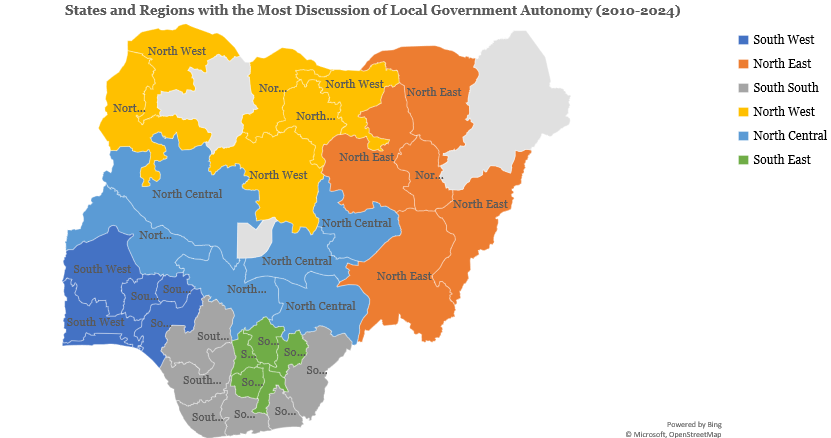
Then came 2024, the year autonomy became impossible to ignore. Discussions about local government independence spread across nearly every region, with 191 separate mentions recorded nationwide. Oyo, Lagos, Delta, Rivers, Anambra, and Ogun became hotspots of advocacy. For the first time in more than a decade, local government autonomy outpaced many other policy debates in both intensity and reach. It was no longer a side conversation. It had become a national demand.

Why did autonomy rise to the top of Nigeria’s political agenda? The answer lies in its direct impact on everyday life. Local governments manage primary schools, markets, rural roads, and community health centers. When councils are financially crippled, these services suffer. Citizens increasingly recognized that the failure of local governments was not simply administrative, but a matter of governance being held hostage by state-level politics. Autonomy was no longer framed as a technical reform, but as a solution to the frustrations of communities across Nigeria.
The regional spread of the debate also tells an important story. In the South West, especially in Oyo and Lagos, strong media institutions and active civic groups kept the conversation alive. In the North Central, where rural communities often feel neglected, states like Benue and Kogi took bold positions. In the South South, the link between revenue control and autonomy shaped the discussion. Even in the North, where the conversation has been quieter, Kaduna and Kano played their part in voicing concerns.
The rise of local government autonomy as Nigeria’s loudest political debate shows that citizens are connecting governance to their daily realities in ways that cannot be ignored. From whispers in 2010 to a nationwide outcry in 2024, Nigerians have made one thing clear: strengthening councils is not a matter of politics between governors and chairmen. It is a matter of dignity, accountability, and service at the grassroots.

If the federal and state governments are serious about improving governance, they must stop treating autonomy as a bargaining chip. The loud voices from across the country are not asking for charity. They are asking for a system where governance begins where people actually live.