

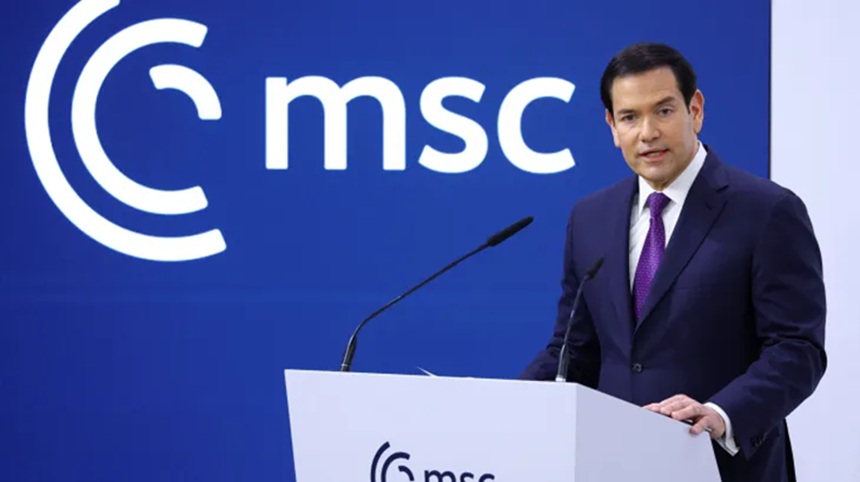
U.S. Secretary of State Marco Rubio used his address at the Munich Security Conference to reaffirm Washington’s commitment to Europe, declaring that the United States has no intention of abandoning its deep alliance with the region.
“We care deeply about your future and ours,” Rubio said. “We want Europe to be strong. We believe that Europe must survive, because the two great wars of the last century serve, for us, as history’s great reminder, that ultimately, our destiny is, and will always be, intertwined with yours.”
The reassurance comes at a sensitive moment. Policies pursued by President Donald Trump — including sharp criticism of NATO burden-sharing, calls for allies to significantly raise defense spending, and renewed trade assertiveness — have unsettled traditional partners. Trump’s public interest in U.S. ownership of Greenland, a Danish territory, further intensified unease in European capitals.
Register for Tekedia Mini-MBA edition 20 (June 8 – Sept 5, 2026).
Register for Tekedia AI in Business Masterclass.
Join Tekedia Capital Syndicate and co-invest in great global startups.
Register for Tekedia AI Lab.
Against that backdrop, Rubio’s speech appeared calibrated to steady relations at a time when some European policymakers have begun reassessing long-term strategic dependencies and exploring alternative partnerships, including deeper economic engagement with China.
In recent years, Europe has faced mounting pressure to balance its trans-Atlantic commitments with economic realities. China remains one of the European Union’s largest trading partners, and some European governments have pursued pragmatic economic engagement even as geopolitical tensions persist.
Trump’s transactional approach to alliances — emphasizing cost-sharing, industrial reshoring, and trade reciprocity — has prompted debate within Europe about strategic autonomy. Calls for greater defense self-reliance, energy diversification, and independent supply chains have accelerated. European Commission President Ursula von der Leyen told the conference that Europe faces “the very distinct threat of outside forces trying to weaken our union from within,” and must become more independent “in every dimension that affects our security and prosperity.”

While she stressed that autonomy strengthens rather than weakens the alliance, the push reflects a broader reassessment underway across the continent. Some analysts note that uncertainty in U.S. foreign policy continuity has led parts of Europe to hedge strategically, keeping channels open with Beijing in trade, climate policy, and industrial cooperation.
Rubio sought to counter any perception of drift. “We do not need to abandon the system of international cooperation we authored,” he said, adding that global institutions “must be reformed” rather than dismantled.
His message signaled that Washington wants reform within the Western-led order, not its replacement.

Ukraine, Gaza, and the Debate Over Leadership
Rubio argued that American leadership remains indispensable in resolving major crises, contrasting U.S. diplomatic initiatives with what he described as limited effectiveness from multilateral institutions such as the United Nations.
“The United Nations still has tremendous potential to be a tool for good in the world,” Rubio said. “But we cannot ignore that today, on the most pressing matters before us, it has no answers and has played virtually no role.”
On Ukraine, President Volodymyr Zelenskyy thanked the United States for its support. “I am grateful to every American heart that was helping us, no matter what. Thank you,” he said, while also criticizing the previous U.S. administration for delays in scaling up military assistance.
NATO Secretary General Mark Rutte urged allies to intensify support under the alliance’s Prioritized Ukraine Requirements List. EU foreign policy chief Kaja Kallas warned that concessions to Russia would only embolden further aggression.
The discussions underscored that while Washington and European capitals remain aligned on core security threats, the methods and pace of response continue to generate debate.
Rubio also framed the alliance in economic terms, criticizing past policies that encouraged supply chain outsourcing and contributed to “deindustrialization.” He argued that the loss of supply chain sovereignty was “foolish” and called for coordinated reindustrialization across the Atlantic.
He outlined areas for deeper cooperation, including artificial intelligence, commercial space, industrial automation, and securing critical mineral supply chains not vulnerable to geopolitical leverage.
These themes align with Trump’s broader economic nationalism agenda, which emphasizes domestic manufacturing revival and strategic decoupling from adversarial supply chains. For Europe, however, industrial competitiveness often intersects with complex trade ties to China, making alignment more nuanced.
Alliance at a Crossroads
Rubio’s speech reflects recognition within Washington that reassurance is necessary. European leaders have increasingly spoken about reducing strategic dependency — not only on Russia for energy but also on the United States for security guarantees.
At the same time, Europe faces its own constraints: fragmented defense capabilities, uneven fiscal space, and internal political divisions. While engagement with China offers economic opportunities, it also carries security and political risks.
The reaffirmation in Munich signals that, despite friction over defense spending, trade policy, and geopolitical posture, the United States continues to view Europe as a foundational partner. But the challenge for European leaders lies in balancing strategic autonomy with alliance cohesion.