

Microsoft has unveiled its first Surface PCs built around Nvidia’s new RTX Spark platform, putting a price and hardware specification behind a new class of Windows machines designed to run advanced AI models and autonomous agents locally.
The company introduced the Surface Laptop Ultra in San Francisco on Wednesday during the city’s Tech Week, with prices starting at $2,600 for the base model and rising to $3,700 for a more powerful configuration. Higher memory and storage options push the price as high as $5,900, with Microsoft saying its most expensive configuration has already sold out.
The launch gives substance to Nvidia’s announcement in June that it had reached agreements with Microsoft and other PC manufacturers to develop Windows computers capable of supporting AI models and agents through its RTX Spark chip. At the time, manufacturers had provided few details about what the machines would cost or what kind of hardware they would contain.
Register for the next Tekedia Mini-MBA.
Register for Tekedia AI in Business Masterclass.
Join Tekedia Capital Syndicate and co-invest in great global startups.
Microsoft has now positioned the Surface Laptop Ultra and the Surface RTX Spark Dev Box as machines designed around a fundamental shift in personal computing: moving more AI workloads from cloud data centers onto the device itself.
The Surface RTX Spark Dev Box, priced from $6,000, is aimed more directly at developers. It comes with Microsoft development tools including VS Code, GitHub Copilot CLI, Windows Subsystem for Linux and PowerShell 7, effectively turning the machine into a dedicated environment for building and testing AI applications and agents.
The central selling point of both machines is their ability to run AI models locally without requiring users to pay for every inference through a cloud service. Microsoft says the computers combine the CPU, GPU, unified memory, and specialized hardware changes, including enhanced cooling, needed to handle demanding AI workloads.

That positioning is necessary because the economics of generative AI have historically been tied closely to cloud infrastructure. Powerful models require substantial computing resources, and developers typically access them through remote APIs operated by companies such as Microsoft and other AI providers.
By putting more computing capacity into the PC, Microsoft and Nvidia are attempting to create another layer of the AI market in which developers can run models privately and with potentially lower recurring costs. Local processing can also reduce dependence on internet connectivity and give users greater control over sensitive data.
The machines therefore represent more than an upgrade in graphics performance. They are seen as part of an effort to redefine the PC around AI as a native computing workload rather than an application accessed primarily through the cloud.

Microsoft is also changing Windows to accommodate that shift. The new machines run a revamped version of Windows 11 that includes a feature called “Execution Containers,” which is designed to make it easier to sandbox AI agents.
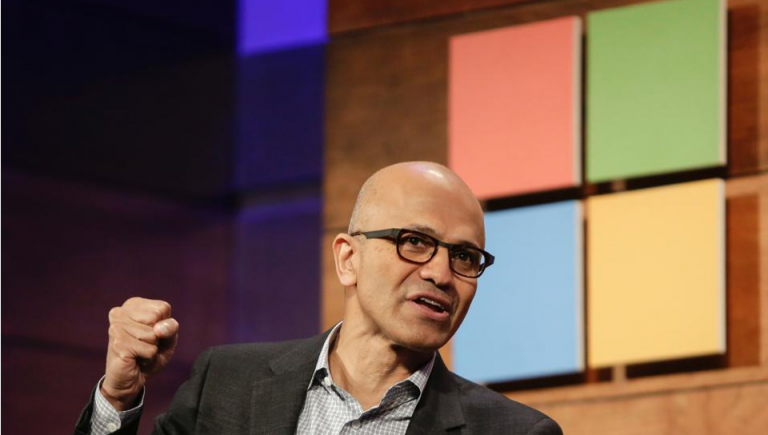
Microsoft CEO Satya Nadella said the feature will eventually be available to all Windows 11 users, extending the underlying agent infrastructure beyond the specialized Nvidia-powered devices.
Nadella argued that the development of AI over the past several years has exposed a limitation in the way the industry initially approached the technology.
“One of the things we realized in the last 3-4 years is that just having a model doesn’t do much for anything. You really do need to orchestrate, and you need to have memory outside of the model. You need to have this harnessed layer that is able to take multiple models plus context, plus memory, and the action space,” he said.
He added that Microsoft is building that capability “not just for our apps but apps for anyone’s agent. That’s what the Windows platform is all about going forward.”
That comment points to a broader ambition for Windows. Rather than simply becoming a platform where users interact with individual AI models, Microsoft wants the operating system to provide the infrastructure through which agents can access applications, maintain context, and execute actions.
The significance is that agentic computing requires more than raw model performance. Agents need memory, access to tools, computing resources and controlled environments in which they can execute tasks. By integrating those capabilities into Windows, Microsoft can potentially make the operating system an important layer in the emerging agent economy.
Premium Pricing Tests Demand for AI Pcs
The challenge is the cost.
At $2,600, the entry-level Surface Laptop Ultra is positioned well above mainstream laptops, while the $6,000 starting price for the Dev Box places it firmly in professional workstation territory. The $5,900 configuration of the laptop also approaches the price of a high-end desktop workstation.
Microsoft is clearly targeting developers and professionals who can justify the expenditure through demanding workloads rather than consumers looking for a conventional laptop upgrade.
The company is even offering up to $1,000 off to customers who trade in a MacBook Pro, an unusually direct attempt to pull developers away from Apple’s ecosystem. Macs have become particularly popular among developers and AI enthusiasts, making them a natural target for Microsoft as it attempts to establish Windows as a serious platform for local AI development.
The trade-in programme also highlights the competitive dimension of the launch. Microsoft is not simply selling a faster Surface machine. It is trying to persuade developers that Windows, combined with Nvidia’s computing hardware and Microsoft’s software ecosystem, is becoming a better environment for building AI agents.
The machines are not restricted to AI development. Microsoft says their powerful graphics processing capabilities also make them suitable for content creation, video processing, and gaming. That broader functionality could help justify the premium hardware costs for users who want a single machine capable of handling multiple intensive workloads.
Microsoft is not alone in pursuing this market. Dell also announced specifications for its previously disclosed Dell XPS 16 Creator Edition, another Windows PC built around Nvidia’s RTX Spark platform.
The Dell machine is available for pre-order at Best Buy for $3,800, with delivery expected later in October.
The expanding line-up suggests Nvidia’s RTX Spark strategy is beginning to move beyond a single flagship product and into a broader PC ecosystem. Microsoft and Dell are effectively testing whether consumers and developers will pay workstation-level prices for computers that combine traditional high-performance computing with local AI capabilities.
The larger concern is whether local AI can become compelling enough to justify that premium.
Cloud-based AI remains convenient because users can access powerful models without purchasing expensive hardware. Local AI, however, offers a different proposition: lower dependence on cloud services, potentially greater privacy, faster response times for certain workloads, and the ability to experiment with models without incurring repeated usage charges.
For developers building autonomous AI agents, those advantages could become more significant as agents require continuous interaction with software, files and other computing resources.
Microsoft’s strategy therefore extends beyond selling expensive PCs. Analysts see this move as an attempt to ensure that Windows remains relevant as computing shifts from users clicking through applications toward AI systems that can operate across them.
Nvidia, meanwhile, gains another avenue for deploying its AI computing architecture beyond data centers. If developers increasingly demand machines capable of running sophisticated models locally, the PC could become another important battleground for AI hardware.
The early sales signal is encouraging for Microsoft, with the highest-end Surface Laptop Ultra already out of stock. But the broader test will be whether that initial interest translates into a sustained market for premium AI machines.
If developers embrace local models and agents at scale, the RTX Spark generation could help establish a new category of Windows PCs. If cloud-based AI remains sufficiently inexpensive and powerful, the premium attached to local AI hardware could prove harder to justify.
For now, Microsoft is betting that the next generation of PCs will not simply assist users with AI features. They will have enough computing power and operating-system support to run AI agents directly on the machine and give those agents a controlled environment in which to act.