

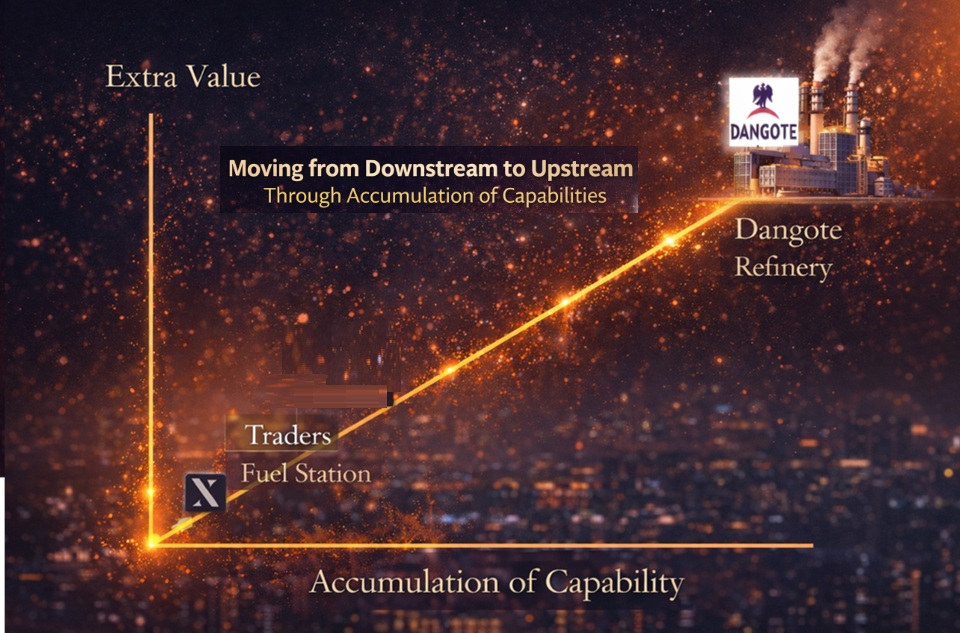
In markets, everyone is welcome to participate, but only a few are invited to collect the trophies. The difference is not location or luck; it is capability. My Accumulation of Capability Construct explains that firms do not win simply because they are present in an industry; they win because they master it. A petrol station operator, a local fuel trader, a neighbourhood car dealer and a global manufacturer like Toyota or a refinery like Dangote are all in the same broad sectors. Yet, the value they capture is radically different.
Why? Because the station and dealer play at the downstream edge of the value chain, while Toyota and Dangote have climbed upstream by accumulating deep technical, financial and organizational capabilities that are extremely hard to copy.
The message for founders and executives in Lagos, Nairobi, Accra and beyond is simple: trading may feed you, but capabilities will keep you. If you remain permanently downstream, you will always be exposed to currency swings, supplier decisions, and policy shocks you cannot control. But if you deliberately climb upstream, like Dangote moving from importation to refinery, or Toyota evolving from assembler to global platform designer, you position your firm where value is thickest and competition is thinnest. Right there, you begin to “tax” the state and the government in what I have called the conglomerate tax!
Register for Tekedia Mini-MBA edition 20 (June 8 – Sept 5, 2026).
Register for Tekedia AI in Business Masterclass.
Join Tekedia Capital Syndicate and co-invest in great global startups.
Register for Tekedia AI Lab.
Here, Conglomerate Tax isn’t a formal government levy but a concept where large conglomerates, due to their scale, market power, and ability to solve major national problems (like infrastructure), effectively receive “taxes” from governments in the form of subsidies, tax breaks, and concessions that smaller businesses can’t get, making the citizens and nations indirectly support their growth. It’s a system where governments subsidize conglomerates to fix critical market frictions, essentially paying them to build national capacity, as seen with Amazon and the Dangote Group.
Good People, the Igbo Apprenticeship System must go upstream. Yes, while currently downstream, the Igbo Apprenticeship System can move upstream by adopting a corporate cooperative framework. This shift mirrors the success of Europe’s FrieslandCampina, which transformed thousands of dairy farmers into a $13 billion corporate powerhouse, serving continents with products, with Peak Milk its most popular brand in Nigeria.
It can be argued that looking to Europe is unnecessary when Nigeria has its own history of scaling the ‘Ubuntu’ cooperative spirit. Before their eventual decline, the cocoa, palm oil, and groundnut marketing boards demonstrated our capacity for large-scale collective enterprise. By embracing the Ghanaian concept of ‘Sankofa’, reaching back to reclaim our past, we can extract vital lessons to architect a more resilient economic future.

---
Connect via my
LinkedIn |
Facebook |
X |
TikTok |
Instagram |
YouTube
It is not enough to trade and make money, you must aim to control and dominate supply chain and distribution networks, without doing so, whatever you remain endangered. What we call cooperatives here must evolve into funding researches and launching products to the market, and not just a mere gathering of people trading and exchange money. Anything you fail to control and dominate, whoever does, you will be at the person’s mercy.