

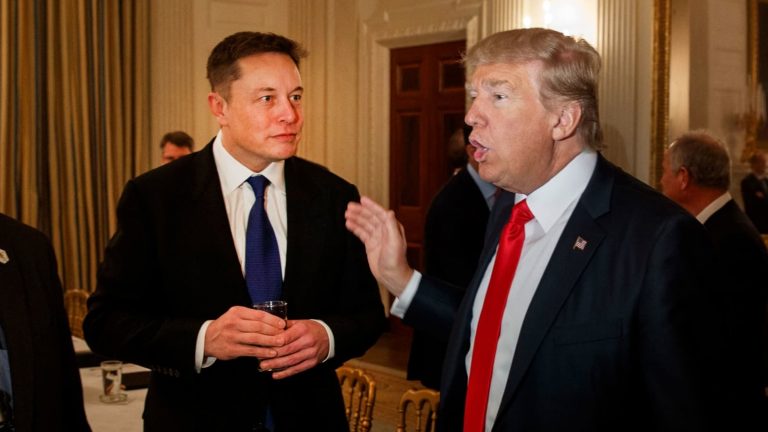
In a rare and pointed criticism of President Donald Trump, Elon Musk has slammed the recently passed Republican spending bill, calling it a setback for efforts to reduce wasteful government expenditure.
The criticism, which aired in a preview of an upcoming interview on CBS Sunday Morning, marks one of Musk’s most direct and public rebukes of the man he has long backed—both ideologically and politically—even when Trump’s policies ran contrary to Musk’s business interests.
“I was, like, disappointed to see the massive spending bill, frankly, which increases the budget deficit, not just decrease it, and undermines the work that the DOGE team is doing,” Musk said, referring to the Department of Government Efficiency (DOGE), the federal cost-cutting agency he headed until recently.
Register for Tekedia Mini-MBA edition 20 (June 8 – Sept 5, 2026).
Register for Tekedia AI in Business Masterclass.
Join Tekedia Capital Syndicate and co-invest in great global startups.
Register for Tekedia AI Lab.
The bill in question—the “One Big Beautiful Bill Act”—is projected by the Congressional Budget Office (CBO) to raise the federal budget deficit by $3.8 trillion over the next ten years. That’s a sharp reversal from DOGE’s stated aim of fiscal prudence.
Since its creation in January 2025, DOGE has claimed to have saved $170 billion in taxpayer money by slashing bureaucratic redundancies and eliminating overlapping federal programs, including a controversial gutting of the U.S. Agency for International Development and job cuts affecting some 275,000 federal employees, according to data from consulting firm Challenger, Gray & Christmas.
Trump had boasted of the bill as a landmark legislative win, calling it “big and beautiful.” But Musk, in a dig at that framing, retorted, “I think a bill can be big or it can be beautiful, but I don’t know if it can be both.”

This stark divergence in rhetoric has sparked speculation of a growing schism between the billionaire industrialist and the Republican leader, especially as Musk announces the end of his role at the White House.
For years, Musk has been seen as a cheerleader for Trump, praising his deregulatory stance and frequently appearing at White House events. He continued to offer public support even when the Trump administration pursued policies that threatened Musk’s core businesses—particularly the electric vehicle sector, which faced headwinds from Trump’s fossil fuel-heavy energy agenda and the rollback of federal EV subsidies.
Trump’s support for oil drilling and traditional automakers has consistently undermined the clean energy transition championed by Tesla and other Musk ventures. Yet Musk, always calculating, maintained cordial relations with Trump, securing influence in key policy discussions and later accepting a high-profile advisory role as DOGE chief—a position that allowed him to shape federal spending but also put him directly in the political spotlight.

Now, Musk’s comments suggest a shift, with the SpaceX and Tesla CEO signaling that he is stepping back from his Washington role.
“It was clear that DOGE became the whipping boy for everything,” Musk told The Washington Post in a separate interview published Tuesday. “The federal bureaucracy is much worse than I realized.”
His withdrawal comes just as Trump’s bill heads to the Senate, where it faces stiff opposition—not only from Democrats but also from Republican fiscal conservatives. Florida Governor Ron DeSantis, a former presidential hopeful and one-time Trump rival, has blasted House Republicans for failing to codify DOGE’s proposed spending cuts, calling it “a betrayal of the voters.”
The timing of Musk’s criticism is significant. Trump is known for his zero-tolerance approach to dissent, particularly from allies. His history of falling out with former aides, executives, and party loyalists is well-documented. From former Secretary of State Rex Tillerson to Attorney General Jeff Sessions and one-time strategist Steve Bannon, Trump has often publicly castigated former allies after a perceived betrayal.
That history raises questions about whether Musk’s comments could escalate into a full-blown feud. Already, reports suggest tensions have been simmering behind the scenes.
Meanwhile, markets appeared to respond positively to Musk’s pivot. Tesla stock edged higher following the release of the CBS interview clip, buoyed by investor optimism that Musk would now be refocusing on the company after months of distraction from political affairs. His companies—including Tesla, X (formerly Twitter), and SpaceX—have faced mounting challenges amid regulatory pressure and competition, making his return to the helm a welcome development for shareholders.
However, the “One Big Beautiful Bill Act” continues to divide Congress—and possibly one of its most high-profile corporate allies. If Musk’s past loyalty can no longer buffer him from Trump’s retaliation, the political fallout could reshape the calculus for other business leaders who’ve walked the tightrope of MAGA politics.