

Nigeria’s online religious conversations are no longer merely exchanges of belief. They have evolved into powerful arenas where identity, fear, power, memory, and national belonging are constantly negotiated. Our examination of Facebook discussions involving Islam, Christianity, and Ì????e reveals an uncomfortable truth about the country’s digital public sphere: Nigerians are not simply debating religion. They are contesting what Nigeria means, who belongs, who suffers, and whose story deserves legitimacy.
First, these discussions appear to be straightforward theological disagreements. Muslims defend Islamic teachings. Christians proclaim biblical convictions. Practitioners of Ì????e assert the legitimacy of indigenous spirituality. Yet beneath the surface lies something deeper and far more consequential. Religion in Nigeria’s online space functions as a language through which people express insecurity, historical wounds, political frustration, and struggles over identity.
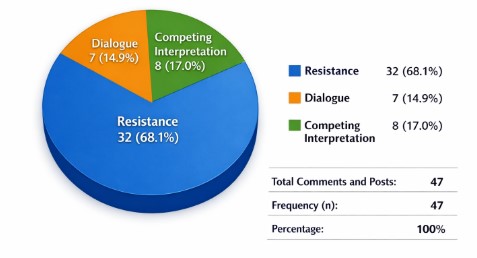
Resistance is the dominant mode of Nigeria’s online religious discussions (68.1%), while dialogue (14.9%) and competing interpretations (17.0%) play secondary but important roles.
Resistance is perhaps the most visible feature of Nigeria’s online religious discourse. Across social media, communities frame themselves as resisting perceived domination or marginalization. Christians often express fears of persecution, religious violence, and political exclusion. Discussions about attacks in northern Nigeria, constitutional secularism, and fears of Islamization frequently emerge in ways that portray Christianity as embattled and under siege.
Register for the next Tekedia Mini-MBA.
Register for Tekedia AI in Business Masterclass.
Join Tekedia Capital Syndicate and co-invest in great global startups.
Muslims, however, tell a different story. Many online voices resist narratives that associate Islam with extremism or terrorism. They argue that violence committed by extremists is unfairly projected onto ordinary Muslims and that public discourse often demonizes Islam while ignoring Muslim experiences of discrimination or insecurity. In these spaces, Muslims are not aggressors but victims of stereotyping and selective outrage.
Meanwhile, Ì????e practitioners present an entirely different form of resistance. Their discourse is often rooted in cultural recovery and decolonization. For many supporters of indigenous spirituality, Christianity and Islam are not simply religions. They are symbols of colonial intrusion and historical displacement. Ì????e becomes more than spiritual practice. It becomes a vehicle for reclaiming African identity and resisting inherited systems of cultural domination.
What emerges is a digital landscape where everyone sees themselves as defending something under threat. Faith becomes intertwined with survival, legitimacy, and recognition. Yet resistance alone does not define Nigeria’s online religious conversations. Dialogue also exists, although it often takes a confrontational form.

Contrary to assumptions that social media only amplifies hostility, many Nigerians still attempt to engage one another constructively. Some users correct misinformation. Others distinguish between religious teachings and extremist violence. Some advocate respect for religious freedom, emphasizing that peaceful coexistence remains possible despite theological differences.
Still, much of this dialogue resembles contestation rather than reconciliation. Participants rarely seek mutual understanding in the conventional sense. Instead, they argue, rebut, defend, and challenge. One group disputes another’s account of violence. One community counters accusations with historical examples. The result is a digital culture where engagement occurs, but consensus remains elusive.
This dynamic reveals an important reality about Nigeria’s social media ecosystem. Online religious conversations are not necessarily spaces of harmony or civic deliberation. They are arenas of negotiation where competing communities attempt to establish moral credibility and narrative authority. Perhaps the most revealing feature of these discussions is the presence of competing interpretations of reality itself.

The same incident can generate radically different understandings depending on religious identity. Violence in a conflict-prone area may be interpreted by one group as evidence of religious persecution and by another as criminality falsely framed through religion. Political developments are understood either as signs of religious domination or as exaggerated fears designed to provoke division. Even the meaning of coexistence differs. Some see tolerance as possible and necessary. Others regard religious difference as an inevitable source of conflict.
This struggle over interpretation matters because stories shape societies. Communities act not only on facts but on what they believe those facts mean. When religious groups hold fundamentally different understandings of victimhood, justice, or power, mistrust deepens and polarization becomes easier to sustain.
Social media intensifies this problem. Platforms reward emotional content. Fear spreads faster than nuance. Outrage generates engagement. Moderation rarely goes viral. The loudest voices often become the most visible, creating the impression that hostility is universal even when many citizens desire coexistence.
Yet it would be simplistic to conclude that Nigeria’s online religious space is irredeemably fractured. These conversations also reveal resilience. Nigerians continue to engage one another despite disagreement. They argue passionately because religion remains deeply meaningful to how they understand themselves and their communities.
The challenge before Nigeria is not to eliminate religious difference. That would be impossible and undesirable. The challenge is to build a digital culture where disagreement does not automatically become dehumanization.
Nigeria’s online religious debates ultimately reveal a nation still negotiating its identity. They show citizens wrestling with history, insecurity, and belonging in real time. In this struggle, resistance, dialogue, and competing interpretations are not signs of democratic failure. They are evidence of a society trying to define itself amid profound diversity.