

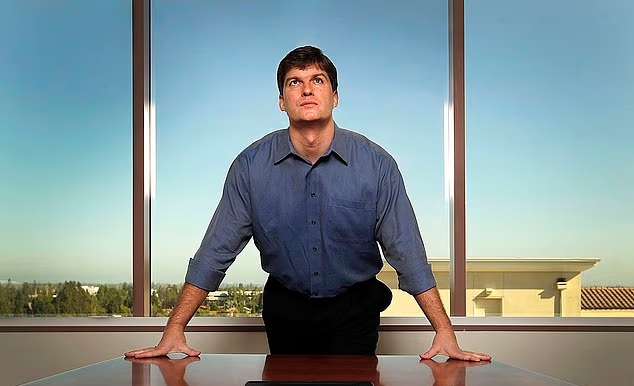
Michael Burry, the investor made famous by his successful bet against the U.S. housing market before the 2008 financial crisis, has signaled that he is steering clear of one of the hottest trades on Wall Street: SpaceX.
The caution from the man known as the “Big Short” comes as Elon Musk’s aerospace and artificial intelligence conglomerate continues a stunning post-IPO rally that has captivated investors and pushed the company’s valuation into territory rarely seen in public markets.
SpaceX, which completed the largest initial public offering in history last week, has surged from its IPO price of $135 per share to more than $200 within days of trading, adding hundreds of billions of dollars in market value and cementing its status among the world’s most valuable publicly traded companies.
Register for the next Tekedia Mini-MBA.
Register for Tekedia AI in Business Masterclass.
Join Tekedia Capital Syndicate and co-invest in great global startups.
Yet Burry, who has built a reputation on identifying bubbles and excessive market optimism, says he is not prepared to either buy or short the stock.
In a post published Tuesday on his Substack page, Burry revealed that while he had examined several put-option strategies that would allow him to bet against SpaceX, he ultimately decided against taking a position.
“No thank you,” he wrote.

“I am not involved with SpaceX now. Neither short nor, ahem, long,” he added.
This forms part of a growing divide among investors over whether SpaceX’s extraordinary valuation can be justified by its underlying business performance or whether the stock is being propelled primarily by enthusiasm surrounding Musk himself.
The debate has intensified as SpaceX’s market capitalization has soared far beyond traditional valuation benchmarks. Before the IPO, Burry had already questioned the company’s worth, arguing that the information contained in its regulatory filing did not support a trillion-dollar valuation.

“Nothing in that S-1 suggests it is worth $1 trillion let alone $2 trillion,” he wrote.
Following the rally, his concerns have only deepened.
“At $2.8 trillion market cap, SpaceX, which is fundamentally a small space company, a niche telecom, a bedeviled social media company, and a Coreweave-light, has less than $20 billion in total revenue,” Burry wrote.
His criticism bolsters a broader concern among some analysts who argue that investors are assigning massive future growth expectations to businesses that have yet to generate profits on a scale that would traditionally support such valuations.
SpaceX currently spans several businesses. Beyond its rocket-launch operations, the company controls the Starlink satellite internet network, artificial intelligence assets acquired through xAI, the social media platform X, and a growing portfolio of AI infrastructure projects.
Investors backing the stock believe these businesses could evolve into dominant platforms across communications, artificial intelligence, cloud computing, and space infrastructure over the coming decade. Elon Musk has fueled those expectations. Earlier this week, he suggested SpaceX could potentially generate about $1 trillion in annual revenue by 2030, a target that would place it among the largest corporations in history.
That vision has helped attract both institutional and retail investors eager to gain exposure to Musk’s latest growth story.
The frenzy has been evident in derivatives markets as well. More than 1.6 million SpaceX options contracts changed hands on Tuesday, the first day options trading became available for the stock. Market observers said that volume shattered the previous record for a newly listed company, underscoring the extraordinary speculative interest surrounding the shares.
Burry used a series of comparisons to illustrate what he views as the disconnect between SpaceX’s valuation and economic reality. According to him, the company’s market value now exceeds the annual economic output of several major countries, including Russia, Canada, and Italy.
He also noted that SpaceX’s valuation could theoretically purchase many of the world’s largest aerospace, defense, and industrial companies while still leaving substantial capital remaining. Perhaps most striking was his comparison with Berkshire Hathaway, the conglomerate built over decades by legendary investors Warren Buffett and the late Charlie Munger.
“Berkshire Hathaway has been eclipsed 2 1/2 times over in just three days,” Burry wrote.
The comparison is notable because Berkshire has long been viewed as one of the most successful wealth-creation vehicles in modern financial history, built through decades of disciplined investing and acquisitions.
For supporters of SpaceX, however, traditional valuation frameworks may no longer be the primary consideration. Several market commentators have argued that investors are effectively buying exposure to Musk’s ability to create entirely new industries rather than valuing the company solely on current earnings or revenue. CNBC’s Jim Cramer recently described SpaceX as a stock that is effectively a bet on “Elon Musk’s brain,” suggesting investors are pricing in future opportunities that have yet to materialize.
The rapid rise of SpaceX is also being closely watched by other companies preparing to enter public markets, particularly in artificial intelligence.
The success of the IPO has strengthened expectations for upcoming listings from OpenAI and Anthropic, two companies at the center of the global AI race. Investment bankers and venture capital firms are now seeing SpaceX’s debut as a test of investor appetite for highly valued technology companies that prioritize growth and market dominance over near-term profitability.
If SpaceX continues to command a multi-trillion-dollar valuation despite ongoing losses and heavy capital spending, it could embolden investors to support similarly ambitious valuations for future AI listings. That possibility may ultimately prove as important as SpaceX’s own stock performance. A sustained rally would signal that public markets remain willing to finance large-scale AI and technology expansion plans, even when profitability remains years away.
For now, however, Burry is choosing caution.
The investor who built his reputation by identifying market excesses before others saw them is watching from the sidelines as SpaceX continues its remarkable ascent, unwilling to bet either for or against one of the most polarizing stocks in modern market history.