

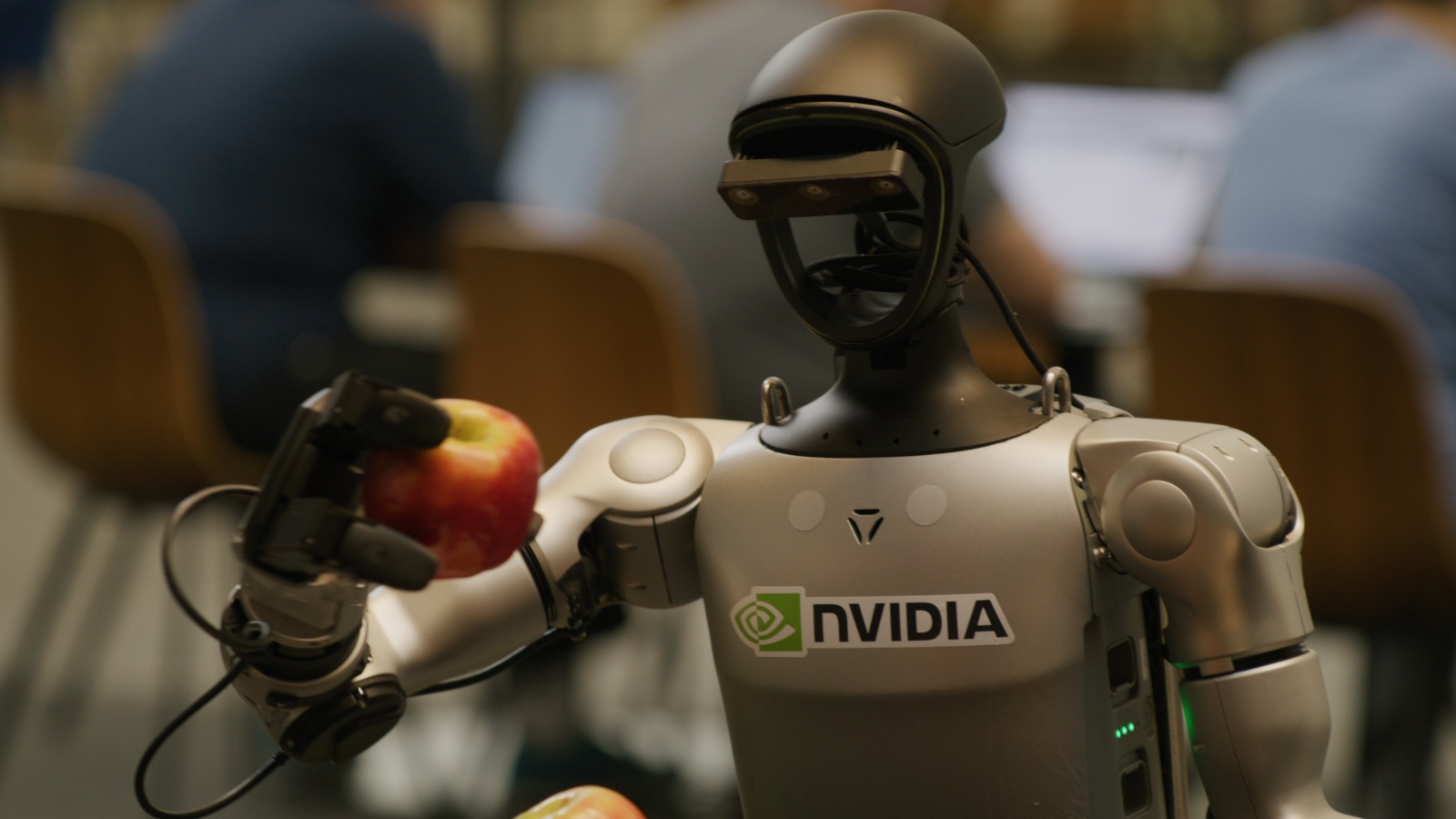
Nvidia on Monday announced a series of major partnerships across South Korea’s technology and industrial landscape, bolstering the country’s critical role in the global AI supply chain while expanding its ambitions into robotics, data centers, and next-generation manufacturing.
The deals, unveiled during CEO Jensen Huang’s high-profile visit to Seoul, his second in seven months, encompass memory chip supply, AI cloud infrastructure, humanoid robotics, and industrial applications. Partners include SK Hynix, Naver, SK Telecom, Doosan Group, LG, and Hyundai Motor Group.
While financial terms were not disclosed, the agreements denote Nvidia’s determination to lock in crucial high-bandwidth memory (HBM) capacity and accelerate the commercialization of physical AI.
Register for the next Tekedia Mini-MBA.
Register for Tekedia AI in Business Masterclass.
Join Tekedia Capital Syndicate and co-invest in great global startups.
The centerpiece is a multi-year technology partnership with SK Hynix, Nvidia’s largest memory supplier. The agreement commits the South Korean chipmaker to developing advanced memory solutions tailored for global AI data centers.
Huang emphasized the depth of the relationship after meeting SK Group Chairman Chey Tae-won.
“SK Hynix has been Nvidia’s largest memory partner. SK Hynix will continue to be Nvidia’s largest memory partner,” he said.

He added that annual procurement from SK Hynix already runs into “billions and billions of dollars” and is set to grow substantially, with the deal extending beyond two years and including options for further extensions.
Expanding Beyond Memory into Robotics and AI Factories
The partnerships extend well beyond chips. Huang had earlier tipped robotics to be South Korea’s next big sector. Under the alliances, SK Telecom will build a gigawatt-scale AI cloud in South Korea using Nvidia technology, with the first data center expected online in 2027. Naver and Doosan Group will also leverage Nvidia’s platforms for AI infrastructure development. Doosan, which supplies materials for Nvidia’s Blackwell chips and is developing robots, sees potential for deeper collaboration in energy solutions and physical AI.
With LG Group, Nvidia is collaborating on electronics, mechanical systems, and AI for humanoid robots. Huang highlighted joint work on future data center architecture, including cooling, power delivery, and full-system design.

A meeting with Hyundai Motor Group Executive Chair Euisun Chung focused on autonomous mobility, robotics, and AI-powered manufacturing. Huang described Hyundai’s planned AI data center in Saemangeum as an “AI Valley”, akin to California’s Silicon Valley, and expressed enthusiasm for building Nvidia’s presence there.
“We would deepen our partnership with Hyundai across a range of AI initiatives, including autonomous mobility, robotics and AI-powered manufacturing,” he said.
South Korea has emerged as one of the clearest winners in the AI boom. As home to Samsung Electronics and SK Hynix, which together produce about 70% of the memory chips essential for AI systems, the country has seen semiconductor exports surge nearly 170% year-on-year in May, driving its strongest export growth in decades.
The KOSPI index has nearly doubled this year, propelled by these chip giants.
However, Monday’s trading saw a sharp reversal, with the benchmark falling 8.3% and Samsung and SK Hynix shares dropping 10.2% and 7.7% respectively, amid broader global tech weakness triggered by strong U.S. jobs data and rate hike fears.
However, Huang downplayed the sell-off, saying: “Everybody should be very happy; they can now buy stock at a cheaper price, and it’s absolutely true that the future of AI is very bright.”
Analysts see the partnerships as bolstering a shift in the memory chip industry from commodity products to more customized, high-value solutions closely aligned with specific AI workloads. Ryu Young-ho at NH Investment & Securities noted that the SK Hynix-Nvidia deal highlights this evolution.
These agreements secure critical supply amid tight HBM markets and set the path for Nvidia to expand into physical AI and robotics — areas Huang has identified as major growth drivers. For South Korea, the deepening ties offer a pathway to move up the value chain, from component supplier to innovation partner in intelligent systems and AI factories.
The partnerships also carry geopolitical weight. In an era of U.S.-China tensions and supply chain vulnerabilities, South Korea’s role as a trusted, high-tech manufacturing hub becomes even more valuable to American tech leaders like Nvidia.
Huang’s repeated visits and personal engagement point to a bet on South Korea as more than a memory provider — a comprehensive partner in the AI ecosystem of the future. As the company pushes into robotics and space-based computing, Korean industrial giants bring world-class execution capabilities that will be essential for turning ambitious visions into reality.