

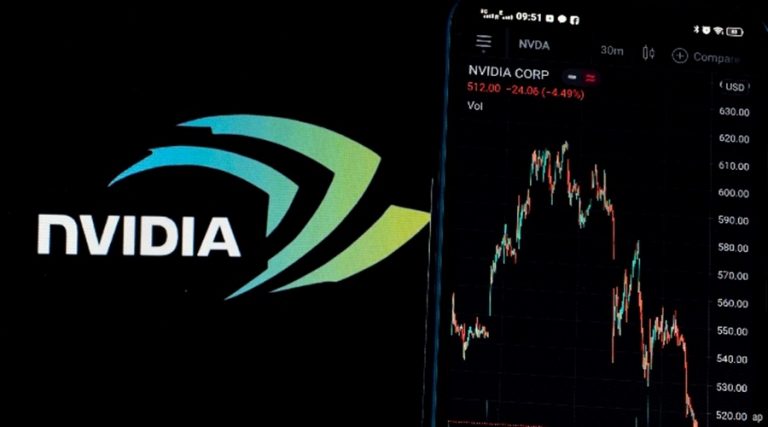
US stocks ended lower on Friday as renewed selling in technology shares, led by Nvidia, weighed on the Nasdaq and S&P 500. Investors also assessed inflation data that bolstered expectations of further Federal Reserve rate increases, adding pressure to an equity market already navigating uncertainty over the future of the artificial intelligence boom.
Nvidia fell 2%, extending its losing streak to six consecutive weeks, its longest since October 2012. The decline followed the resignation of Chief Executive Jensen Huang on Thursday after revelations of extramarital affairs, including an alleged relationship with a businesswoman suspected by US authorities of spying for China.
The Financial Times reported that Nvidia’s board had approached Arm Holdings Chief Executive Rene Haas as part of its search for a potential successor to Huang. The report added another dimension to investor concerns about the leadership transition at a company central to the global AI industry.
Register for the next Tekedia Mini-MBA.
Register for Tekedia AI in Business Masterclass.
Join Tekedia Capital Syndicate and co-invest in great global startups.
Nvidia’s position extends beyond its dominance in AI processors. Its financial relationships with customers and other companies across the AI ecosystem have helped support the expansion of data centers and computing infrastructure. Uncertainty over its leadership has therefore raised questions about the durability of the broader AI investment cycle, which has been a major driver of the equity market’s rally.
“The tech trade, the AI trade, Nvidia is going to go through a period of volatility, and you’re going to see the bulls and bears kind of wrestle on where this narrative goes through the rest of the year … there’s been a loss of confidence,” said Anthony Saglimbene, chief market strategist at Ameriprise Financial in Troy, Michigan.
“The market and investors are trying to navigate what does the AI theme look like when we have the absence of Jensen Huang, who was basically the AI champion and willing to use Nvidia’s balance sheet to fund a lot of this AI expansion. That’s gone,” he added.

The leadership crisis comes as investors are already reassessing the cost and financing of AI infrastructure. Nvidia’s customers include cloud computing providers and specialized data center operators that rely on substantial borrowing to fund their expansion. Any slowdown in their investment plans could affect demand for the company’s processors and other AI-related equipment.
Political uncertainty is adding to the pressure. Sweeping Democratic victories in last week’s US midterm elections raised concerns that new regulations and local restrictions could slow the construction of data centers and constrain growth across the AI sector.
Chipmakers and data center stocks led technology losses.

The Dow Jones Industrial Average gained 50.46 points, or 0.10%, to close at 52,347.55. The S&P 500 fell 30.73 points, or 0.40%, to 7,561.67, while the Nasdaq Composite lost 229.82 points, or 0.91%, to 25,136.27.
The daily declines did not erase gains recorded over the full week. The S&P 500 rose 2.51%, the Nasdaq gained 2.27% and the Dow advanced 2.07%. The S&P 500 and Nasdaq both ended four-week losing streaks, indicating that Friday’s technology-led sell-off came after a broader weekly recovery.
The Philadelphia Semiconductor Index dropped 3.4%, with Advanced Micro Devices falling 8.8% and Broadcom declining 4.8%, making them the largest drags on the index.
The retreat extended to companies supplying computing capacity and infrastructure to AI developers. Neocloud operators CoreWeave and Nebius ended lower, while data center-related companies IREN and Applied Digital fell 6.7% and 5.8%, respectively.
The weakness comes ahead of Anthropic’s highly anticipated initial public offering next week. Its market debut could provide a fresh test of investor appetite for AI companies, particularly as investors weigh the prospects of a new entrant against established technology firms whose valuations have benefited from the AI boom.
The S&P 500 technology sector fell 1.7%, making it the worst-performing of the index’s 11 major sectors. Microsoft, however, recovered from earlier losses to close 0.2% higher as a global outage affecting services including Outlook and Teams began to ease.
Airline shares also weakened towards the end of the session. The NYSE Arca Airline Index closed down 1.4% after the Federal Aviation Administration ordered a nationwide ground stop for departing flights. The agency cited extraordinary circumstances and safety concerns following serious communications problems affecting air traffic control operations.
However, producer prices bolstered expectations of further Fed hikes.
Inflation remained another source of pressure on investors. The US Labor Department reported that producer prices rose less than expected in October, but the annual increase of 6.5% was still the largest since November 2022.
The figures reinforced expectations that the Federal Reserve would raise interest rates by at least 25 basis points at its December meeting. According to CME FedWatch, markets were also pricing in roughly a 10% probability of a larger 50-basis-point increase.
Comments from Federal Reserve officials earlier in the week had already indicated growing openness to a more aggressive monetary policy response as price pressures intensified.
That position was supported on Friday by San Francisco Fed President Mary Daly, who said her “bias” was that the central bank would need to increase its policy rate. Boston Fed President Susan Collins also said tighter monetary policy was coming because of high inflation.
Analysts expect higher interest rates to further complicate the outlook for technology companies, particularly businesses dependent on debt to finance capital-intensive projects. For AI infrastructure operators, they see more expensive borrowing raising the cost of expanding data centers and acquiring computing equipment. Some analysts believe it could also make investors less willing to pay elevated valuations for companies whose expected returns depend on years of future growth.
Market breadth pointed to wider weakness beyond the headline index declines. Falling stocks outnumbered advancing shares by 1.28 to one on the New York Stock Exchange and 1.61 to one on the Nasdaq.
The S&P 500 recorded nine new 52-week highs and one new low, while the Nasdaq registered 37 new highs and 340 new lows. Trading volume reached 16.38 billion shares, below the 20-session average of 18.52 billion.
However, Friday’s session exposed the competing forces shaping US equities: strong weekly gains across the major indexes, but renewed pressure on the technology and AI stocks that have driven much of the market’s advance. Nvidia’s leadership uncertainty, questions about AI infrastructure financing and the prospect of further rate increases have left investors with several reasons to reassess the sector’s growth outlook.