

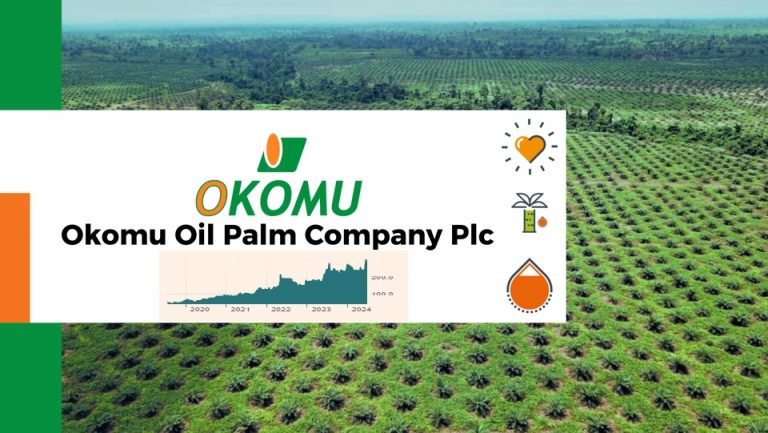
Okomu Oil Palm Company Plc has recorded its highest-ever net profit of N39.9 billion in 2024, a staggering 94 percent increase from the N20.6 billion it posted in 2023, positioning the firm as one of the clear winners in Nigeria’s fast-rising palm oil sector, which is quietly turning into one of the country’s most profitable agribusiness frontiers.
Speaking at the company’s 45th Annual General Meeting held Thursday in Abuja, Board Chairman Gbenga Oyebode described 2024 as a remarkable year for the company despite an “exceptionally challenging” economic environment.
“The company’s net profit for 2024 on continuing operations increased by approximately 94 per cent,” Oyebode said. “This exceptional performance was mainly fueled by a sustained rise in the prices of our products. Crude Palm Oil (CPO) prices experienced approximately a 35 percent year-on-year increase, coupled with a 194 percent rise in rubber prices.”
Register for Tekedia Mini-MBA edition 20 (June 8 – Sept 5, 2026).
Register for Tekedia AI in Business Masterclass.
Join Tekedia Capital Syndicate and co-invest in great global startups.
Register for Tekedia AI Lab.
He said Okomu generated N107.5 billion in revenue from palm oil products alone — up 60 percent from the previous year. But its cost of sales also surged, jumping by 73 percent to N40.8 billion due to inflationary pressure and high operational expenses, such as energy, logistics, and raw material inputs.
Nigeria’s Palm Oil Comeback
Despite these cost burdens, Okomu emerged stronger, and the result is now placing Nigeria’s palm oil sector in sharper focus. The industry, once in decline after Malaysia and Indonesia outpaced Nigeria in global production, is now seeing a revival — and Okomu’s performance is proof.
Palm oil, traditionally a staple in Nigerian households, is regaining its economic relevance. In recent years, top producers like Okomu Oil and Presco Plc have posted stellar results, benefitting from rising global prices, export demand, and import restrictions that have pushed local consumption higher.

In 2023, Presco Plc posted an all-time high revenue of N105.5 billion and a net profit of N34.8 billion — figures that mirrored Okomu’s strong upward trend. Like Okomu, Presco attributed its growth to a combination of price increases and operational expansion.
Nigeria’s palm oil output stands at about 1.4 million metric tons, but local demand is nearly 2.1 million metric tons, creating a significant shortfall that keeps domestic prices elevated. With the Central Bank of Nigeria (CBN) restricting access to forex for palm oil importers since 2015, local producers have the opportunity to command the market, enjoying price premiums and increased demand.
Between 2020 and 2024, average palm oil prices in Nigeria surged surged from about N400,000 per metric ton to over N950,000 per metric ton in 2024. The price then further increased to N1.3 million per metric ton by the end of 2024, driven by global supply constraints, currency devaluation, and the removal of fuel subsidies, which pushed up transportation and production costs.

This has made the business wildly profitable for operators with production scale, plantation assets, and strong market access.
Okomu says it currently maintains a total oil palm plantation area of 19,071 hectares, with 18,349 hectares already matured and 662 hectares classified as new or immature. The company also remains one of Nigeria’s few major rubber exporters, a strategic edge in an economy where access to foreign exchange has become increasingly elusive.
“We export the rubber we produce,” Oyebode noted. “And our company continues to be a significant investor in Edo State by supporting our local communities and shareholders.”
Dr Graham Hefer, the company’s Managing Director, said that Okomu’s success came despite “a high-inflation environment coupled with difficulties in accessing foreign exchange,” which negatively impacted the cost of sales. He credited the company’s ability to hedge against these challenges through price optimization and cost control.
“The company has done very well in managing these costs, generating better revenue, and we are able to provide better dividends to our shareholders,” Hefer said.
Nigeria’s Harsh Business Climate Still a Threat
Okomu’s record-breaking earnings came against a backdrop of severe macroeconomic volatility. In 2024, Nigeria witnessed the highest inflation in three decades — peaking at 34.8 percent — alongside a massive depreciation of the naira and sharp hikes in petrol prices following subsidy removal.
Oyebode warned that the business environment remains “demanding and hostile,” with mounting debt service costs eating into government revenue and inflation spiraling costs for both businesses and households.
However, these very distortions — especially import restrictions, rising local demand, and naira depreciation — are creating an unusual tailwind for agro-exporters and import-substitution players like Okomu.
A Sector Reawakening
Nigeria was once the world’s largest palm oil producer in the 1960s, contributing 43 percent of global output. Today, it contributes only 3-5% of global output. But the sector is stirring back to life, largely thanks to private-sector players reviving aging plantations, embracing mechanized processing, and capitalizing on rising local demand.
Recent figures from the National Bureau of Statistics (NBS) show that agriculture remains Nigeria’s second-largest contributor to GDP, with crop production — including palm oil — accounting for over 80 percent of the agricultural sector’s output.
The Nigerian Investment Promotion Commission (NIPC) recently listed palm oil as one of Nigeria’s top investment-ready sectors, citing rising profitability, an ever-growing market, and government support through incentives like the Anchor Borrowers’ Programme.
With producers like Okomu now showing that profits can rival those of industrial firms, analysts believe palm oil is fast becoming Nigeria’s new gold.
How can I be part of this investment
WELL WORK TO OKOMU,I WILL LOVE TO BE EMPLOYED IN THIS COMPANY