

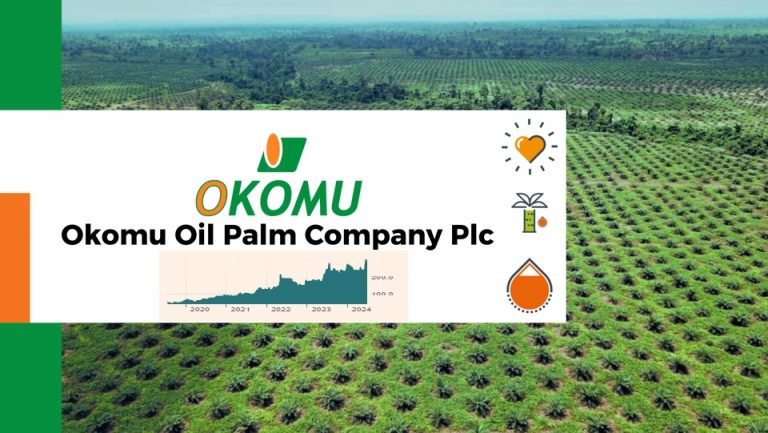
Okomu Oil Palm Company Plc reported a pre-tax profit of N87.3 billion for the year ended 31 December 2025, marking a 63.64% increase from N53.3 billion in 2024, according to its unaudited financial statements.
The performance was underpinned by strong revenue growth across its oil palm and rubber segments, although fourth-quarter pre-tax profit declined to N3.2 billion from N12.5 billion in the same period of 2024, suggesting a softer close to the year.
Turnover rose 52.35% year-on-year to N198.1 billion, reflecting both volume expansion and favorable pricing conditions in Nigeria’s palm oil market. Earnings per share climbed to N66.60 from N41.89, reinforcing improved shareholder returns.
Register for Tekedia Mini-MBA edition 20 (June 8 – Sept 5, 2026).
Register for Tekedia AI in Business Masterclass.
Join Tekedia Capital Syndicate and co-invest in great global startups.
Register for Tekedia AI Lab.
Revenue Surge Mirrors Sector-Wide Expansion
A closer look at the numbers shows that local sales drove the bulk of the increase. Revenue from domestic palm oil and rubber sales jumped 60.53% to N172.6 billion, while export revenue rose modestly to N25.5 billion from N22.5 billion.
The strong topline expansion mirrors broader developments in Nigeria’s palm oil sector, which recorded significant growth in 2025. Industry participants benefited from elevated domestic prices, improved plantation yields, and tighter import conditions that supported local producers.
Nigeria remains one of Africa’s largest consumers of palm oil, with demand driven by food processing, consumer goods manufacturing, and industrial applications. Import substitution policies, currency pressures, and rising global edible oil prices have encouraged greater reliance on domestic production, creating favorable conditions for established operators like Okomu.

Analysts expect the sector’s momentum to carry into 2026, supported by sustained domestic demand, continued capital investment in plantation expansion, and ongoing efforts to boost agricultural productivity. Improved pricing discipline and relatively stable input costs are also projected to underpin margins.
Margin Expansion and Operational Leverage
Cost of sales increased to N58.5 billion from N48.4 billion, but the pace of cost growth lagged revenue expansion, enabling gross profit to rise 71.09% to N139.5 billion. The widening gross margin indicates improved operating leverage and stronger pricing power.
Operating profit advanced 81.77% to N90.03 billion after operating expenses of N49.5 billion were accounted for. The company maintained cost discipline even as revenue scaled sharply.

Finance income stood at N11.07 billion, while finance costs rose to N13.7 billion. After net finance charges, pre-tax profit reached N87.3 billion. A tax charge of N23.7 billion resulted in profit after tax of N63.5 billion, representing a 59% increase year-on-year.
The drop in fourth-quarter profit may reflect seasonal production cycles, inventory timing, or commodity price moderation toward year-end. Investors are likely to monitor first-quarter 2026 results to assess whether this was temporary or indicative of a trend.
Strengthened Asset Base and Capital Position
On the balance sheet, fixed assets rose 20.34% to N81.5 billion, signaling ongoing capital expenditure in plantation development, milling capacity, and operational infrastructure.
Current assets increased slightly to N41.6 billion, supported by cash holdings of N12.9 billion and inventory valued at N20.7 billion. The inventory position may reflect anticipation of continued strong demand in early 2026.
Total equity stood at N56 billion, marginally above N55.4 billion in 2024, with revenue reserves accounting for 97.3% of shareholders’ funds. Revenue reserves rose to N54.5 billion, reflecting retained earnings accumulation.
The modest rise in total equity relative to profit growth suggests dividend distributions or reinvestment decisions could shape shareholder returns going forward.
The Market’s Outlook
As of mid-day trading on 13 February 2026, Okomu’s share price stood at N1,327, up 9.99% on the day. The stock has delivered a year-to-date return of 21%, indicating strong investor appetite.
The company’s performance aligns with renewed investor interest in agribusiness stocks, particularly those benefiting from structural shifts toward domestic production and food security initiatives.
Looking ahead, sustaining momentum will depend on several factors: plantation yield performance, global edible oil price trends, exchange rate stability, input cost management, and weather conditions. However, with Nigeria’s palm oil sector experiencing strong structural tailwinds and analysts projecting continued expansion in 2026, Okomu appears positioned to consolidate its gains.
The 2025 results not only reflect company-level execution but also underscore the broader transformation underway in Nigeria’s palm oil industry, where rising domestic demand and strategic investment are reshaping the sector’s growth trajectory.