

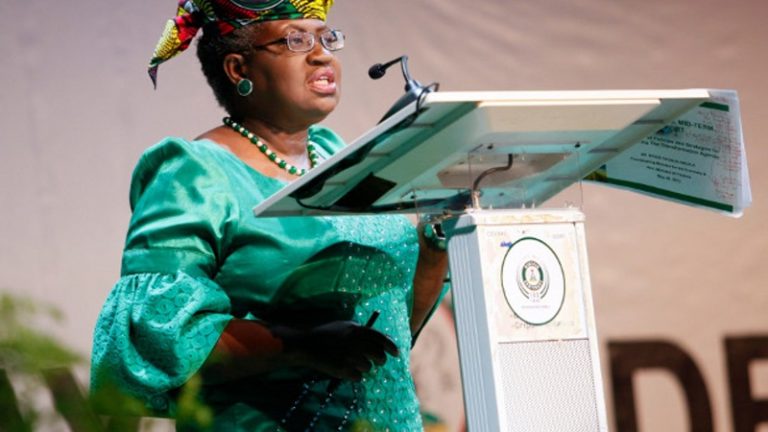
The Director-General of the World Trade Organisation (WTO), Dr. Ngozi Okonjo-Iweala, has issued a stern call to African leaders, urging them to abandon their long-standing reliance on foreign aid and instead mobilize domestic resources to attract investments and drive economic growth.
Her remarks come at a critical time, as the recent suspension of the United States Agency for International Development (USAID) by the US government has thrown many African countries into uncertainty, exposing the continent’s dangerous overdependence on external assistance.
Speaking on the sidelines of the African Union (AU) meeting in Ethiopia, Okonjo-Iweala warned that the continued dependence on aid not only hinders economic self-sufficiency but also leaves African nations vulnerable to abrupt policy shifts from donor countries.
“Africa really needs to change its mindset about access to aid. We should begin to see it as a thing of the past,” she said.
Instead of waiting for handouts, the WTO chief advised that Africa should focus on two key areas: attracting investment and mobilizing domestic financial resources.
The Impact of USAID Suspension in Africa
Okonjo-Iweala’s call comes amid mounting concerns over the recent suspension of USAID operations by the US government, which has left thousands of aid-dependent projects in disarray across Africa. The decision, made by US President Donald Trump’s administration, has triggered controversy and alarm in many African countries, which have historically relied on USAID-funded programs for critical sectors such as healthcare, education, agriculture, and infrastructure.
USAID is one of the largest sources of development aid for Africa, with an annual budget exceeding $20 billion for projects across the continent. It plays a major role in funding programs related to:
- Healthcare (HIV/AIDS treatment, malaria eradication, maternal and child health)
- Food security and agriculture
- Education and literacy programs
- Economic development and infrastructure
- Democracy and governance initiatives
Several African nations, including Nigeria, Kenya, Ethiopia, Ghana, South Africa, and Uganda, have historically been top beneficiaries of USAID funding. The agency’s sudden suspension has left many governments scrambling to fill the funding gap, exposing the fragility of their financial planning and economic policies.
Africa’s Overreliance on Aid is A Dangerous Precedent
Despite Africa’s vast natural and financial resources, the continent continues to heavily depend on external assistance, making it vulnerable to abrupt policy changes in donor nations. According to economic analysts, foreign aid often comes with political strings attached, limiting the sovereignty of African governments in decision-making.
By depending on aid rather than building self-sustaining economies, African nations have weakened their bargaining power on the global stage, often being forced to adhere to donor-imposed conditions that may not always align with their national interests.
Okonjo-Iweala argued that African nations have enough domestic wealth to finance their own development, but leaders must be willing to mobilize these resources efficiently.
Unlocking Africa’s Domestic Wealth Through Pension Funds and Development Banks
A major financial asset that Africa has failed to effectively leverage, according to Okonjo-Iweala, is pension funds. She revealed that the continent holds approximately $250 billion in pension assets, yet much of this money is invested outside Africa, benefiting foreign economies instead of driving local growth.
“The biggest pension funds are in South Africa, followed by Nigeria, Kenya, Morocco, Botswana, and Namibia. These resources are hugely significant, and we need to find ways to tap into them,” she said.
She also emphasized the need to recapitalize Africa’s multilateral development banks, such as the African Finance Corporation (AFC), which have a combined balance sheet of only $70 billion, despite Africa’s annual infrastructure financing gap of over $200 billion.
“Instead of looking outward for financial support, we must strengthen our own institutions,” she urged.
Halting Export of Raw Materials Without Value Addition
Beyond financial resources, Okonjo-Iweala stressed that Africa must take full control of its vast mineral wealth and develop local industries to process its raw materials. She pointed to minerals like lithium, manganese, and copper, which are crucial for electric vehicle (EV) battery production, as prime examples of Africa’s underutilized potential.
Instead of exporting these raw materials cheaply, Africa should invest in processing plants to create jobs, boost intra-continental trade, and develop a strong industrial base.
“We need to develop our processing industries to create jobs, boost intra-continental trade, and ensure we stop exporting raw materials without value addition,” she stated.
Leveraging technology can certainly leapfrog such reforms. Spot-on Madam Secretary!
I have enjoyed the content. It is true Africa needs to wake up and take control of it’s resources for the good of it’s people.