

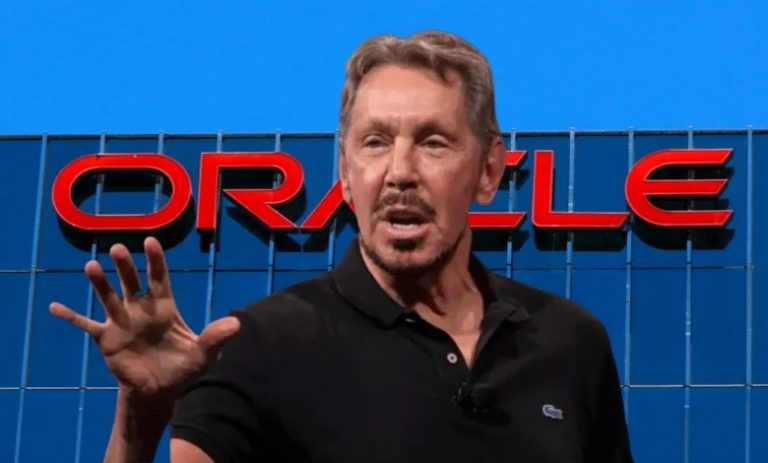
Oracle’s bond market turbulence deepened this week after fresh concerns surfaced over the company’s plan to take on another $38 billion in debt to fund its cloud and artificial-intelligence buildout.
The unease followed reporting by CNBC that the company intends to load significantly more leverage onto an already heavy debt stack, prompting renewed scrutiny from analysts and fixed-income investors.
Oracle has committed billions of dollars this year to expand its cloud and AI infrastructure. That effort has already pushed its outstanding debt to about $104 billion, including $18 billion in bonds, leaving the company spending more than it generates from operations as it chases long-term profit through major capacity contracts with firms such as OpenAI.
Register for Tekedia Mini-MBA edition 20 (June 8 – Sept 5, 2026).
Register for Tekedia AI in Business Masterclass.
Join Tekedia Capital Syndicate and co-invest in great global startups.
Register for Tekedia AI Lab.
The market reaction has been immediate. Prices for Oracle’s 2033 bonds, carrying a 4.9% coupon, have slipped, lifting yields by more than three basis points over the last two weeks. Newer 2032 bonds with a 4.8% coupon have also seen yields climb by nearly two basis points in a week, according to traders monitoring the action.
The added pressure comes at a moment when several big tech names are leaning on debt markets to maintain their capital-spending and stock-buyback plans. Lisa Shalett, chief investment officer at Morgan Stanley Wealth Management, said the pattern has become clear across the industry.
“Most of the major tech companies are trying to sustain their buyback programs at the same time that they’re spending on capex currently and to do that, they’re actually borrowing and so they’re using debt,” she said.

According to Reuters, some of the concerns playing out in Oracle’s bonds have been echoed by credit analysts. Stu Novick of Gimme Credit said activity in the past few sessions indicates rising caution.
“There’s definitely some selling pressure,” he said. “The numbers are enormous and a lot of people are asking, ‘how are they actually making money on this stuff?’”
Even so, others argue the reaction is more of a stress ripple than a sign of deeper trouble. Tim Horan, chief investment officer for fixed income at Chilton Trust, downplayed the idea that the dip in Oracle’s bonds signals structural risk.

“I’m viewing this more as a bump in the road,” he said. “I don’t think what Oracle is experiencing is symptomatic of a popping of some kind of bond market expensive bubble.”
He added that the company still has levers to pull before it would need to touch dividends.
Beyond the bond moves, heavy spending from major players in the AI race has triggered a broader conversation about whether investors are underestimating the real cost of maintaining these massive infrastructure engines. Michael Burry — known for his prescient bet against the U.S. housing market before the 2008 financial crisis — recently argued that tech giants investing heavily in AI, including Oracle, Microsoft, and Google, have been extending depreciation schedules in ways that smooth reported earnings at a time when their capital outlays are surging. Burry estimated that between 2026 and 2028, those accounting choices could understate depreciation by roughly $176 billion across the sector, artificially lifting profit figures.
The durability of data-center investments has also entered the discussion. Michael Field, chief equity strategist at Morningstar in the Netherlands, said assigning a precise economic life to data-center infrastructure is increasingly difficult.
“It’s decreasing all the time and it could be single, low single-digit years very shortly,” he said. “It could be three to four years and then something’s obsolete, and you have to make a hell of a lot of money in that particular time to pay off the infrastructure that went into that site in the first place.”
That tension, massive upfront spending, short technology cycles, and increasingly careful investors, is now hanging over Oracle’s expansion drive. The company is wagering that long-term AI demand will justify its rising debt. Bond markets, for the moment, are signaling that buyers want more clarity before taking that on faith.