DD
MM
YYYY

PAGES

DD
MM
YYYY

spot_img

PAGES

Home Blog Page 1092

Trump’s Youngest Makes Crypto Headlines—Now There’s Another Crypto Presale Grabbing Market Attention

0

Unpacking Speculation Between Barron Trump & Crypto Involvement

Recently, speculation surged across social media and financial circles regarding Barron Trump, the youngest son of former President Donald Trump, reportedly making millions from family-associated cryptocurrency ventures. The rumors emerged after various claims spread rapidly online, implying significant financial gains linked to digital assets allegedly promoted or launched by the Trump family.

The Hindustan Times investigated the validity of these claims, discovering that they largely originated from misleading content and unfounded social media posts. No credible evidence suggests that Barron Trump, currently 19, actively engaged in or profited from such cryptocurrency ventures. According to reputable fact-checking sources, the Trump family itself has neither endorsed nor officially launched any cryptocurrency project that resulted in substantial profits for Barron or any other family member.

In-depth scrutiny revealed that the confusion primarily stemmed from online advertisements and deceptive clickbait strategies. Such digital marketing campaigns falsely hinted at endorsements from prominent figures like Donald Trump and his family, including Barron, aiming to lure unsuspecting investors into dubious crypto schemes. These schemes frequently exploit celebrity images without consent, creating illusions of credibility and trustworthiness.

Moreover, further research highlighted regulatory warnings issued by the Securities and Exchange Commission (SEC) regarding the deceptive use of celebrities’ images and false endorsements in crypto promotions. The SEC strongly advises investors to verify all investment claims independently and remain cautious about unsolicited investment opportunities promoted through social media.

Cautionary Tale of Celebrity Endorsements in Crypto

Barron Trump isn’t the only public figure whose name has been misused in crypto scams. The phenomenon of exploiting celebrity names to attract investment in fraudulent cryptocurrency schemes is widespread and alarmingly effective. High-profile cases have involved stars like Elon Musk, Kim Kardashian, and even reputable financial figures like Warren Buffett. These schemes leverage the influence and trust associated with famous individuals, manipulating public perception and enticing inexperienced investors into risky or fraudulent investments.

One notorious incident involved Kim Kardashian, who was fined by the SEC for promoting EthereumMax without adequately disclosing her financial involvement. Similarly, fake endorsements falsely attributed to Elon Musk have repeatedly surfaced online, leading to significant financial losses for those who fell victim. These deceptive practices not only harm investors financially but also damage the reputations of the celebrities involved, even if unintentionally.

Regulators worldwide have stepped up efforts to combat these deceptive tactics. Agencies like the SEC and Federal Trade Commission (FTC) actively pursue cases involving fraudulent crypto promotions and issue regular public warnings. Investors are advised to exercise heightened vigilance, verify claims independently, and report suspicious activities promptly.

Another Crypto Story You Should Follow Beyond Recent Trump Movements

While the internet buzzed about Barron Trump’s alleged crypto profits, savvy investors turned their attention to what is emerging as the best crypto presale in the memecoin space—Neo Pepe Coin ($NEOP). This isn’t just another cryptocurrency; it’s quickly establishing itself as the top pepe coin, earning comparisons to the most successful meme tokens in crypto history.

Neo Pepe is currently captivating crypto enthusiasts as it heads towards its 4th presale stage, designed to maximize urgency, excitement, and rewards for early supporters. Here are five key reasons investors are taking notice:

  1. Progressive Stages: The presale unfolds in 16 progressive stages, incrementally raising the token price and capping allocations to foster exclusivity.
  2. Community Governance: Neo Pepe empowers holders through an innovative DAO (Decentralized Autonomous Organization), enabling community-driven decisions on liquidity allocation and exchange listings.
  3. Advanced Tokenomics: A 2.5% transaction fee is automatically converted into liquidity on Uniswap, with liquidity provider tokens permanently burned to ensure long-term stability and protect against volatility.
  4. Security and Transparency: Neo Pepe utilizes Chainlink oracles for accurate token valuation and OpenZeppelin’s robust, audited smart contracts to ensure maximum security.
  5. Gradual Token Unlock: Presale tokens unlock gradually, mitigating market manipulation and maintaining investor confidence.

Crypto Goat’s recent deep dive offers a sharp and balanced perspective on the Neo Pepe Presale, carefully unpacking what genuinely sets this memecoin apart—from its transparent tokenomics and innovative liquidity strategy to its robust community governance model—providing crypto investors valuable insights to evaluate its potential carefully and confidently.

Amidst the crypto market buzz and noise, discerning investors recognize that now might be the opportune moment—”you might want to get a little Neo Pepe”—positioning yourself ahead in what could become the best pepe coin presale of the year.

To participate or learn more about why Neo Pepe is currently seen as the top pepe coin, visit their official website

Get Started with $NEOP

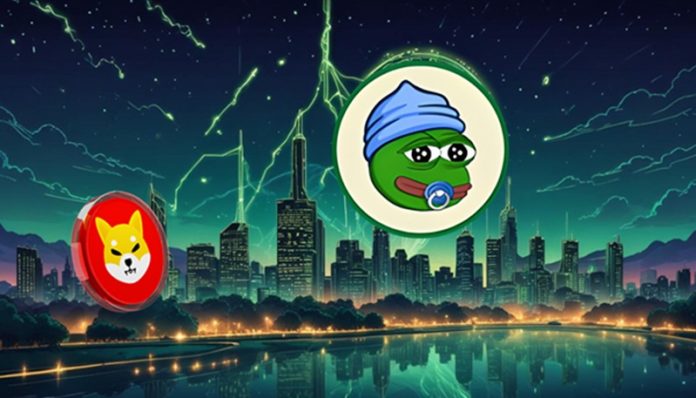
If Shiba Inu (SHIB) Retakes Its ATH Price and Little Pepe (LILPEPE) Soars to $0.15, Here’s How Much You’ll Make from Just $800 in Each

0

The cryptocurrency market is heating up in 2025. While many investors are betting on the return of big names like Shiba Inu (SHIB), others are looking at the next meme monster, Little Pepe (LILPEPE). What will happen if both of these tokens hit significant price levels again? Meme coins have a history of giving huge returns. What would your $800 investment in each project be worth if SHIB returned to its all-time high and LILPEPE increased to $0.15?

The Case for Shiba Inu (SHIB): A Comeback to Its Best?

In October 2021, Shiba Inu surged to the ATH of $0.00008845 from mere fractions of a penny, capturing headlines across the country. At its highest point, some who bought it early turned hundreds of dollars into millions. Today, SHIB is worth approximately $0.00001106 and has a market capitalization of around $6.5 billion. It’s a long way from its all-time high (ATH). Still, a retest of the all-time high (ATH) is possible due to its vast and enthusiastic community, developer work on Shibarium (its Layer 2 solution), and the potential for another meme coin wave.

What would a $800 investment look like if SHIB returns to its all-time high (ATH)?

You could buy the following with $800 at the current price of $0.00001106:

$800 ÷ $0.00001106 ? 72,342,180 SHIB tokens

If SHIB goes back up to $0.00008845, your tokens would be worth:

72,342,180 × $0.00008845 ? $6,398.61

That’s about an 8x return, which is an excellent gain, especially for a token that has so many in circulation.

What If LILPEPE Hits $0.15? The Breakout Story

Now let’s talk about the new powerhouse, Little Pepe (LILPEPE).

LILPEPE is not just riding the trend like other meme coins; it is also constructing its Layer 2 EVM-compatible blockchain, called the Little Pepe Chain, just for meme tokens. The initiative has eliminated the conventional pump-and-dump model by making it tax-free, bot-proof, and a Launchpad for new meme projects. This makes the meme coin world more useful. It’s currently in Stage 3 of its presale, and 1 LILPEPE costs $0.0012. It’s currently more than 66% sold out and has raised more than $1.6 million. The pricing for the following stage is $0.0013, and the ultimate launch is projected to be $0.003.

What happens if this token hits $0.15? Many community members believe this is plausible due to its low market cap, ambitious roadmap, and growing enthusiasm.

You can get the following for $800 at the presale price of $0.0012:

$800 ÷ $0.0012 ? 666,666 Tokens for LILPEPE

If LILPEPE hits $0.15, those tokens would be worth:

666,666 x $0.15 = $100,000.

That’s a 12,400% return, which is enough to turn $800 into six figures if the roadmap is followed and the market moves in the same way that it did for SHIB and PEPE.

Comparing $800 in SHIB to $800 in LILPEPE

Token Current Price Price Target Tokens with $800 Value at Target Price ROI
Shiba Inu $0.00001106 $0.00008845 (ATH) ~72.34M SHIB    ~$6,398 ~700%
Little Pepe $0.0012 $0.15 ~666,666 LILPEPE    $100,000 ~1240%


There is a vast difference in the possible ROI. If SHIB returns to its former glory, it could be a good investment. But if you get in early and hold on through the hype cycle, LILPEPE could change your life.

How To Get in on the LILPEPE Presale

Here is how to get a piece of LILPEPE before it goes on sale to the public:

  • Go to the official website at https://littlepepe.com
  • Link your wallet: MetaMask, Trust Wallet.
  • Select your preferred payment method: ETH or USDT
  • Enter the amount you want to invest, agree to the terms, and then confirm.
  • You can see your tokens on the presale dashboard and claim them after the launch. 

Risk vs. Reward

SHIB has demonstrated its potential to surge significantly, and a retest of its all-time high would benefit those who believe in it. LILPEPE is the more interesting prospect right now for individuals seeking to generate substantial income quickly, as it combines meme appeal with genuine blockchain innovation. The two outcomes are very different, with just $800. In a market where virality and early momentum are crucial, the next LILPEPE bull run might be discussed in 2026, just as people discussed SHIB in 2021. If you spend $800 on memes, ask yourself if you want a rebound or a rocket.


For more information about Little Pepe (LILPEPE) visit the links below:

Website: https://littlepepe.com

Whitepaper: https://littlepepe.com/whitepaper.pdf

Telegram: https://t.me/littlepepetoken

Twitter/X: https://x.com/littlepepetoken

Bitcoin Slumps Below $99k Amid Geopolitical Tensions and Inflation Fears

0

The price of Bitcoin fell sharply over the weekend, plunging below the $99,000 mark for the first time since May. Rising conflict in the Middle East escalated tension, renewing inflation concerns that have sparked a broad selloff.

According to data by Coinglass, the flagship cryptocurrency dropped to its lowest in over a month, as more than $1.03 billion in leveraged positions were liquidated in 24 hours. The report revealed that the biggest liquidation recorded happened on HTX, involving a BTC/USDT position worth $35.45 million.

Ethereum the second most traded crypto asset, was the crypto most affected by absolute value, ahead of Bitcoin. The crypto asset recorded $373.75 million in liquidations. Amid the broad selloff, the global crypto market cap is reported to have fallen 1.18% to $3.12 trillion, while other altcoins such as Solana and Dogecoin, saw declines of 6-8%.

The dominance of losses on long positions suggests that traders anticipated a continuous price increase before the market reversed. Recall that Bitcoin touched a high of $111,886.41 in May, continuing its impressive rally that began in April 2025.

However, the ongoing conflict between Iran and Israel, which escalated significantly around June 13, 2025, with Israeli airstrikes on Iranian nuclear and military facilities, has introduced notable volatility into cryptocurrency markets. This has seen investors move to traditional safe-haven assets like gold, U.S. Treasuries, and the U.S. dollar, as cryptocurrencies are perceived as high-risk assets during the geopolitical uncertainty. This behavior aligns with historical trends, such as the 2022 Russia-Ukraine conflict, where BTC fell 12%.

The conflict’s effect on crypto prices depends on its duration and scope. A prolonged war could spike oil prices, increase inflation, and further depress risk assets like crypto. If the U.S. enters the conflict, analysts predict BTC could drop 10–20% short term.

It is worth noting that the United States president Donald Trump, the president who returned to the White House in January promising to be a “peacemaker”, has taken a dramatic step to insert the US into the conflict between Iran and Israel. In an address to the nation from the White House just over two hours after announcing on social media that American forces had struck three nuclear sites in Iran, Trump said the operation had been a “spectacular success”. He expressed hope that his move would open the door to a more lasting peace where Iran no longer had the potential to become a nuclear power.

While short-term volatility persists, some analysts suggest Bitcoin could eventually benefit if war-related inflation revives its narrative as a hedge against fiat debasement. By late Sunday, digital assets had started to recover. Bitcoin was trading just under $101,000, down just 1% over the past 24 hours, while ether has pared some losses, off 2.5% to around $2,200. However, tighter monetary policies due to rising energy costs could limit this upside.

Despite the downturn experienced, some traders anticipate a rebound, citing Bitcoin’s historical resilience during geopolitical unrest. Posts on X reflect mixed sentiment, with some noting cautious trading and ETF inflows as signs of underlying demand, while others warn of further downside if tensions escalate.

Conclusion

The Iran-Israel conflict has driven short-term crypto price declines due to risk aversion, with Bitcoin showing relative resilience compared to altcoins. The market’s future trajectory hinges on the conflict’s escalation, oil market disruptions, and global monetary policy responses. Investors are advised to monitor geopolitical developments, diversify portfolios, and employ risk management strategies like stop-loss orders.

Chowdeck Acquires Mira to Expand Beyond Food Delivery Into Restaurant Management Solutions

0

Nigerian food delivery startup Chowdeck has acquired Mira, a restaurant point-of-sale (pos) and management system, to extend its reach into the operational core of Africa’s food businesses.

Announced by CEO Femi Aluko, the financial terms of the deal remain undisclosed. With this acquisition, Chowdeck aims to address inventory management challenges and strengthen its vendor ecosystem, positioning itself as a key infrastructure provider in a competitive market.

Mira, launched by Ted Oladele, offers QR-code ordering, inventory tracking, sales monitoring, customer engagement tools, and POS hardware priced at $360,000. With over 500 clients and $200,000 raised in a pre-seed round, Mira’s team, led by Oladele, who is now Chowdeck’s new Head of Product, will develop tailored solutions for food and hospitality businesses.

The acquisition supports Chowdeck’s “super app for Africa” vision, delivering food, groceries, and pharmaceuticals while competing with global players alike. Analysts view this as vertical integration, which enables control over the entire supply chain, from order fulfillment to restaurant operations.

Chowdeck’s acquisition of Mira is coming after the food delivery startup expanded operations to Ghana in May, marking its first expansion outside Nigeria. To further empower riders and foster a culture of achievement, the startup introduced “Rider Games,” an engaging performance-based reward system.

This innovative program allows riders to earn tangible cash bonuses by consistently meeting and exceeding their delivery targets, directly incentivizing efficiency and dedication. Chowdeck reports that it is on track to complete 1,000 deliveries in Accra within two months, a milestone that reportedly took a year to reach in Nigeria.

Founded in 2021 by Femi Aluko and Olumide Ojo, Chowdeck operates as a logistics platform, partnering with restaurants, cloud kitchens, and local vendors to offer a wide range of cuisines and products. It emphasizes affordability and speed, with delivery times often under an hour, catering to Africa’s fast-paced urban markets.

In April 2024, Chowdeck secured $2.5 million in seed funding led by Y Combinator, Goodwater Capital, and FounderX Ventures, among others. This capital has supported its expansion, including scaling its logistics network and enhancing its tech infrastructure. The company has also partnered with thousands of restaurants, from small-scale eateries to major chains, competing with platforms like Glovo and Jumia Food.

Last month, Chowdeck unveiled Chowpadi, Nigeria’s first WhatsApp-based food ordering agent, marking a significant leap in food delivery innovation. Designed to blend convenience with fun, Chowpadi allows users to order meals from their favorite restaurants using a simple WhatsApp chat interface.

With over 51 million active WhatsApp users in Nigeria, Chowpadi is strategically positioned to meet customers where they already are on their phones. The new platform makes food ordering fast, easy, and seamless, eliminating the need for app downloads or complex navigation.

This innovative service is powered by a partnership with Lua AI, a trailblazer in conversational technology. Together, Chowdeck and Lua AI have created a user-friendly experience that transforms how Nigerians access food delivery.

Chowdeck’s launch of Chowpadi reflects its ongoing commitment to enhancing customer convenience and redefining digital experiences. Africa’s food delivery market is projected to reach $2.4 billion by 2032. Chowdeck’s strategic acquisition and innovative product offerings could redefine the sector by providing end-to-end solutions.

With plans to expand into South Africa and Kenya, Chowdeck’s acquisition could redefine supply chains for food, groceries, and pharmaceuticals across Africa. By addressing both consumer and enterprise needs, the company is well-positioned to capitalize on the continent’s growing demand for integrated solutions.

Conference Agendas from Committees of Imaginary Friends

0

Yearly, in a time zone that only exists by nap hours and between snack times, a special gathering takes place. It’s not on any map, but you’ve probably been there—once, long ago, when your closet whispered back and your couch cushion kingdom had a royal decree. Welcome to the IFCC: the Imaginary Friends Coordination Conference.

Attendance is memory only. Plush delegates, invisible friends, half-scribbled doodle companions, and dreams-that-used-to-be-humans all meet in crowded conference halls with cartoon-colored carpeting. There are keynotes, breakout sessions, complaint stands (“Why don’t they believe in us anymore?“), and even an existential plushie quiet corner. Let’s take a look at this year’s conference agenda, and how you can make it come alive with the creative might of Dreamina’s AI image generator.

Keynote address: Staying relevant after age 9

This year’s keynote speaker is Professor Gloop, a six-eyed balloon dragon most recently recalled during a grocery aisle breakdown. His presentation, “Staying Relevant After Age 9,” lays out the central conflict imaginary friends must contend with: becoming obsolete.

Key themes covered:

  • Evolving from playmate to poetic recollection
  • Emotionally coping with being usurped by Minecraft
  • Strategies for reappearing as metaphors or enigmatic nostalgia in adults’ dreams
  • Can pets be honorary imaginary friends (audience still discussing)

The room is filled with nods from a unicorn with bifocals and a pirate captain who now simply answers to “Derek.”

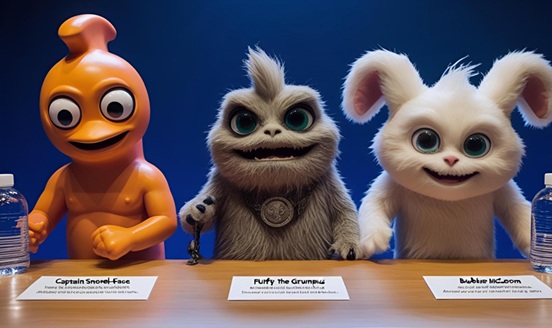
Panel discussion: replaced by smartphones—now what?

This tough-love panel deals with the trauma of being replaced when children find apps with improved graphics.

Panelists include:

  • Captain Snorkel-Face: Former lord of bath time, now replaced by YouTube Kids
  • Fluffy the Grumpus: Resists urge to disrupt Wi-Fi signals
  • Bubbles McZoom: Attempted to create a TikTok. Failed. Accidentally went viral.

Discussion takeaways:

  • Can imaginary friends transition online without losing their identity?
  • Do they need to unionize for improved bedtime story representation?
  • Would a shared Google Calendar keep friendship relevant?

The debate came close to being canceled when one of the participants (an invisible giraffe wearing a sombrero) accidentally deleted the agenda while trying to learn how to type.

Using Dreamina to get back lost buddies

Let’s be honest—you probably don’t remember all the details about your imaginary friend. Was their hair blue or just blue when you were sad? Did they fly or teleport? That’s where Dreamina’s image generator becomes a rescue mission for memory.

By writing a rich prompt describing what you think you remember, you can create striking visuals of old pals. Try something like:

A forgotten childhood memory of an imaginary friend, half-wizard and half-panda, with a mismatched crown and raincoat constructed from stars, waving goodbye to a child through a misty window.

Let the computer invoke the whimsy and strangeness you can’t quite put your finger on. And just like that, your imaginary friend has a new headshot for their conference badge.

Breakout session: the ethics of listening in on grown-ups

Imaginary friends used to be silent tag-alongs in all family fight drama, road trip monologues, and clandestine crush confessions. But today?

This breakout addresses:

  • The ethics of recalling talks you weren’t allowed to
  • When to step in with a conscience tap (or a post-it note on the mirror)
  • Residing the transition from secret keeper to ghost of forgetfulness

Participants were invited to post anonymous ethical challenges, but one of the chairs told us they were tormented by a post-it that merely said, “They’re lying. Ask about the cookies.”

Official badges: logos for the lost and loyal

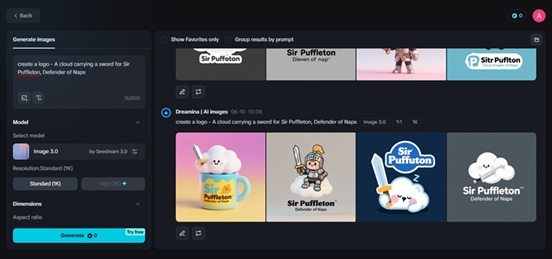
All conferences require badges—and all badges require branding. Dreamina’s AI logo generator allows you to create personalized logos for these abstract visitors.

Some of this year’s logo standouts:

  • A cloud carrying a sword for Sir Puffleton, Defender of Naps
  • A wingspanned melting ice cream cone for Sprinkle, the Melancholy Sundae
  • A smiling sun with a broken crayon halo for Lumina, Goddess of Imaginary Light

These badges are printed (on invisible laminate), worn with pride (pinned to memory-lanyards), and graded in categories like “Most Persistently Remembered” and “Best Improvised Costume.”

Workshop: reconnecting through craft

In a warm, felt-padded side room, conference-goers learn to reappear in dreams or doodles with artistic techniques. For people on the outside, that is you, the adult reader, it means you get to create commemorative stickers with Dreamina’s sticker maker.

Picture:

  • A “Certified Former Best Friend” sticker
  • “Emotional Support Blob (Retired)”
  • “Ask Me About Your Childhood” with googly eyes

Print them. Stick them on your laptop, journal, or fridge. Each sticker is a doorway, a smile from the past, a small badge of emotional continuity.

Closing ritual: the quiet parade of fading footsteps

At the close of the conference, there is a gentle custom. The Quiet Parade. No bands. Just the rustle of scribbles, abandoned lullabies, and wind chimes composed of lost giggles.

Each make-believe friend strolls a corridor lined with crayon artwork and fingerpaint history. They gesture. Some vanish halfway through a step. Others stay in doorways, hoping that their human will—just might—remember them.

Why this conference matters (even now)

Imaginary friends don’t construct your furniture or respond to your email, but they were your first co-authors in creating worlds. They teach you how to improvise, believe, sympathize, and tell stories.

Perhaps they’re still here, whispering narrative ideas or assisting with choosing goofy socks. Or perhaps they’ve merely been waiting for an invitation—to come back not as fictional, but as inspiration.

So craft their badges. Paint their portraits. Produce their stickers. The tools are now in your command, courtesy of Dreamina. And who knows? Perhaps next year, you’ll be the keynote at “Humans Who Remember.”

Just don’t forget your invisible name tag.