DD
MM
YYYY

PAGES

DD
MM
YYYY

spot_img

PAGES

Home Blog Page 11

Good luck if you’ve picked the Entrepreneurship Lane

0

Every year, thousands of people announce that they are starting a company. Social media celebrates entrepreneurs as heroes, venture capital rounds become headlines, unicorns become legends, and successful founders are presented as symbols of freedom, wealth, and influence. The narrative is attractive: identify an idea, build a product, raise money, scale rapidly, ring the bell on a stock exchange, and retire wealthy.

Unfortunately, that is not how entrepreneurship works for most people. Entrepreneurship is not a vacation job. It is one of the most demanding professions in the world, and before anyone decides to enter it, the person must understand one simple reality: building a company is a commitment to solving problems every day for many years!

There will be difficult days. There will be disappointments, uncertainty, rejection, and sacrifice. But when a company genuinely reduces a market friction and consistently creates value for customers, the market can reward it. The entrepreneur’s mission is not merely to launch a business. It is to redesign a market by making a friction disappear.

And if you get it wrong, there will be wahala. Many people venture into entrepreneurship because they dislike their jobs, desire more freedom, or believe owning a business will give them greater control over their time. The reality, however, is very different. Running a company is almost always harder than working for one.

If you remember your Integrated Science classes in junior secondary school, you will recall the concept of optical illusion where what appears to be true is not actually true. Entrepreneurship has its own version of that illusion.

From a distance, owning a business looks like freedom. You become your own boss, set your own schedule, and answer to no one. But look more closely, and the picture changes. Instead of working for an employer, you now work for your customers, your employees, your investors, your suppliers, your regulators, and your mission. The business begins to dictate your priorities, consume your time, and demand your attention.

In other words, you gain the freedom to build a company, only to become accountable to that company and everything it represents. The freedom is real, but so is the responsibility. And for many entrepreneurs, that responsibility is far more demanding than the job they left behind.

In summary, entrepreneurship is not a vacation job. It is one of the hardest jobs in the world. Yet for those who are prepared to endure, learn, build, and serve, it can also be one of the most meaningful. Good luck if you’ve picked that lane!

Slowly Learn the Rules of Pusoy Online

0

Pusoy online has made one of the Philippines’ most popular card games easier to enjoy than ever before.

Instead of waiting for family gatherings, reunions, or weekends with friends, players can now join a match whenever they have free time.

What makes Pusoy stand out is that winning isn’t determined by luck alone. Every player receives 13 cards, but how those cards are arranged often decides the outcome of the game.

A well-planned hand can outperform one filled with stronger-looking cards if it follows the game’s ranking system correctly.

That combination of strategy, planning, and unpredictability is why the game continues to attract both experienced players and complete beginners.

Learning the fundamentals is simple, but developing the ability to make consistently good decisions is what keeps players coming back for another round.

Understanding the Pusoy Rules Is the Key to Better Matches

Before every game begins, each player receives 13 cards that must be arranged into three separate hands.

The Pusoy rules require one five-card back hand, one five-card middle hand, and one three-card front hand.

Although arranging the cards sounds straightforward, following the proper order is what makes the game challenging.

The back hand should always contain your strongest five-card combination. Players commonly place hands such as a full house, flush, four of a kind, or straight flush in this section because they represent the highest-ranking hands.

The middle hand also consists of five cards, but it cannot be stronger than the back hand.

Meanwhile, the front hand contains only three cards, limiting it to combinations like a high card, one pair, or three of a kind.

If these hands are arranged incorrectly, the result is a foul hand. Even if one section contains an excellent combination, breaking the required order automatically loses the round.

Once every player finishes arranging their cards, the front hands, middle hands, and back hands are compared separately.

Winning more hand comparisons than your opponent gives you the advantage, while winning all three often results in a clean sweep.

Understanding these rules early helps players avoid unnecessary mistakes and build stronger habits from the start.

Mastering the Pusoy Hierarchy Takes Practice and Patience

Learning the Pusoy hierarchy is one of the biggest steps toward becoming a more consistent player.

New players often make the mistake of creating the strongest back hand possible without considering how that decision affects the remaining cards. As a result, their middle and front hands become too weak to compete.

A more effective approach begins by evaluating the entire set of cards before arranging anything.

Many experienced players first look for matching suits because a flush is usually easier to identify than a straight and ranks higher under standard Pusoy hand rankings.

After checking suits, the next step is identifying duplicate values that can form pairs, three of a kind, four of a kind, or full houses.

Every arrangement requires compromise. Strengthening one hand too much often weakens another, making it harder to win multiple comparisons.

Instead of chasing the highest possible ranking for a single hand, experienced players focus on creating three balanced hands that work together.

Over time, recognizing these patterns becomes second nature, allowing players to make better decisions more quickly without sacrificing the overall strength of their arrangement.

Explore Different Ways to Play Pusoy Online

Today’s players have several options when choosing where to enjoy Pusoy online, and each platform offers its own unique experience.

Pusoy Go has become one of the best-known choices thanks to its welcoming design and beginner-friendly features.

New players can quickly learn the basics while participating in online clubs, claiming daily rewards, and joining community activities that make every session more engaging.

Players looking for something more straightforward may prefer Pusoy ZingPlay.

Instead of emphasizing social features, it focuses on efficient matchmaking, responsive controls, and a clean interface that allows players to concentrate on strategy.

Practice modes against AI opponents also provide an excellent opportunity for beginners to improve before entering competitive matches.

Although these platforms differ in presentation, they both preserve the traditional gameplay that has made Pusoy popular for generations.

Some players enjoy earning rewards and interacting with the community, while others simply want uninterrupted matches where they can sharpen their skills.

Trying different platforms allows players to discover which environment best supports their preferred style of play.

Find More Ways to Play Pusoy Online on GameZone

The GameZone platform gives players access to several versions of Pusoy instead of limiting them to a single format.

Players who prefer the traditional experience can start with Pusoy Plus, which closely resembles the classic rules that many Filipino players already know.

Those interested in experimenting with different strategies can try Pusoy Wild, where controlled adjustment mechanics allow players to improve difficult hand arrangements before making their final submission.

Meanwhile, Pusoy Jackpot keeps the familiar gameplay intact while introducing jackpot-based rewards tied to match outcomes.

GameZone also features Pusoy Dos, which offers a completely different objective despite its similar name.

Instead of arranging three hands, players compete to discard all their cards before everyone else.

Having multiple Pusoy variants available in one place gives players the flexibility to switch between traditional and alternative game styles without downloading another application or learning an entirely different platform.

Improve Your Pusoy Online Skills With GameZone

Every Pusoy match offers an opportunity to become a better player, and having a reliable platform to practice makes that process much easier.

GameZone provides an environment where beginners can learn the fundamentals while experienced players continue refining their strategies through regular competition.

Beyond its collection of Pusoy games, the platform also offers other popular Filipino card games such as Tongits and Pusoy Dos, together with casino classics including poker, blackjack, and slots.

As a PAGCOR-licensed online casino, GameZone follows regulations that support fair gameplay, responsible gaming, and secure transactions.

Registering is simple, requiring only one valid government-issued ID and a mobile phone number.

Deposits and withdrawals can also be completed through trusted payment methods such as GCash, Maya, GrabPay, and QR PH.

If you’re looking for a convenient place to enjoy classic Filipino card games while steadily improving your skills, GameZone provides multiple game modes and a practical platform where every match becomes another chance to learn.

FAQs

Q: Is Pusoy the same as Pusoy Dos?
A:
No. Pusoy is a hand-arrangement game, while Pusoy Dos is a shedding game where players race to discard all their cards.

Q: What happens if I arrange my hands incorrectly?
A:
Your hand is considered a foul, which automatically loses the round.

Q: Is Pusoy online suitable for beginners?
A:
Yes. Many platforms provide beginner-friendly matches and practice opportunities to help new players learn the game.

Q: Which Pusoy games are available on GameZone?
A:
GameZone offers Pusoy Plus, Pusoy Wild, Pusoy Jackpot, and Pusoy Dos.

Q: What do I need to register on GameZone?
A:
One valid government-issued ID and a mobile phone number.

Game Providers at the Core: How Innovative Studios Drive the Modern Online Gaming Industry

0

The online gaming ecosystem usually attracts attention through flashy platforms and blockbuster releases, yet the true engine of progress resides in the creative and technical teams that supply fresh content. Market growth, shifting player demographics, and relentless advances in hardware all place new pressures on studios to deliver experiences that feel both familiar and surprising.

A rising generation of specialized developers, including iconic21, illustrates how focused expertise converts abstract ideas into commercially viable products. Concept art, math models, sound design, and compliance checks now unfold in parallel rather than in sequence, reducing launch times while improving overall cohesion.

Value Added Beyond Pure Entertainment

Successful providers contribute far more than a catalog of titles. Robust backend frameworks, adaptable engines, and transparent certification pipelines shape the reputation of entire platforms. Service quality therefore hinges on technical depth as well as creative artistry.

Pillars of Provider Contribution:

  • Mathematical Integrity: Fair randomization algorithms, transparent return-to-player calculations, and independent audits protect user trust and regulatory standing.
  • Cross-Device Performance: Optimized code bases allow seamless shifts from desktop to mobile, preserving frame rates and touch responsiveness without bloated file sizes.
  • Localized Assets: Multilingual text, region-specific imagery, and culturally tuned narratives attract new segments while limiting friction for existing users.
  • Security Toolkits: Built-in anti-fraud modules, robust encryption, and real-time anomaly alerts reduce chargebacks and protect sensitive data.
  • Update Cadence: Regular content drops, seasonal events, and balance tweaks keep engagement metrics healthy long after the honeymoon phase.

Clear priorities in each area distinguish leading providers from studios that merely chase trends. Solid foundations simplify future integrations, whether through virtual reality peripherals or emerging payment rails.

Fresh mechanics also carry strategic weight. Innovations such as skill-based bonus rounds, cooperative progression, and narrative branching encourage repeat visits without relying solely on escalating jackpots. The result: extended session lengths and improved lifetime value.

Emerging Forces Reshaping Provider Roadmaps

Growing user sophistication increasingly drives studios to refine both form and function. Today’s audience expects cinematic polish, instantaneous feedback loops, and transparent reward structures. Providers able to anticipate these demands secure premium distribution deals and stronger brand visibility.

Trends That Influence Roadmaps:

  • Hybrid Monetization Models: Combining cosmetic microtransactions with fixed prizes reshapes revenue projections and broadens appeal.
  • Modular Engines: Swappable physics layers, animation packs, and UI skins accelerate white-label opportunities while maintaining brand differentiation.
  • Adaptive Difficulty: Real-time telemetry adjusts challenge curves to individual behavior patterns, lowering churn for casual participants and sustaining tension for veterans.
  • Environmental Responsibility: Energy-efficient server architecture and carbon-neutral hosting resonate with eco-conscious markets and forward-looking regulators.

Between those forces lies an ongoing balance of novelty and familiarity. Excessive experimentation risks alienating core audiences, yet stale mechanics fade quickly under social-media scrutiny. Providers that analyse telemetry, community feedback, and regional legislation in tandem craft releases capable of withstanding hype cycles.

Strategic partnerships further magnify reach. Collaboration with payment processors, esports organizers, and streaming influencers turns each launch into a multi-platform event rather than a quiet catalog addition. The provider thereby secures an expanded marketing funnel without shouldering every promotional cost alone.

Conclusion: A Quiet Powerhouse Behind Every Click

While spotlight narratives often celebrate front-end aggregators, the sustained health of the online gaming sector ultimately rests on provider innovation. Standardized security protocols, breathtaking art, and resilient code bases combine to form a virtuous loop that benefits operators and players alike. Continuous refinement remains essential, because audience taste evolves as quickly as underlying technology. Studios that treat each release as a living product rather than a static deliverable will define the next chapter of interactive entertainment.

From faster loading screens to ethical monetization, providers hold the keys to progress. Platforms that recognise and nurture such expertise position themselves for durable growth, and players gain richer experiences in return. The modern industry, therefore, is not merely shaped by providers; it is actively carried forward by them—one meticulously balanced title at a time.

Manufactured Fear in Osun 2026 Governorship Election

0

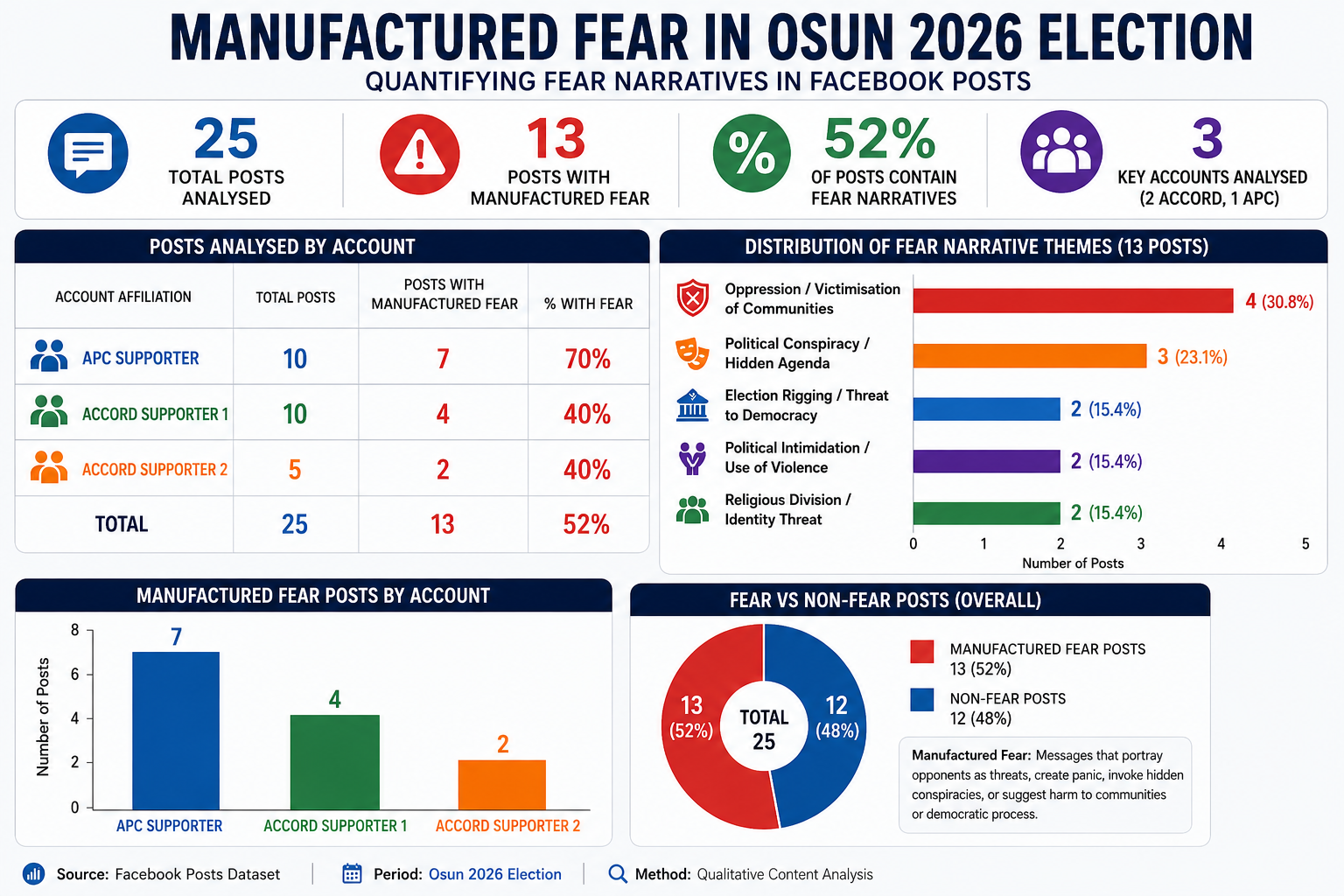
As the Osun State governorship election approaches, campaign communication is becoming increasingly emotional. While elections should ideally revolve around competing policy proposals and governance records, a growing pattern has emerged across social media. Political actors and their supporters are attempting to influence voters not only through promises and achievements but also through fear. This strategy, often described as manufactured fear, involves constructing narratives that portray political opponents as threats to communities, democracy and the future of the state.

An analysis of Facebook posts from influential supporters of the All Progressives Congress (APC) and the Accord Party shows that manufactured fear has become an important feature of the online campaign. Although many posts focus on endorsements, campaign activities and development achievements, several messages go further by encouraging voters to believe that electing the opposing party would expose them to oppression, instability, deception or intimidation.

One prominent pattern is the portrayal of the incumbent administration as hostile to particular communities. Rather than presenting governance shortcomings as administrative failures, several posts attribute deliberate malice to the government. One message urges voters to support the opposition in order to “rescue the community” from oppression and injustice. Another questions why a particular community has become the target of government “hatred” while alleging deliberate neglect of infrastructure and public services. Such messages transform electoral competition into a struggle for survival by suggesting that communities are being punished because of their political identity. This framing encourages voters to perceive political change not as a democratic choice but as an urgent necessity.

Another recurring strategy is the construction of hidden political conspiracies. Posts alleging that political emissaries offered huge sums of money to induce defections or claiming that senior government officials were preparing to abandon the administration create an impression of widespread instability within government. Whether these allegations are substantiated is less important than their communicative effect. Repeated exposure to such claims encourages citizens to believe that government institutions are collapsing behind the scenes and that the administration is rapidly losing legitimacy.

Supporters of the governing party deploy manufactured fear differently. Rather than portraying the opposition as oppressive, they frame it as a threat to democratic stability and social cohesion. Some posts accuse opposition actors of promoting dangerous religious narratives in an attempt to divide voters. Given Nigeria’s history of religious tensions, such messages invite citizens to associate the opposition with social instability rather than democratic competition. Other posts introduce concerns about electoral manipulation by referring to claims that external political actors could influence the election. Even when such claims are dismissed, their repeated circulation keeps electoral insecurity within public discourse.

Another strand of communication portrays the opposition as increasingly desperate and willing to employ intimidation. Several posts allege the destruction of campaign materials and billboards after unsuccessful political rallies. These messages encourage supporters to interpret political setbacks as evidence that opponents may resort to coercion instead of democratic persuasion. Whether these allegations are ultimately verified is separate from the communication strategy itself. The intended effect is to portray political opponents as willing to undermine peaceful electoral competition.

The analysis also suggests that manufactured fear is not the dominant communication strategy employed by either political camp. Many posts focus on campaign momentum, endorsements by influential individuals, infrastructure projects and criticism of opponents’ performance. However, the fear narratives stand out because they redefine elections as contests between safety and danger rather than between competing policy alternatives. Voters are encouraged to believe that failure to support one candidate could expose their communities to oppression, corruption, violence or social division.

Perhaps the most significant finding is that both political camps construct different versions of fear while pursuing the same objective. Opposition-aligned messages depict the incumbent administration as vindictive, discriminatory and hostile to dissenting communities. Pro-government messages portray the opposition as deceptive, intolerant and prepared to undermine democratic norms through intimidation or divisive identity politics. In both cases, electoral choices are framed less around governance performance than around avoiding perceived threats posed by political opponents.

This communication strategy carries significant implications for democratic consolidation in Osun State. When political actors consistently present rivals as existential threats, public trust in democratic institutions begins to erode. Elections become less about evaluating policies and more about defeating perceived enemies. Such narratives deepen political polarisation, increase suspicion between supporters of rival parties and make post-election reconciliation more difficult.

As campaigning intensifies ahead of the Osun 2026 election, political parties, candidates and their supporters should recognise that every message shared online contributes to the broader democratic environment. Robust criticism and political competition are essential features of democracy, but campaigns that deliberately amplify fear risk weakening the very democratic institutions they seek to control. The long-term health of Osun’s democracy will depend not only on the credibility of the election itself but also on the quality of political communication that shapes citizens’ choices before they cast their votes.

Navigating the Information Storm in Osun 2026 Election

0

The upcoming Osun State governorship election, scheduled for August 15, 2026, has emerged as a critical barometer for the health of Nigeria’s democracy ahead of the 2027 general elections. Since the lifting of the ban on political campaigns, the state has become a primary theatre for Information Manipulation and Interference (IMI), where digital platforms are weaponised to distort public discourse and erode institutional trust. As “polluted messages”, ranging from AI-generated deepfakes to coordinated smear campaigns, intensify, a diverse array of actors is mounting a sophisticated, multi-layered response to safeguard the integrity of the vote.

The Anatomy of the Threat

The current campaign landscape in Osun is defined by high social media penetration and a troubling trust deficit in electoral institutions. Malign actors are exploiting these vulnerabilities through fabricated content, such as false claims of voter registration fraud by the Independent National Electoral Commission (INEC). Furthermore, the deployment of performance misinformation, such as unproven claims regarding the hiring of 5,000 teachers, and reputation manipulation targeting leading candidates has become commonplace. Perhaps most dangerous are the fear-based falsehoods, including social media reports of alleged bandit invasions in Inisa and Oyan, which were designed to suppress voter turnout before being debunked by the Nigeria Police Force.

Strategic Responses: Early Warning and Grassroots Monitoring

In a direct response to these security and information threats, the Kukah Centre and the European Union Support to the National Peace Committee (EU-NPC) have launched a 5-day intensive training programme for field observers across all 30 Local Government Areas (LGAs) in Osun. This initiative focuses on the implementation of Early Warning and Early Response (EWER) mechanisms, equipping actors with the skills to identify and report potential security flashpoints and information interference in real-time. By decentralising monitoring, these organisations aim to create a “human shield” of credible data collection that can outpace the viral spread of disinformation. This project, implemented via the STEP-G project in partnership with the Swiss Federal Department of Foreign Affairs, represents a shift toward proactive conflict-sensitive observation.

Institutional Resilience and Digital Literacy

Recognising that the integrity of the election is inextricably linked to the capacity of the electoral umpire, the International Press Centre (IPC) has initiated fact-checking and digital literacy workshops specifically for INEC officials in Osun. This institutional approach is vital; research suggests that when electoral technology, such as the Bimodal Voter Accreditation System (BVAS), is supported by well-trained personnel, it significantly reduces “non-issues” like allegations of manual rigging and ethnoreligious biases. By empowering officials to navigate the digital communication space, actors are effectively “pre-bunking” potential claims of institutional sabotage.

The Ecosystem-Based Response: A Path Forward

Evidence has pointed towards an ecosystem-based response that moves beyond reactive fact-checking. Actors are now looking toward the “building blocks for success” identified in broader African contexts: understanding the local digital threat landscape, investing in diverse coalitions, and taking a hybrid approach that bridges online and offline spaces. In Osun, this means connecting digital forensics labs with community leaders and traditional media to ensure that verified narratives reach rural and peri-urban voters who may be less digitally literate.

In this case, there is a growing call to institutionalise electoral technology as Critical National Digital Infrastructure. By formalising the protection of result transmission portals and accreditation systems, the state can prioritise these assets for cybersecurity coordination and disaster response. Actors are also advocating for a Joint Electoral Cybersecurity Task Force (JECyTF), comprising INEC, the Nigerian Communications Commission (NCC), and security agencies to mitigate algorithmic bias and coordinated sabotage.

Beyond Ballot Boxes

Protecting Osun 2026 requires more than just securing physical ballot boxes; it demands the protection of the information environment itself. The responses from the Kukah Centre, the EU, and the IPC demonstrate recognition that democratic resilience is built on verified facts. As campaigns evolve into the era of synthetic media and deepfakes, the success of these actors in building digital resilience will determine not just the outcome of the Osun governorship, but the stability of Nigeria’s democratic future. The goal is to ensure that the will of the people is driven by informed choice rather than manufactured fear.