DD
MM
YYYY

PAGES

DD
MM
YYYY

spot_img

PAGES

Home Blog Page 1100

Top Penny Crypto to Buy Now? $APORK Gains Momentum as Congress Pushes Crypto Legislation

0

This week the cryptocurrency market unravelled almost overnight, caught midway between rising Middle East hostility and a raw public spat between two of its most famous backers. Traders were jolted when nearly $1.2 billion in long positions evaporated as volatility spiked.

Congress, however, refused to flinch. In a rare display of cross-aisle momentum, a coalition of Democrats and Republicans pushed the Digital Asset Market Clarity Act—one bill that finally tries to pin down the gray zone between a currency and a security. Lobbyists now expect at least a committee mark-up by early December.

While Washington haggles, some investors have decided that waiting for calm is overrated. A deflationary newcomer known as Angry Pepe Fork is luring late-night buyers with sky-high staking yields that flirt with 10,000% APY, and it’s CommunityFi framework let’s holders start earning within hours of their deposit. A handful of hedge funds already describe the token as a high-risk, high-beta hedge on mainstream renewal.

Bitcoin Threatens Five-Digit Territory as Markets Collapse

Bitcoin itself slipped 4% in ugly candles that took it to $100,500 and threatened to thrust it back into five-digit territory for the first time in weeks.

The Trump-Musk Catalyst

The spark was simple enough: Musk, for the second time this month, blasted Trump’s so-called Big Beautiful Bill as a “disgusting abomination,” to which Trump retorted with threats to yank federal contracts from any firm dabbling in disloyal chatter.

Exchanges lit up almost instantly, and Slack rooms of quantitative desks buzzed with orders to trim delta before liquidity vanished. For investors hoarding options, the brief chaos offered a textbook Gamma scalp that padded PnLs by Monday morning.

Political Crypto Holdings Reveal Market Paradox

A financial filing attributed to Donald Trump claims he netted $57.3 million from token placements linked to World Liberty Financial and still controls at least $1 million in ether. Such disclosures underscore how public officials are diversifying into digital assets even as their squabbles send prices swinging.

Middle East Tensions Amplify Crypto Selloff

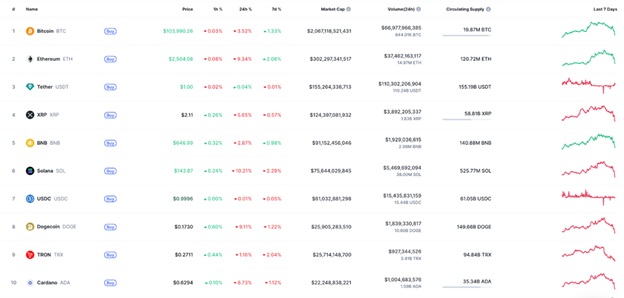
Fresh hostilities in the Middle East injected new stress into global markets almost overnight. Israeli bombardments meant to cripple Iran’s alleged nuclear sites sent the aggregated value of all cryptocurrencies tumbling 7% to about $3.3 trillion, with Bitcoin sliding roughly 5% to $103,464.

Liquidation Tsunami Sweeps Exchanges

Exchange records kept by CoinGlass reveal that forced liquidations surged 125% in 24 hours, reaching a staggering $1.2 billion. Ethereum was knocked down 10% to $2,471, while Solana retraced 11% as jittery traders moved toward traditional havens.
Anxieties rippled beyond crypto when oil futures jumped almost 9% on Friday, pushing West Texas Intermediate crude toward the $74-per-barrel mark and reviving inflation fears that had only just begun to subside.

Congressional Breakthrough: CLARITY Act Advances

In the midst of such turbulence, lawmakers in Washington advanced legislation that could reshape the digital-asset landscape. The CLARITY Act is now scheduled for a full markup before the House Financial Services Committee, with a hearing date targeted for June 10.

Regulatory Framework Revolution

The new 236-page Clarity Act places most digital assets squarely under the Commodity Futures Trading Commission’s watch rather than the Securities and Exchange Commission’s tougher regime. A remarkable bipartisan coalition—three Democrats included—has signed on as co-sponsors, signaling broad political momentum.

In the upper chamber a complementary stablecoin bill is nearing final passage. Senator Ruben Gallego predicts a lopsided vote that could free up institutional dollars now sitting on the sidelines out of sheer regulatory uncertainty.

Angry Pepe Fork: Meme Culture Meets Serious DeFi

Away from Beltway headlines cryptocurrency markets are still feeling the weight of macroeconomic pressure. Enter the presale of Angry Pepe Fork, a project combining meme-culture flair with serious DeFi mechanics, priced right now at $0.0269 and already sparking chatter among risk-loving investors.
Sky-High Staking Yields and Supply Discipline

Early participants can stake their allocation during the sale for eye-popping annual yields of over 10,000%.

Supply discipline is baked in as well—1.9 billion tokens total, with a burning protocol meant to sustain upward price momentum.

Cross-chain availability on Ethereum, BNB Chain, and Solana maximizes the project’s reach.

CommunityFi: Activity-Based Income Revolution

Perhaps the most distinctive feature lies in its CommunityFi experiment: users earn rewards for tweeting, blogging, and otherwise promoting the protocol instead of simply parking coins in a wallet. That activity-based income stream cushions holders when broader markets slump.

GambleFi Integration

Shortly after the initial launch, the interface incorporates a set of on-chain mini-games in which participants stake $APORK tokens. Victors are rewarded on the spot, and a fixed proportion of the staked tokens is burnt, ensuring that the overall supply steadily contracts and every existing holder quietly benefits from the continuous deflationary force.

Presale Momentum Building

A staggered bonus schedule sweetens early participation: those who invest at least $50 earn 5% extra, while purchases of $150, $250, and $500 push the rewards up to 10, 15, and 20% respectively. The bracketed tiers create a built-in incentive for retail backers to commit larger sums sooner rather than later.

Market Outlook: Opportunity in Crisis

Angry Pepe Fork pairs instant-on staking rewards with a design that deliberately shreds supply while also opening several parallel earning channels. That combination gives it an edge over older blockchains now leaking capital amid regulatory headwinds. Members of Congress who once hesitated are drafting bills that lean crypto-friendly, meaning platforms with demonstrable utility and engaged user bases could be first in line for incoming institutional dollars.

The current presale is the rare window that lets new investors board before wide exchange listings and general mainstream attention. History shows that entering at this stage often delivers the richest returns in the cryptocurrency world.

Learn more about the $APORK here: Visit Angry Pepe Fork

Amazon CEO Andy Jassy Confirms AI Will Shrink The E-commerce Workforce, Following $100bn Investment in Expansion

0
Andy Jassy, boss of AWS

Amazon’s CEO Andy Jassy has confirmed what many white-collar workers have feared for years: artificial intelligence is not only here to stay, it will displace jobs.

In a memo sent to employees on Tuesday, Jassy said the company expects its corporate workforce to shrink as it gains efficiency through the adoption of AI, particularly generative AI systems and intelligent agents.

“We will need fewer people doing some of the jobs that are being done today, and more people doing other types of jobs,” Jassy said.

The announcement came as part of a broader internal communication updating employees on Amazon’s fast-expanding AI capabilities. Jassy said generative AI is already embedded in nearly every corner of the company—from logistics and inventory management to customer service and product development—and that it will “change how we all work and live.”

Amazon, the world’s second-largest employer with over 1.5 million people globally, is betting big on AI. In 2025, the company plans to spend $100 billion on capital expenditure, most of which will be funneled into expanding its AI services and building new data centers to support the infrastructure—up from $83 billion last year. Internally, more than 1,000 AI applications and services are either active or under development.

Jassy emphasized that the most transformative phase is yet to come.

“Many of these [AI] agents have yet to be built,” he said. “They’re coming, and fast. They’ll change the scope and speed at which we can innovate for customers.”

Industry Signals a Broader Shift

Across corporate America, executives are issuing similar messages, linking AI advances to both efficiency and workforce reductions. This week, UK telecom giant BT said its plans to cut 40,000 jobs by 2030 “did not reflect the full potential of AI,” suggesting that further reductions may be ahead.

Swedish payments company Klarna has said its AI assistant is now doing the job of 700 full-time customer service employees. While CEO Sebastian Siemiatkowski later admitted the company may have gone too far in cutting human roles, he still believes AI poses a serious threat to white-collar employment.

Language app Duolingo has also adopted AI to replace contract workers. CEO Luis von Ahn told staff the company would “gradually stop using contractors to do work that AI can handle” and that new hires would only be approved if automation was not feasible.

At Shopify, CEO Tobi Lütke made it clear that AI comes before hiring. He told managers they must prove why AI can’t accomplish their goals before requesting new employees. Cybersecurity firm CrowdStrike also cited AI as a reason for a 5% workforce cut this year, highlighting growing corporate dependence on automation across back and front office operations.

Even those building AI tools are expressing concern. Dario Amodei, CEO of leading AI firm Anthropic, recently warned that up to half of all entry-level white-collar jobs could disappear within five years due to AI automation.

“We, as the producers of this technology, have a duty and an obligation to be honest about what is coming,” Amodei told Axios in May. “I don’t think this is on people’s radar.”

From Efficiency to Disruption

While Jassy’s memo stressed long-term innovation and customer benefits, the tone reflects growing awareness that job losses from AI are no longer speculative. As these technologies move from support tools to core operating systems, they are fundamentally altering how companies function and how jobs are distributed.

Bloomberg Intelligence estimates that up to 200,000 banking jobs alone could be automated. AI is already being used to write code, manage inventories, and provide real-time customer service. With the technology advancing rapidly, roles once thought safe—from marketing and legal work to HR—are increasingly within AI’s reach.

In Amazon’s case, the strategy is not merely about replacing labor but reshaping the business around new capabilities. Amazon is hoping to stay ahead of competitors while trimming cost centers that no longer need as many human hands, by aggressively integrating AI into every layer of the company.

As generative AI evolves from predictive text tools into autonomous agents capable of decision-making, strategic planning, and operational execution, companies like Amazon are not just reducing staff—they are redefining what work means in a tech-driven economy. Jassy’s message is that the biggest changes are just beginning.

Key Points On The U.S.-UK Finalized Trade Deal

1
CREATOR: gd-jpeg v1.0 (using IJG JPEG v80), quality = 82

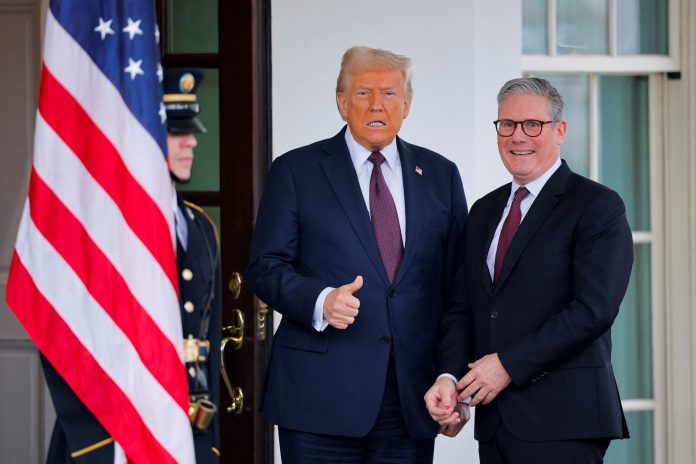
The United States and the United Kingdom finalized a trade deal on June 16, 2025, announced by President Donald Trump and Prime Minister Keir Starmer during the G7 summit. This agreement, described as a “breakthrough” and “historic,” focuses on reducing tariffs and enhancing market access, particularly for specific sectors, while maintaining some tariffs and leaving details to be finalized.

US tariffs on UK steel and aluminum imports, previously set at 25%, have been scrapped entirely. Tariffs on UK car exports to the US reduced from 27.5% to 10% for a quota of 100,000 vehicles annually, covering nearly all UK car exports (104,000 in 2024). UK eliminates tariffs on US ethanol imports, benefiting American farmers with over $700 million in ethanol exports and $250 million in other agricultural products like beef.

Rolls-Royce engines and plane parts from the UK will be exported to the US tariff-free, while the UK agreed to purchase $10 billion worth of Boeing planes. The deal provides US companies with unprecedented access to UK markets, creating a $5 billion opportunity for US exporters, particularly in agriculture (beef, ethanol, fruits, vegetables, etc.) and aerospace.

Reciprocal market access for beef, with both countries granted quotas for 13,000 metric tonnes of beef exports. Streamlined customs procedures and preferential access to UK aerospace components for US manufacturers, securing supply chains for aerospace and pharmaceuticals. The agreement establishes a new trading relationship for steel and aluminum, with negotiations for an alternative to Section 232 tariffs.

Commitments to high-standard provisions in intellectual property, labor, environment, and digital trade, though the UK’s 2% Digital Services Tax (DST) remains a sticking point, with the US expressing disappointment over its retention. Strengthens economic security through cooperation on investment security, export controls, and ICT vendor security. The deal is not a comprehensive free trade agreement but a framework for ongoing negotiations, with details on digital trade, pharmaceuticals, and other sectors still to be finalized.

The US maintains a 10% baseline tariff on most UK goods, higher than the 2.5% pre-Trump rate. UK officials aim to negotiate further reductions to the 10% tariff and address remaining reciprocal tariffs. US stakeholders, including Wisconsin Manufacturers and Commerce and Nebraska Governor Jim Pillen, praised the deal for providing stability and boosting exports. UK officials, including Chancellor Rachel Reeves and Treasury Minister Darren Jones, highlighted job protection (150,000 jobs) and benefits for carmakers like Jaguar Land Rover and the steel industry.

Prime Minister Starmer called it a “fantastic, historic day,” emphasizing job creation and economic stability. Some analysts view the deal as limited, with many tariffs remaining and unresolved issues like the UK’s DST and services trade (a significant part of US-UK trade). UK farmers, via the National Farmers Union, expressed concerns about increased competition from US agricultural imports, particularly bioethanol.

The American Automotive Policy Council criticized the deal for prioritizing UK vehicles over USMCA-compliant vehicles from Canada and Mexico. The deal’s selective tariff reductions may violate WTO’s “most favored nation” principle, potentially inviting legal challenges or retaliation from other countries. The deal is expected to have a limited immediate economic impact due to its narrow scope and ongoing negotiations.

US markets showed a muted response, with stocks rising modestly but enthusiasm fading. UK businesses, particularly in steel and automotive sectors, see it as a lifeline, but uncertainty persists regarding implementation timelines and supply chain conditions. This is the first trade deal since Trump’s “Liberation Day” tariffs on April 2, 2025, which imposed up to 50% duties on 57 trading partners, later paused for 90 days until July 9, 2025.

The UK, not hit by the higher reciprocal tariffs, benefited from its relatively balanced trade with the US ($148 billion in goods trade in 2024). The deal may serve as a template for negotiations with other nations like India, Japan, and South Korea, though challenges remain due to larger trade imbalances. The agreement aligns with the UK’s post-Brexit strategy to offset reduced EU trade and the US’s push for reciprocal trade under Trump’s tariff strategy.

The deal has been signed, but implementation details, particularly for steel, aluminum, and pharmaceuticals, are still under negotiation, with potential delays until the end of June or later. Both sides continue to work on finalizing provisions, with the UK seeking to reduce the remaining 10% tariff and the US pushing for changes to the DST. This trade deal marks a significant step in US-UK economic relations, leveraging their historical alliance to address tariff barriers, but its limited scope and ongoing negotiations suggest it is more a starting point than a fully realized agreement.

SPY Token Presale Is Heating Up: Here’s Why Investors Are Rushing In

0

The SPY token is starting to look like more than just another crypto project. It’s powering something that could change how we spend crypto in everyday life.

The ongoing presale is catching fire as interest is growing quickly. SPY is starting to position itself in a space that many think could define the future of digital payments.

The token is powering SpacePay, a crypto payment solution that turns digital assets into something you can use in physical stores. It connects directly with traditional card machines, so you don’t need any new hardware or complicated apps. Just scan and pay, with crypto the same way you would with your card.

SpacePay is building a bridge between your crypto wallet and the real world. It allows users to pay merchants using crypto, while the merchant receives the exact amount in their local currency.

The platform works with more than 325 wallets and also accepts various cryptocurrencies. With it, users can send crypto without being afraid of volatility affecting the value of the coin. It also offers instant transactions and charges as low as 0.5% per transaction.

SPY is a store-of-value token and also a key part of a much bigger infrastructure. It powers user rewards, gives holders a say in platform decisions, and unlocks access to exclusive features. All these make the ongoing presale interesting.

Why the SPY Token Presale Is Gaining Momentum

SPY has already passed the $1 million mark in its presale, and interest keeps growing. This early rush isn’t just driven by speculation. Buyers are getting in now to gain access to the ecosystem and enjoy the long-term benefits.

Some are drawn to the platform’s built-in rewards. Others are looking at governance features, where holders get to vote on the project’s direction. There’s also staking potential, loyalty perks, and early access to new tools.

It helps that SpacePay has a working MVP, and the payment system will be integrated with traditional point-of-sale machines. This isn’t about what could happen someday but about a product that’s already in motion.

When you hold SPY, you’re getting something in return. The platform gives monthly loyalty airdrops to the most active wallets. Token holders also get to vote on key proposals that shape the future of the project.

Holders also get early access to new features and products. They earn a share of the platform’s revenue. Moreover, SpacePay matches charitable donations made by holders to pre-approved charities.

Every quarter, SPY holders can also join exclusive webinars with the SpacePay leadership team. These sessions provide updates, insights, and a behind-the-scenes look at how the platform is evolving. So the token gives financial perks and connects you more closely to the project itself.

The total supply of SPY is 34 billion tokens. Out of that, 20% is set aside for the public sale. 17% is reserved for loyalty rewards and user incentives. 18% is focused on ecosystem partnerships, while another 18% goes into marketing and community building. Development and reserve funds make up the rest.

This kind of setup tells a clear story. It’s built to reward actual users, not early whales. There are no unfair allocations, and there’s no worry about big investors dumping on retail buyers. It’s a design meant for long-term growth and active community involvement.

Why the Presale Stage Matters and What Comes Next

Presales move in stages, and each one comes with a price bump. That’s why early participation matters. Buying in now gives users more tokens for the same amount of money, plus better positioning for staking and loyalty benefits once the platform grows.

After the presale ends, the team has big plans. Listings on decentralized and centralized exchanges are on the roadmap. More merchant partnerships will be added. Loyalty programs will roll out, and wallet integrations will continue to grow.

So this moment isn’t just about buying tokens. It’s about getting a seat at the table before things really take off.

How to Join the SPY Token Presale

Here’s how to get in: head over to the official SpacePay presale page. Once there, you’ll connect your wallet: MetaMask and Trust Wallet are both supported, among many others.

Next, choose how you want to pay. You can use ETH, BNB, MATIC, USDT, AVAX, BASE, or even a regular bank card. After entering the amount, confirm the transaction. The SPY tokens will be sent directly to your wallet.

Everything stays in your control. You’re not handing over funds to a centralized exchange. You keep your wallet, your keys, and your access at all times.

 JOIN THE SPACEPAY (SPY) PRESALE NOW

 Website    |    (X) Twitter    |  Telegram


ADA Price Breakout? Neo Pepe Coin Set To Dominate After 1.1 Million Raised

0

Cardano’s Unexpected Rise Could Still Trail Neo Pepe Coin

Cardano (ADA) is shaping up to be a major surprise outperformer, according to analysts, potentially eclipsing rivals Solana (SOL) and XRP in this crypto cycle. However, Cardano might still find itself second to a rising powerhouse—Neo Pepe Coin. Neo Pepe’s ongoing presale has already secured more than $1.1 Million, signaling robust investor interest and confidence in its distinctive decentralized governance model.

Unlike typical meme tokens, Neo Pepe Protocol ($NEOP) stands apart with its strong structural transparency, full DAO governance, and fixed tokenomics, which blend meme-driven appeal with serious blockchain functionality.

Cardano’s Strong Fundamentals Set Stage for Rally

Cardano has gradually strengthened its market position, showing resilience as SOL and XRP exhibit mixed performances. ADA recently surged by approximately 3% after inclusion in Nasdaq’s cryptocurrency index, with an impressive 68% spike in trading volume. Solid technical support remains robust between $0.66–$0.72, suggesting potential upside.

Key metrics also favor ADA’s potential. Its MVRV ratio dipped to -9.34%, a historically favorable indicator for rebounds, while social dominance metrics show growing investor interest. Analysts foresee ADA potentially rallying toward the $1.10–$1.20 range if bullish momentum is maintained through Q2.

In contrast, despite institutional backing via Nasdaq index inclusion, XRP faces a constrained trajectory after its recent rally, and SOL’s upward momentum has slowed amid ETF speculation. Thus, ADA’s fundamentals currently position it more favorably for sustainable growth.

Why ADA Could Surprisingly Outperform This Cycle

Market observers note ADA’s breakout setup, anticipating a significant rally if it breaches resistance levels near $1.00–$1.10. Crypto influencer Alex Becker underscores ADA’s undervaluation compared to Solana, pointing to protocol upgrades such as LEOs that promise substantial improvements.

On-chain data further strengthens the bullish narrative:

  1. Exchange Withdrawals: Approximately $1 billion withdrawn from exchanges signals strong accumulation.
  2. Social Buzz: ADA currently tops crypto social buzz charts, indicating heightened investor attention.
  3. Smart Contract Adoption: Continued growth and adoption of smart contract features bolster ADA’s practical use and investor confidence.

Combined with its disciplined accumulation pattern and rigorous developmental approach, Cardano seems positioned for breakout growth this altcoin season.

Neo Pepe Coin– Crypto Phenomenon Investors Can’t Ignore

While ADA offers attractive upside, Neo Pepe Coin ($NEOP) could surpass it with its dynamic market energy and uniquely structured decentralized approach.

$NEOP’s 16-stage presale strategically incentivizes early adopters, offering incrementally priced entry points that progressively reward initial contributors. With a fixed supply of 1 billion tokens and a structured token unlocking mechanism hourly post-launch, the protocol ensures market stability and long-term sustainability.

Neo Pepe’s decentralized treasury is entirely DAO-managed, ensuring transparent, community-driven governance of every financial decision and strategic move. Key protocol features include:

  • Auto-liquidity Generation: A built-in 2.5% fee automatically enhances liquidity on Uniswap, permanently burning LP tokens.
  • Controlled Token Burns: Limited to 5% of the total supply, initiated exclusively via DAO governance.
  • Immutable Smart Contracts: Once deployed, no central party can alter protocol contracts, ensuring genuine decentralization and transparency.

Crypto Gems 2.0 Examines Neo Pepe’s Presale

In their latest video, Crypto Gems 2.0 skillfully walks viewers through the enticing aspects of Neo Pepe’s ambitious presale, spotlighting the project’s innovative governance approach, automatic liquidity boost, and meticulously structured token release schedule. They emphasize the project’s careful alignment with community-driven crypto trends, suggesting meaningful long-term possibilities. At the same time, Crypto Gems 2.0 tactfully points out considerations like token unlock frequency and market sentiment, not as deterrents but as manageable factors for savvy investors. Through a balanced and insightful lens, they portray Neo Pepe as an intriguing opportunity, encouraging enthusiasm tempered with informed decision-making.

Neo Pepe Coin— Join Memetrix’s Movement

Don’t get left behind—Neo Pepe Coin isn’t just another meme coin; it’s a transformative crypto movement blending cultural resonance with serious decentralized governance. With structured DAO participation, immutable contracts, and innovative tokenomics, Neo Pepe Protocol represents one of the most compelling opportunities of 2025.

How to Participate:

  1. Visit the official Neo Pepe Website.
  2. Choose your contribution method (ETH, USDT, USDC).
  3. Secure your allocation at the current presale stage.
  4. Track token unlocking schedules and community votes via the official DAO portal.

Invest wisely—join the Neo Pepe Protocol community and secure your part in crypto’s next major wave!