DD
MM
YYYY

PAGES

DD
MM
YYYY

spot_img

PAGES

Home Blog Page 1101

Amazon’s Zoox Opens Massive Robotaxi Factory, Signaling Fierce New Phase in Autonomous Vehicle Race

0

Amazon-backed Zoox has launched its first dedicated robotaxi production facility in Hayward, California, a move that underscores intensifying competition in the autonomous ride-hailing sector.

The facility, a 220,000-square-foot complex, is designed to build over 10,000 custom-built autonomous vehicles annually, marking Zoox’s transition from a testing-phase innovator to a full-fledged manufacturer in a market currently dominated by Alphabet’s Waymo and, soon, Elon Musk’s Tesla.

Zoox confirmed on Wednesday that it plans to begin its commercial robotaxi services in Las Vegas later this year, followed by a broader rollout in San Francisco, where it already conducts public road testing in the SoMa (South of Market) neighborhood. This next phase will include onboarding public riders and scaling production in response to anticipated demand across new U.S. cities in the years ahead.

“This expansion, plus the anticipated demand once rides open up to the general public, and additional market entrances in the coming years, warrants this increase in robotaxi production,” the company said in a statement.

A Purpose-Built Robotaxi, Not a Retrofit

Unlike rivals such as Waymo and Tesla that modify existing vehicles, Zoox stands out as the only U.S. company operating fully autonomous, purpose-built robotaxis. The vehicles, designed from the ground up, lack traditional driving controls like steering wheels and pedals and instead feature a carriage-style layout where passengers face each other—akin to a lounge on wheels.

This deliberate design shift allows Zoox to optimize safety, user experience, and efficiency, differentiating itself from Tesla’s upcoming Model Y-based robotaxi service or Waymo’s outfitted Jaguar I-Pace and Chrysler Pacifica fleets.

Tesla’s and Waymo’s Expanding Footprints

Tesla is expected to debut its robotaxi service on June 22, starting with its Model Y SUVs running Full Self-Driving software, and later introducing the “Cybercab”—a two-seater that, like Zoox’s vehicle, lacks manual controls. Meanwhile, Waymo remains the current market leader, already operating commercial driverless taxi services in multiple cities including Phoenix, San Francisco, Los Angeles, and Austin. Its vehicles log millions of paid miles each month, offering a formidable benchmark for newer entrants like Zoox.

The entry of Zoox into high-volume robotaxi manufacturing increases the stakes in what was already a fiercely contested sector. Analysts believe that the move could compress the time-to-market for advanced autonomous services and exert pricing and innovation pressure on competitors, ultimately accelerating the commercialization timeline across the board.

Zoox’s approach appears calculated. The Hayward plant is modular and flexible, allowing for increased automation as demand scales. The company currently produces one robotaxi per day but says the facility can ramp up to three vehicles per hour running two shifts.

Safety, Regulatory, and Cost Challenges

However, the robotaxi market continues to face serious hurdles. Industry-wide, companies have dealt with federal investigations, recalls, and regulatory scrutiny following vehicle incidents. Zoox itself conducted a voluntary recall in Las Vegas earlier this year after a minor traffic collision involving one of its autonomous vehicles.

Beyond safety, the broader challenge remains cost efficiency. Building and maintaining a fleet of self-driving vehicles—particularly purpose-built ones—demands deep capital and infrastructure commitments. This makes Amazon’s deep-pocketed support for Zoox a strategic edge that smaller players may struggle to match.

Acquired by Amazon in 2020 for over $1.2 billion, Zoox now operates as a semi-independent unit under CEO Aicha Evans and co-founder Jesse Levinson. The company has more than 2,500 employees and growing collaborations with Amazon’s cloud, AI, and logistics operations—elements that could give it an ecosystem advantage beyond ride-hailing.

Zoox’s immediate goal is to launch a fully driverless, paid ride-hailing service in Las Vegas by the end of 2025, before expanding into San Francisco and later cities like Austin and Miami. Its vehicles will continue to be refined and tested on U.S. roads, even as the company contends with strict regulatory compliance and public perception.

The road to widespread robotaxi adoption remains long and uncertain, but Zoox’s industrial-scale production signals a pivot in the industry: from pilot programs and flashy demos to real-world commercialization and competitive execution.
Rexas Finance (RXS) Predicted to Hit $5—Can It Outperform Solana’s Performance?

0

Rexas Finance (RXS) continues to gain momentum in the digital asset space. Following its official launch on June 19, 2025, the project has already sold over 499 million out of the 500 million tokens allocated for presale. The RXS presale began at $0.03 and now sits at $0.25. As excitement builds, market analysts predict RXS could reach $5, representing a potential 25x return from its final presale price of $0.20.

RXS Builds Strength with Utility and Demand

Unlike speculative tokens, RXS has ground in real-world application. The platform will provide space to tokenize physical assets, including real estate, gold, and artwork. This provides the users with fractional ownership of high-value assets. RXS is secure and widely compatible as it runs on the ERC-20 standard of Ethereum and has undergone a CertiK audit.

Another distinctive feature of Rexas Finance is its tools like the Token Builder and the QuickMint Bot. These enable any person to mint asset-backed tokens without any coding-related expertise. Further, staking for RXS is now officially live, allowing token holders to earn passive rewards by locking their tokens through Rexas Finance’s secure staking dashboard.

However, before launch, the project generated nearly $55.9 million via presale due to the high investor confidence. RXS will experience high trading volume since it is listed on MEXC, BitMart, and LBank. 

Even Rexas Finance has already shown strong potential during its presale, growing from $0.03 in Stage 1 to $0.20 in Stage 12—a 567% increase. So many analysts believe a long-term target of $5 is possible if momentum continues, this would represent a 20x return from the launch price.

Solana Eyes a Breakout but Faces Resistance

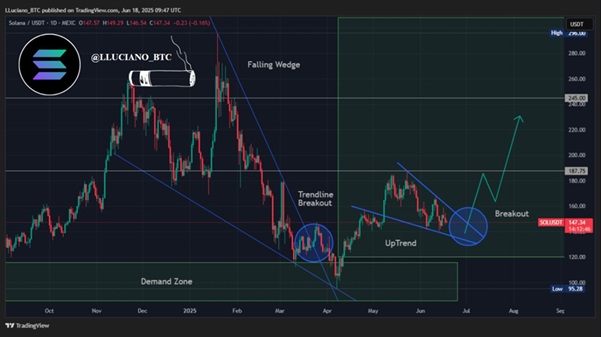
Solana is also attracting attention as it forms a bullish pattern on the charts. After a period of correction, Solana broke out of a falling wedge near the $125 mark. It then rallied toward $187 before entering another descending wedge. The price is currently consolidating just below wedge resistance at around the price of $147.

Source:X

In the event Solana rises again, the initial resistance will be at $187. This was a high resistance in the past and could cause immediate selling. A breakout of $187 will move the price higher to $245. Over and above that, bulls might target the former cycle high of $290. However, the rally depends on good volume and positive sentiment.

On the downside, Solana has support between $95 and $120. This zone has consistently attracted buyers. Moreover, it could serve as a safety net in case of a pullback.

Conclusion

Solana is exhibiting technical strength and can rally back to former highs should the market continue to be favorable. Nevertheless, RXS will launch with the advantage of sound fundamentals, robust presale demand, and actual use cases. 

Although Solana might wait until breakout confirmation before the next move, RXS may steal the show and achieve rapid growth and mainstream usage. As a trader interested in buying at an early stage, Rexas Finance offers a reasonable chance to beat the performance of Solana.


For more details about Rexas Finance (RXS), visit the links below:

Website: https://rexas.com/

Twitter/X: https://x.com/rexasfinance

Telegram: https://t.me/rexasfinance


The Brent Crude Surge To $77.45 Highlights A Fragile Balance

0

Brent crude’s 1% rise to $77.45, a high not seen since January, signals tighter energy markets, likely driven by supply concerns or demand optimism. This uptick is fueling inflationary pressures on global energy and food prices, as higher oil costs ripple through production and transportation.

Meanwhile, European stock indexes and U.S. equity futures are sliding, possibly reflecting investor unease over inflation risks or fears of tighter monetary policy to curb it. The interplay suggests markets are grappling with growth concerns against a backdrop of rising commodity costs.

The 1% rise in Brent crude to $77.45, a high since January, and the corresponding drop in European stock indexes and U.S. equity futures point to significant economic implications and a deepening divide in market dynamics. Higher Brent crude prices directly increase energy costs, which cascade into higher transportation and production expenses. This fuels inflation, particularly for energy-intensive industries and food supply chains, where transport costs are significant.

Consumers may face higher prices for goods and services, squeezing household budgets, especially in lower-income regions. Rising oil prices could prompt central banks, like the Federal Reserve or European Central Bank, to tighten monetary policy to curb inflation. Higher interest rates could further pressure equity markets, as seen in the declining European indexes and U.S. futures, by increasing borrowing costs and dampening corporate earnings.

Energy Sector vs. Broader Market: The energy sector may see short-term gains from higher oil prices, benefiting producers and related industries. However, broader markets, particularly tech and consumer discretionary sectors, are likely weighed down by inflation fears and potential rate hikes, as reflected in the falling equity indexes.

Emerging markets, heavily reliant on imported oil, face greater strain from rising energy costs, potentially widening economic disparities with developed nations. Food price inflation could exacerbate social unrest in vulnerable regions, while wealthier economies may better absorb the shock but still face growth slowdowns.

Energy companies and oil-producing nations (e.g., OPEC members) stand to gain from higher Brent prices, while energy-intensive industries (e.g., manufacturing, airlines) and consumers bear the cost. This creates a divide between sectors and regions profiting from oil price spikes and those facing margin compression or reduced purchasing power.

Wealthier nations with stronger currencies and energy reserves can mitigate the impact of rising oil prices, while emerging markets with weaker currencies face heightened inflation and trade balance pressures, deepening global economic inequality. Investors in energy stocks or commodities may see gains, but consumers face higher costs at the pump and in grocery stores. This divide fuels tension between market optimism in certain sectors and broader economic pessimism.

Short-term market reactions (falling equities) reflect fears of inflation and policy tightening, but long-term implications depend on whether oil prices stabilize or continue climbing. Persistent high prices could accelerate the shift to renewables, while short-term reliance on fossil fuels entrenches energy cost pressures.

Energy price spikes boost inflation and strain equities, while deepening divides between sectors, regions, and economic stakeholders. Markets are signaling caution, with falling indexes reflecting broader growth concerns. Monitoring OPEC decisions, geopolitical risks, and central bank responses will be key to understanding whether this divide widens or narrows.

BlackRock Strengthens Ethereum’s Credibility

0

BlackRock, the world-famous asset manager, has made a significant move by investing $48.4 million to purchase 19,070 Ethereum (ETH). This places the company not only among the top asset managers but also among the leading institutional players recognizing the legitimacy of cryptocurrency.

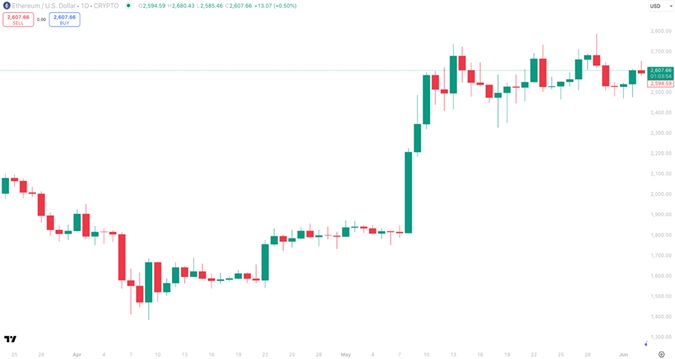
This purchase signals growing confidence from BlackRock in blockchain technology and the Ethereum project specifically. Despite a volatile market, Ethereum remains attractive, with the ETHUSD chart consistently trending upward since May.

This acquisition comes as Ethereum seems to be stabilizing after a period of intense price fluctuations. For BlackRock, this is a diversification strategy, marking its entry into a second major cryptocurrency after Bitcoin.

More than a simple purchase, this move delivers a strong message to the rest of the market. BlackRock’s involvement could inspire similar actions from other institutional players, reinforcing what is already a relatively stable and burgeoning asset class. And BlackRock’s interest also sets the scene for developing new, financial derivatives backed by ETH, which is another solid step toward establishing a robust digital financial infrastructure.

Nevertheless, hurdles remain, especially around regulations and continued market volatility. Even so, BlackRock’s decision implies that cryptocurrencies in general and Ethereum in particular are positioning themselves as strategic assets in traditional investment portfolios. If this trend persists, Ethereum is poised to play a central role in tomorrow’s finance, situated at the intersection of technological innovation and large-scale capital investment.

This shift also indicates a broader transformation in wealth preservation strategies. While gold has traditionally been the ultimate safe-haven asset, Bitcoin is now emerging as its digital counterpart. Bitcoin’s not alone, though, as Ethereum has also started to make its way into the portfolios of high-profile institutions. Other digital assets, such as Solana (SOLUSD) — known for its high-speed blockchain infrastructure — and XRP (XRPUSD), which has gained traction for cross-border payments, are also being re-evaluated by institutional investors. Their increasing adoption lends Ethereum its own aura of legitimacy and suggests the rise of a second major digital asset. All of this may portend the start of a new era where digital asset class coexists with — or even rivals — traditional inflation hedges.

How America Builds – Lesson As Meta Assemblies AI Talent for the Grand AI Battle

0

Meta’s Mark Zuckerberg is shopping and assembling the talent for the grand AI battle of the 21st century. After spending $14.3 billion primarily to get the founder of Scale AI, it has also brought another group: “The most recent targets include Daniel Gross, co-founder of Safe Superintelligence—the secretive AI startup launched by former OpenAI co-founder Ilya Sutskever—and Nat Friedman, former GitHub CEO and longtime AI investor.”

The AI talent wars are on, and Meta CEO Mark Zuckerberg is leaving no stone unturned. Meta was in talks to acquire search startup Perplexity, Bloomberg reports, citing anonymous sources, before investing $14.3 billion in Scale AI and hiring founder Alexandr Wang last week. It also made a bid to buy the $32 billion AI startup Safe Superintelligence before successfully poaching CEO Daniel Gross, according to CNBC, citing anonymous sources. Ex-Github CEO Nat Friedman is also joining Meta, which is targeting rival AI talent with massive bonuses.

Good People, I truly admire how Americans run businesses: it is either you win or you go home. That is why none of the sports here has space for silver or bronze. Simply, the only trophy is GOLD. And in this AI age, everyone is looking to win GOLD.

Africa must learn how to build.  I am personally jealous of how Americans (and Chinese) evaluate risks in the way they do in business. How do you pay someone $100 million salary for something you are not sure will work? How do you spend and spend and your investors do not panic?

Safe Superintelligence was launched in 2023 by Sutskever after his dramatic exit from OpenAI. Publicly here, I had asked him to make space for our community for $5m. Unfortunately, you needed at least $100m to join the party. Today, that company is valued at $32 billion, and it has no product yet!

Nigeria and Africa, we must pursue KNOWLEDGE and ensure our own Mark, Sutskever, etc are discovered. We need them for a chance to compete in the future. That is why we must have a university with zero tuition, zero fees, etc so that every genius can be educated with no barrier. I have asked NUC to waive the onerous requirements of a 100 hectare-built campus for a license (do you expect investors to build a campus before a license?).

If they do that, some people will come with specialized campuses (not open learning which is structured for teaching with no research) and deliver impacts.