DD
MM
YYYY

PAGES

DD
MM
YYYY

spot_img

PAGES

Home Blog Page 1103

Altcoin Analyst Reveals 2025’s Best Crypto Options— XRP, HBAR, or Neo Pepe Coin?

0

Investors Eyeing Top Altcoin Picks for 2025

As investors make active $1,000 investments in popular altcoins like XRP and Hedera (HBAR), the spotlight has turned toward identifying the best, most reliable opportunities to place our bets for 2025. One of those leading contenders is the presale for Neo Pepe Protocol, now up to about $1.3 Million raised and counting.

What makes Neo Pepe Coin an interesting proposition isn’t just its presale momentum, however. Unlike a conventional altcoin, Neo Pepe Protocol is a decentralized governance model, meaning every critical treasury and protocol decision is made by the community—in a completely transparent manner, and with an entirely on-chain voting process. Its deflated economics and pseudo-sensible DAO structure make $NEOP a much more interesting play than your average altcoin.

XRP & HBAR—Evaluating Risk & Reward

When you stack up XRP and Hedera (HBAR) against each other as potential long-term investments, they show distinctly different—actually quite opposite—risk/reward profiles, thanks to their underlying technologies, market positions, and adoption rates. Meanwhile, XRP trades for $2.32 and describes its value proposition thusly; XRP is the best digital asset for payment providers and financial institutions to use when sending money across borders and in different currencies. Partnerships with banks (like VTB) lend credence to some of XRP’s claims. Nevertheless, this is a digital asset with a ton of centralization and regulatory risk tossed in—thanks to all the control Ripple Labs has over it. Hedera Hashgraph is a far more efficient system—speedier, with a much larger potential capacity strategically important for a payments system.  Hedera operates on something called the ultra-efficient Hedera Hashgraph blockchain, known for speed and low energy consumption. Governed by a global corporate council, Hedera emphasizes decentralized applications. However, its smaller market cap and still-developing ecosystem present higher volatility and adoption uncertainties.

Analyst Insights— Essential Traits of Top 2025 Altcoins

Analysts suggest top altcoin picks for 2025 share several critical characteristics:

  1. Strong fundamentals: Robust technological foundations and clear value propositions.
  2. Deflationary mechanisms: Fixed supplies and controlled token burns ensure scarcity and sustained value.
  3. Transparent smart contracts: Audited, secure smart contracts build investor trust.
  4. Decentralized governance: Community-driven decision-making empowers holders to steer project direction.
  5. Liquidity and market stability: Strategic exchange listings and substantial liquidity pools facilitate stable trading environments.
  6. Innovative community engagement: Features like gamified participation and staged presales attract early investors and maintain momentum.

Altcoins combining these elements—like Neo Pepe Coin—are well-positioned to capture significant market attention and deliver robust growth within the dynamic crypto ecosystem of 2025.

Bold New Challenger Enters Meme Coin Territory

In the oversaturated meme coin market, Neo Pepe Coin emerges as a beacon of sophistication and an impressive deliberate choice, one born of thoughtful design, a high degree of transparency, and a seemingly genuine commitment to decentralization. At bottom, the Neo Pepe Protocol is run on a community-controlled Dev & Governance model—it has no centralized team, no team wallets, and very few recognizable figures behind it. Not much happens with Neo Pepe unless the community has voted to make it happen, and votes are taken quite seriously. That’s because the governance model in place is designed to make it very hard for any shenanigans to go down without being caught and very easy for any necessary protocol proposals to go through.

Bull Run Angel Takes Flight w/ Neo Pepe Coin

YouTuber Bull Run Angel conducts an analysis that is part and parcel of a traditional crypto deep dive. That is, Angel reviews not only the emerging potential of Neo Pepe but also its presale structure and community-driven governance model. Assuredly not acting as a shill for Neo Pepe, Angel dutifully notes that the presale for the NEOP token is fabulously generous for early supporters. As good as it may get for presales, the NEOP presale has, Angel indicates, is creative, brilliant, and, in the context of recent crypto projects, almost mind-blowing. What Angel has highlighted here is not just that presale for Neo Pepe is damned good and very good news for early supporters, but also that the NEOP token has been designed for strategic momentum.

Why Investors Should Consider $NEOP:

  • Fully decentralized governance: Community-driven decisions through on-chain voting.
  • Strategic scarcity: Controlled token supply and deflationary tokenomics.
  • Transparent execution: All activities are visible and accountable on-chain.
  • Progressive presale stages: Rewarding early adopters with favorable token pricing.
  • Robust market stability: Automated liquidity generation and gradual token unlocking to prevent sell-offs.

By strategically blending scarcity, decentralization, and disciplined execution, Neo Pepe Protocol is more than a meme coin—it represents a calculated investment opportunity for those seeking to ride the next significant crypto wave confidently.

Join the growing Neo Pepe Protocol community today and actively shape the journey towards becoming a leading force in the crypto market.

Website
Telegram
Coinbase Secures Landmark EU MiCA License in Luxembourg, Strengthening Crypto’s Global Legitimacy

0

Coinbase has become the first U.S.-based cryptocurrency exchange to secure a license under the European Union’s sweeping Markets in Crypto Assets (MiCA) framework, marking a major step forward in both the platform’s global expansion and the mainstream acceptance of digital assets in tightly regulated jurisdictions.

The license, issued by Luxembourg’s financial watchdog, the Commission de Surveillance du Secteur Financier (CSSF), authorizes Coinbase to offer crypto services to all 27 EU member states from a single regulatory base. This effectively gives Coinbase regulatory passporting rights to operate across the bloc, using Luxembourg as its hub.

This move signals a shift in Coinbase’s regional strategy. In 2023, the company had designated Ireland as its EU base, rolling out a high-profile campaign to mark its commitment to Dublin. However, that plan has now been replaced by Luxembourg’s more advanced regulatory landscape.

“The decision was made less-so due to Ireland, but rather for the reasons that Luxembourg presented a highly compelling option,” said Daniel Seifert, Coinbase’s Vice President and Regional Managing Director for EMEA, in an interview with CNBC. He noted that Luxembourg already has four blockchain-related laws in place, while Ireland still lacks crypto-specific regulations.

Despite the change in regional base, Coinbase remains invested in Ireland. The company is planning to hire around 50 new employees in its Dublin office, and Seifert has personally relocated to Ireland to head Coinbase’s Irish entity.

A Milestone for Crypto Regulation

The MiCA license approval marks a profound moment for cryptocurrency regulation. MiCA, which came fully into effect in late 2023, is the first unified regulatory framework for crypto assets in any major economic bloc. It aims to create legal clarity, reduce systemic risk, and protect retail investors across the EU, following a series of collapses in the sector, including FTX and Terra.

The regulation covers stablecoins, trading platforms, wallets, and token issuance, imposing requirements on disclosure, governance, capital reserves, and anti-money laundering compliance.

Coinbase is showing its readiness to embrace and comply with rigorous regulatory standards—something CEO Brian Armstrong said is critical for long-term growth – by securing the MiCA license.

“Coinbase is all in on Europe, and we’re advocating for crypto’s future across the continent,” Armstrong told CNBC. “MiCA has set the standard, and Luxembourg is leading the way with its pro-business climate and thoughtful approach to regulation.”

A Growing Crypto Footprint

Coinbase is not alone in eyeing the EU as a vital market. Crypto exchanges such as Bybit, OKX, and BitGo have also received MiCA-related authorizations, while U.S. rival Gemini is expected to secure its license from Malta soon, having designated the Mediterranean country as its EU hub earlier this year.

Coinbase’s move comes amid increased global scrutiny of digital assets, especially in the United States, where regulatory clarity has remained elusive. The company is currently battling the U.S. Securities and Exchange Commission (SEC) over allegations of offering unregistered securities. In contrast, the MiCA framework offers Coinbase a clearly defined path to operate, build, and expand in Europe.

The development further underlines the growing global adoption of crypto assets and the increasing willingness of highly regulated jurisdictions to embrace digital finance. Europe has now positioned itself at the forefront of regulated crypto innovation.

The move comes as investors, institutions, and developers look to jurisdictions where clear rules enable long-term planning and investment. The MiCA framework not only increases investor confidence but also provides traditional financial institutions with a legal foundation to enter the crypto space more confidently.

Coinbase also aligns with the country’s deep legacy as a European financial hub and its role in hosting many of the world’s major banks, funds, and fintech firms by basing itself in Luxembourg. The decision to operate from such a jurisdiction may help further reassure institutional investors wary of the volatility and opacity that has characterized parts of the crypto market in recent years.

Coinbase’s Strategic Bet

For Coinbase, the MiCA license is not just regulatory compliance—it’s a strategic bet on Europe’s potential to become the global epicenter of regulated digital finance. The company is now better positioned to offer spot trading, custody services, and staking products to both retail and institutional clients in a unified market of over 450 million people.

The license will also enable Coinbase to integrate more deeply into European payment systems, offer euro-denominated services, and roll out innovations without worrying about fragmented national regulations.

While the global regulatory environment remains complex, Coinbase’s approval under MiCA provides a blueprint for what crypto regulation could look like in other developed markets, including the United States and Asia. As jurisdictions from the UK to Japan consider more comprehensive rules, Europe’s MiCA may prove to be the model others follow.

Tekedia Launches Tekedia Daily, A Video Podcast, For Podcasting Revelations on Business

0

We are super-excited to announce that Tekedia Institute is launching a podcast, Tekedia DailyAt Tekedia Institute, we believe that knowledge is the engine of economic growth. With our new Tekedia Daily, a podcast, we are deepening our mission to inform, educate, and inspire. Each edition offers curated insights, business intelligence, and innovation opportunities for Africa and beyond. From tech and strategy to policy and execution, this is a practical daily companion for entrepreneurs, professionals, and policymakers.

This is not just a podcast— it is a Knowledge Daily, developed to stimulate the minds that will build the next Africa. As I often say, nations rise when citizens accumulate capabilities. Tekedia Daily is our commitment to that capability accumulation, distributed in a simple, daily video format, to our Tekedia and Blucera communities.

Let’s innovate, grow, and advance — together. Be part of Tekedia Daily, podcasting revelations on business. New episodes daily at Tekedia.com and Blucera.com.

Purpose and Strategic Vision

Tekedia Daily is more than just a content product — it’s part of a broader movement to democratize business education and drive entrepreneurial execution in Africa and other emerging regions. By delivering concise but intellectually rich content each day, Tekedia positions itself not only as a knowledge provider but also as a catalyst for transformation.

Prof. Ndubuisi Ekekwe’s philosophy — “nations rise when citizens accumulate capabilities and apply them” — is embedded in every episode. The format ensures daily learning becomes habitual, and insights become springboards for business growth, innovation, and impact.

How To Listen to Tekedia Daily

At Blucera, home of Blucera WinGPT (AI personal educator and coach), eVault Legal Custodial services (store vital personal, family and business documents securely), business tools to grow enterprises, and global archives of Tekedia courses and libraries, Ndubuisi Ekekwe podcasts every week day. Some Tekedia Institute programs offer bonus access to Tekedia Daily or one can register at Blucera for the podcast.

KuCoin’s Introduction Of Dormancy Fees For Non-KYC Accounts

0

KuCoin announced that it will impose dormancy fees on inactive non-KYC (Know Your Customer) and non-KYB (Know Your Business) accounts starting July 15, 2025. This policy targets unverified accounts to enhance platform security and comply with regulatory pressures. US users, along with those in restricted regions like mainland China, cannot complete KYC/KYB verification due to KuCoin’s Terms of Use and local regulations.

As a result, they are urged to withdraw their assets to self-custody wallets or other exchanges to avoid these fees. KuCoin will notify affected users before deducting fees, giving them time to act. Transfer assets to an external wallet (e.g., a non-custodial wallet like Best Wallet) or another exchange. KuCoin supports crypto withdrawals without KYC, though limits apply (e.g., 2 BTC daily for non-KYC accounts).

After withdrawing, consider closing your KuCoin account to avoid future fees. Notifications will be sent, but users should move assets before fees are applied on July 15, 2025. KuCoin’s withdrawal fees vary by cryptocurrency and network (e.g., 0.0002 BTC for Bitcoin, 1 USDT for Tether on TRC20). Check the withdrawal page for current fees. US users face restrictions due to KuCoin’s lack of a US license, limiting access to fiat withdrawals and advanced features without KYC. Using a VPN to bypass restrictions is risky and may lead to frozen assets.

This move aligns with global trends toward stricter KYC enforcement to combat fraud and money laundering. KuCoin’s introduction of dormancy fees for non-KYC accounts and its urging of US users to withdraw funds have significant implications for users, the crypto industry, and the broader divide between centralized exchanges (CEXs) and decentralized finance (DeFi). Dormancy fees will erode funds in inactive, unverified accounts, disproportionately affecting users who hold small balances or use KuCoin sporadically. Exact fee details are unclear, but they could be flat or percentage-based, similar to other platforms (e.g., Binance’s 0.0005 BTC monthly fee for inactive accounts).

Non-KYC users must either withdraw assets, incurring withdrawal fees (e.g., 0.0002 BTC for Bitcoin), or complete KYC where possible. For US users and those in restricted regions (e.g., mainland China), KYC isn’t an option, pushing them to exit the platform. Users who avoid KYC for privacy reasons may feel pressured to abandon KuCoin, potentially migrating to DeFi platforms or other CEXs with looser policies (e.g., MEXC, though it also enforces KYC in some cases).

KuCoin’s lack of a US license already limits US users’ access to fiat withdrawals and advanced features. The dormancy fees and withdrawal urging effectively signal a soft exit from the US market, aligning with regulatory scrutiny from agencies like the SEC and CFTC. Rushed withdrawals increase the risk of errors (e.g., sending funds to incorrect addresses or incompatible networks). Users without self-custody wallets may struggle to find secure alternatives, especially if unfamiliar with DeFi or other CEXs.

Withdrawing assets may trigger taxable events in the US, depending on the user’s cost basis and holding period. Users must track transactions for IRS reporting, adding complexity. The policy reflects KuCoin’s efforts to align with global anti-money laundering (AML) and counter-terrorism financing (CFT) regulations, especially after facing scrutiny in jurisdictions like the US and India. By penalizing non-KYC accounts, KuCoin reduces exposure to illicit activity risks.

Dormancy fees could generate additional revenue from inactive accounts, offsetting operational costs or regulatory fines (e.g., KuCoin paid $22 million to settle a NY lawsuit in 2023). KuCoin may lose privacy-focused users but attract institutional or KYC-compliant traders, aligning with its goal of becoming a regulated, mainstream platform. KuCoin’s move signals a broader industry trend toward stricter KYC/AML enforcement, driven by global regulators like FATF. Other CEXs (e.g., Binance, Coinbase) may follow with similar policies, shrinking the space for non-KYC trading.

Disaffected users may migrate to decentralized exchanges (DEXs) like Uniswap or PancakeSwap, which don’t require KYC. However, DeFi’s complexity and risks (e.g., smart contract vulnerabilities) could deter mainstream adoption. As CEXs diverge based on regulatory stances, users may face a fragmented landscape where access to liquidity and services depends on their jurisdiction or KYC willingness.

Centralized (CEXs like KuCoin) prioritize regulatory compliance to operate legally, attract institutional investors, and integrate with fiat systems. KYC, dormancy fees, and user restrictions (e.g., US bans) are tools to achieve this, but they alienate privacy advocates. Decentralized (DeFi, DEXs) emphasize user control, anonymity, and censorship resistance. Non-KYC users pushed out of KuCoin may turn to DeFi, but barriers like technical complexity, high gas fees, and regulatory risks (e.g., Tornado Cash sanctions) limit accessibility.

The divide deepens as CEXs become gatekeepers for fiat on-ramps, while DeFi remains a niche for tech-savvy or ideologically driven users. This could slow crypto’s mainstream adoption if users feel trapped between compliance and complexity. Non-KYC users value anonymity to protect against surveillance, data breaches, or authoritarian regimes. KuCoin’s fees and KYC push undermine this, forcing users to choose between financial loss or exposure.

Push for KYC/AML to curb illicit activities (e.g., money laundering, tax evasion). KuCoin’s policy aligns with this, reflecting pressure from global watchdogs like FATF and US agencies. The divide creates a zero-sum game where privacy and regulation are at odds. Users in restricted regions (e.g., US, China) face exclusion from CEXs, while privacy-focused platforms risk regulatory crackdowns.

Those in KYC-friendly jurisdictions (e.g., EU, Singapore) can comply and continue using KuCoin with minimal disruption. They benefit from enhanced security and access to regulated services. Users face exclusion, forced withdrawals, or reliance on risky workarounds (e.g., VPNs). This creates a two-tier system where access to crypto depends on geography.

The divide reinforces inequality in crypto access, favoring users in compliant jurisdictions while marginalizing others. This could fuel demand for DeFi or unregulated CEXs in restricted regions, complicating global regulatory efforts. Bitcoin and early crypto aimed for financial sovereignty and decentralization. Non-KYC users align with this, resisting centralized control.

CEXs like KuCoin bridge crypto and traditional finance, prioritizing compliance over ideology. Dormancy fees and KYC mandates reflect this shift toward centralized control. The divide alienates crypto purists, who may abandon CEXs for DeFi or peer-to-peer trading, while pragmatic users accept KYC as the cost of convenience. This fractures the crypto community’s unity.

KuCoin’s dormancy fees and US withdrawal urging highlight the tension between regulatory compliance and crypto’s decentralized ethos. For users, the policy means financial and logistical challenges, especially for non-KYC and US-based accounts. For the industry, it underscores a growing divide between centralized, regulated platforms and decentralized, privacy-focused alternatives.

This divide risks fragmenting the crypto ecosystem, with access, privacy, and ideology as key fault lines. Users must adapt by securing assets and exploring alternatives, while the industry grapples with balancing regulation and innovation. For specific guidance, US users should withdraw funds before July 15, 2025, and contact KuCoin support for assistance.

What is the accumulation of capabilities Construct? Case Study of Dangote Group

0

Question: “What is the accumulation of capabilities according to Ndubuisi Ekekwe in tekedia?”

Response: According to Ndubuisi Ekekwe, as frequently discussed on Tekedia, the accumulation of capabilities is a fundamental principle for companies to succeed and address market frictions. He emphasizes that companies are established to solve problems or “frictions” in the market, and to do so, they must acquire and accumulate specific capabilities.

These capabilities are built upon three key pillars:

Tools: This refers to the technologies, software, machinery, and other physical or digital resources that a company utilizes to operate and produce.

Processes: These are the established methods, procedures, and workflows that a company implements to organize its operations, ensure efficiency, and deliver consistent results.

People: This encompasses the human talent, skills, knowledge, and expertise within the organization. Skilled and knowledgeable individuals are crucial for effectively utilizing tools and executing processes.

Ekekwe posits that these three pillars—tools, processes, and people—are then used to organize and reorganize factors of production. This organization allows companies to create the products and services that are ultimately deployed in the market to solve customer frictions and generate value.

In essence, for Ekekwe, the accumulation of capabilities is about building a robust and adaptable internal engine (comprising the right tools, efficient processes, and skilled people) that enables a company to innovate, produce, and effectively address the evolving needs of its target market.

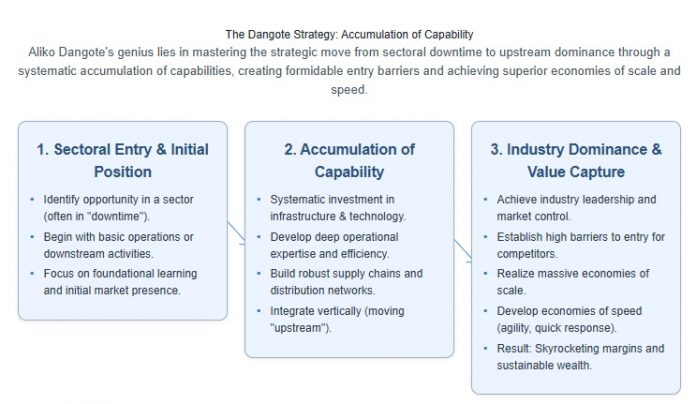
In this video, I have used the Dangote Group as a case study. Next week, as I begin podcasting daily on the revelations on business, deeper insights would be shared.

According to Ndubuisi Ekekwe in Tekedia, the “accumulation of capability” construct refers to a strategic process where companies systematically develop and gather the necessary abilities, resources, and expertise to gain a competitive advantage and ultimately dominate their market.

Here’s a breakdown of what it entails:

  • Fixing Market Frictions: Companies are established to address specific challenges or “frictions” within a market. To effectively resolve these, they must acquire and accumulate capabilities.
  • Pillars of Capability: These capabilities are built upon three main pillars:
    • Tools: The technologies, machinery, and systems utilized.
    • Processes: The efficient and optimized workflows and operational methods.
    • People: The skilled talent, expertise, and human capital.
  • Organization and Reorganization: These three pillars (tools, processes, and people) are then organized and reorganized to effectively manage factors of production.
  • Creating Products and Services: The culmination of these organized capabilities leads to the creation of superior products and services that effectively address customer frictions in the market.
  • Strategic Outcome (Higher Value Segments): When companies successfully accumulate capabilities, they are able to operate in higher-value market segments compared to their competitors.
  • Example (Dangote Group): Ekekwe often uses the Dangote Group as a prime example. Dangote leverages its accumulated assets and technical expertise (e.g., in cement production) to establish significant barriers to entry for new competitors. By continually perfecting its system, Dangote achieves higher productivity, economies of scale, and economies of speed, which in turn lead to skyrocketing margins and industry leadership.

In essence, it’s a dynamic process of continuous learning, investment, and strategic integration that allows a firm to not just compete, but to lead and extract maximum value from a sector.