DD
MM
YYYY

PAGES

DD
MM
YYYY

spot_img

PAGES

Home Blog Page 1107

Eyenovia’s $50 Million HYPE Treasury Strategy Is A Bold Bet On DeFi’s Future

0

Eyenovia, Inc. (NASDAQ: EYEN), an ophthalmic technology company, announced on June 17, 2025, a $50 million private placement in public equity (PIPE Financing) to establish a cryptocurrency treasury reserve strategy focused on acquiring HYPE tokens, the native token of the Hyperliquid blockchain. The funds will be used to purchase over 1 million HYPE tokens, positioning Eyenovia as one of the top global validators for Hyperliquid and the first U.S. publicly listed company to hold HYPE in its treasury.

The company will issue non-voting convertible preferred stock convertible into approximately 15.4 million shares of common stock at $3.25 per share and warrants to purchase about 30.8 million shares at the same price, potentially raising up to $150 million if all warrants are exercised. Eyenovia also appointed Hyunsu Jung as Chief Investment Officer and Board member to lead this strategy and Max Fiege as Strategic Advisor to support the HYPE treasury initiative. The company plans to implement a HYPE staking program through a partnership with Anchorage Digital while continuing its core business, including the development of the Gen-2 Optejet User Filled Device, expected to be registered with the FDA by September 2025.

Eyenovia will rebrand as Hyperion DeFi with the ticker symbol HYPD, with the transaction expected to close around June 20, 2025. Additionally, Avenue Capital Group, Eyenovia’s largest common stockholder, amended the company’s senior secured debt, extending the maturity from November 2025 to July 2028 and reducing the interest rate from 12% to 8%.

The implications of Eyenovia, Inc.’s (NASDAQ: EYEN) $50 million PIPE financing to establish a HYPE token treasury reserve and its strategic pivot toward decentralized finance (DeFi) and blockchain are multifaceted, creating both opportunities and risks. This move also highlights a growing divide between traditional finance and the emerging crypto/DeFi sector. Eyenovia’s decision to become the first U.S. publicly listed company to hold HYPE tokens in its treasury positions it as a trailblazer in corporate cryptocurrency adoption. By acquiring over 1 million HYPE tokens and becoming a top validator on the Hyperliquid blockchain, Eyenovia could benefit from potential appreciation in HYPE’s value and staking rewards, diversifying its financial strategy.

The volatility of cryptocurrencies, including HYPE, poses significant financial risks. A sharp decline in HYPE’s value could impair Eyenovia’s balance sheet, especially since the $50 million investment represents a substantial allocation of capital for a small-cap company (market cap ~$50 million pre-announcement). Regulatory scrutiny from the SEC or other agencies could also arise, given the novel nature of holding crypto as a treasury asset.

By integrating DeFi through HYPE staking and validator status, Eyenovia aims to create a new revenue stream via staking rewards and potential blockchain governance influence. The rebranding to Hyperion DeFi (ticker: HYPD) signals a long-term commitment to this hybrid model, potentially attracting crypto-savvy investors. This pivot may dilute focus on Eyenovia’s core ophthalmic technology business, including the Gen-2 Optejet device, which is critical for FDA registration by September 2025. Investors expecting a pure-play biotech may view the DeFi strategy as a distraction, potentially leading to stock price volatility or shareholder dissent.

The PIPE financing, convertible preferred stock issuance, and warrant structure could raise up to $150 million if fully exercised, providing significant capital for both the HYPE reserve and ongoing R&D. The debt amendment with Avenue Capital (extended maturity to July 2028, reduced interest rate from 12% to 8%) improves Eyenovia’s financial flexibility. Issuing 15.4 million new shares (plus ~30.8 million via warrants) at $3.25 per share could lead to substantial dilution, potentially depressing the stock price if investor confidence wanes. The conversion price is close to recent trading levels ($3.30 as of June 17, 2025, per X posts), increasing the likelihood of conversion and further dilution.

Appointing Hyunsu Jung as Chief Investment Officer and Max Fiege as Strategic Advisor brings crypto and DeFi expertise to Eyenovia’s leadership, potentially enhancing execution of the HYPE strategy. Partnerships with Anchorage Digital for staking add credibility. The sudden shift in leadership focus toward crypto may raise concerns about alignment with Eyenovia’s biotech mission. Stakeholders may question whether the board and management have the bandwidth to execute both strategies effectively.

The announcement has generated buzz on platforms like X, with some users praising Eyenovia’s bold move into DeFi as a “game-changer” for corporate treasuries. This could attract a new investor base, including crypto enthusiasts and growth-focused funds. Traditional biotech investors may react negatively, perceiving the crypto pivot as speculative or misaligned with Eyenovia’s expertise. X posts show mixed sentiment, with some calling it a “desperate move” for a struggling biotech. The stock’s performance will hinge on how Eyenovia balances its dual identity.

Eyenovia’s strategy underscores a growing divide between traditional finance (TradFi) and the emerging crypto/DeFi ecosystem, with implications for markets, regulation, and investor behavior. TradFi emphasizes stability, regulatory compliance, and tangible assets. Biotech investors typically value predictable cash flows, clinical trial milestones, and FDA approvals. Eyenovia’s core business fits this mold, with its Optejet device targeting a clear market need.

Crypto/DeFi prioritizes decentralization, innovation, and speculative growth. HYPE tokens and Hyperliquid represent a bet on blockchain’s disruptive potential, appealing to investors comfortable with high risk and volatility. Eyenovia’s hybrid model attempts to bridge this divide but risks alienating both camps. TradFi investors may distrust the crypto pivot, while DeFi purists may question a biotech’s role in blockchain.

TradFi operates within well-defined SEC, FDA, and IRS frameworks. Eyenovia’s biotech operations are subject to rigorous FDA oversight, while its public listing requires transparent financial reporting. Crypto/DeFi faces an evolving and fragmented regulatory landscape. The SEC’s stance on crypto as securities remains unclear, and holding HYPE tokens could invite scrutiny. Staking rewards may also raise tax or accounting questions.

Eyenovia’s move could prompt regulators to clarify how public companies can integrate crypto into treasuries, potentially setting a precedent. However, adverse rulings could harm Eyenovia’s strategy or the broader DeFi sector. TradFi institutional investors (e.g., mutual funds, pension funds) dominate biotech, favoring long-term stability. Avenue Capital’s debt restructuring suggests confidence from some TradFi players, but others may hesitate.

Crypto/DeFi attracts retail investors, hedge funds, and crypto-native funds (e.g., via Anchorage Digital). X posts indicate retail excitement around HYPE, but institutional crypto adoption remains limited. Eyenovia’s stock may see increased volatility as these investor groups clash. The PIPE’s success depends on attracting crypto-friendly capital, but dilution risks could deter both sides.

TradFi biotech stocks are valued on fundamentals (e.g., pipeline progress, revenue potential). Eyenovia’s Optejet could address a $5 billion market, per analyst estimates, but its crypto pivot overshadows this narrative. Crypto/DeFi valuations are often sentiment-driven, tied to token utility and network growth. Hyperliquid’s traction (e.g., validator rewards, DeFi use cases) could boost HYPE’s value, benefiting Eyenovia’s treasury.

Eyenovia’s valuation may decouple from biotech peers, becoming a hybrid play. Success hinges on HYPE’s performance and Optejet milestones, creating a complex risk-reward profile. Eyenovia’s $50 million HYPE treasury strategy is a bold bet on DeFi’s future, positioning it as a pioneer among public companies. It offers diversification and potential upside but risks dilution, regulatory hurdles, and investor skepticism. The move amplifies the TradFi-Crypto divide, highlighting tensions between stability and innovation, regulation and freedom, and institutional vs. retail mindsets.
XRP falls 7% due to lawsuit, CryptoMiningFirm helps you make $81,350 a day and avoid the turbulence of the cryptocurrency market

0

XRP’s price has been hit hard by the ongoing legal dispute. After reaching a daily high of $2.31, the token has fallen more than 7% and is currently trading at around $2.15. Since May 29, XRP has failed five times in its attempts to break through the $2.27 to $2.30 resistance level, with the most recent failure occurring on June 16.

Cryptocurrency investors are strategically positioned, and many traders have turned to the cloud mining platform CryptoMiningFirm to obtain safer and more stable passive income to face the market turmoil that may occur at any time. According to one trader, he has made a daily profit of up to $81,350.

First let us briefly understand Crypto Mining Firm?

Crypto Mining Firm is a UK-based cloud mining leader that has been committed to helping Bitcoin (BTC), Ripple (XRP), Dogecoin (DOGE) and Solana (SOL) enthusiasts achieve this goal since its establishment in 2021. With $80 million in Series A funding and 9.39 million users in 195 countries, the platform maximizes computing efficiency and reduces carbon emissions through advanced hardware and intelligent algorithms, providing a simpler and more efficient mining solution for all cryptocurrency enthusiasts. Imagine a world where owning the most coveted cryptocurrency, Bitcoin, doesn’t require a noisy factory or expensive equipment to make $1,000-81350  a day

Investment Security

Your financial security is the top priority of Crypto Mining Firm. We protect your investment security through:

Offline Cold Storage: Most funds are kept in secure offline wallets, free from cyber threats.

Strong Encryption: McAfee® SECURE and Cloudflare® SECURE protocols protect your data.

Transparent Income: Daily payouts are regularly audited to ensure reliability and trust.

With our tight security, you can mine with confidence, knowing that your wealth is protected in a rapidly evolving market.

Website Advantages

Crypto Mining Firm offers a cutting-edge platform designed for simplicity and profitability:

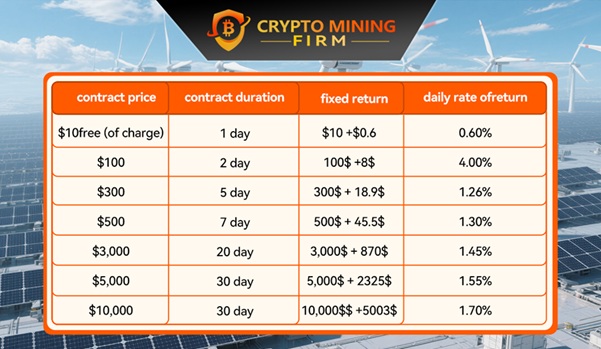
Newbie Bonus: Sign up and get $10-100, which can be used to experience daily signing contracts ($0.60/day) and try cloud computing services risk-free. (508 places remaining)

No hardware hassles: Mine BTC, ETH, DOGE, LTC, and more without owning equipment — our global data centers can handle it all.

Green Mining: Our operations use 100% renewable energy (solar and wind power), achieve carbon neutrality, and integrate profits with sustainability.

Flexible Withdrawal: Enjoy sub-minute USDC withdrawals and support more than 10 cryptocurrencies.

Recommendation Rewards: Referrals can get a 4.5% bonus, with a maximum reward amount of $10,000.

Seamless Interface: Start mining in 30 seconds, perfect for both newbies and experts.

Zero Hidden Fees: Transparent pricing to maximize your profits.

Round-the-Clock Support: 100% uptime and 24/7 expert assistance ensure a flawless experience.

How to participate in Crypto Mining Firm mining:

Step 1: Register an account

Visit cryptominingfarm.COM

Sign up in 30 seconds to claim a bonus of $10 to $100.

Choose a BTC, LTC or Dogecoin mining contract that suits your goals.

Watch daily profits flow in – withdraw or reinvest instantly.

Don’t delay – sign up now to lock in your gains before regulatory changes come!

Step 2: Choose a plan

We offer a variety of high-yield mining programs to meet your financial goals. Whether you are looking for short-term gains or long-term returns, CRYPTOMININGFIRM can meet your needs.

Step 3: Start earning money

Easily control your income growth without any management. Daily income will be automatically deposited into your account, and you can also withdraw your income to your cryptocurrency wallet address.

Investment Plan Details

Starter Plan: $100

o Average daily income: about $2.50

o Suitable for beginners

Pro Plan: $500

o Average daily income: about $15.00

o Most popular among part-timers

Elite Plan: $1,000

o Average daily income: about $35.00

o Most value long-term profits

Once your balance reaches $100, you can withdraw to your wallet or reinvest for significant growth.

Crypto Mining Firm also launched an affiliate program, which is a platform where you can make money by recommending the website to other people. You can start making money even without investing. After inviting a certain number of active referrals, you will receive a one-time fixed bonus of up to $60,000. With unlimited referrals, your earning potential is also unlimited!

Actual Reviews from Real Investors

Amir R., Turkey:

“I began with only $100 and now make more than $150 per day. DOGE withdrawals are quick and easy with CryptoMiningFirm.”


Linda M., UK:

“This is the first time I’ve earned actual passive income on the web. I don’t even have to understand mining — CryptoMiningFirm handles it all.”


Joon Sung., Korea:

“With the AI-supported plans, I amplified my payouts from $500 to $5,000 per month. The XRP withdrawal feature is a game changer at CryptoMiningFirm.”

CRYPTOMININGFIRM‘s cloud mining is one of the safest and most profitable ways to tap into the potential of cryptocurrency. Instead of waiting for market trends, smart investors can proactively create passive income. Join millions of investors earning $1,000 to $81,350 per day through cloud mining and take control of your financial future

For more information, please visit the official website: https://cryptominingfirm.com/

Salesforce Adds AI Agents To Every Product, Raises Prices By 6%, Despite Doubts Over Effectiveness and Customer Backlash

0

Salesforce has announced a fresh round of price increases for several of its flagship cloud products, doubling down on artificial intelligence as the centerpiece of its future—even as mounting concerns about the actual capabilities of its AI tools raise questions about whether the tech is ready for prime time.

Starting August 1, the company will raise prices by an average of 6% for Enterprise and Unlimited editions of Sales Cloud, Service Cloud, Field Service, and selected Industry Cloud offerings. Products under the Starter, Pro, and Foundations tiers will be exempt from the hike. This follows a 10% across-the-board increase implemented just last August, which Salesforce similarly justified by citing growing AI integrations.

The Agentforce Rollout: Salesforce’s Big AI Bet

The price bump comes as Salesforce officially launches two versions of its new AI platform, Agentforce, which the company claims will deliver a new era of automation across customer relationship management and enterprise workflows. These tools are designed to deploy AI agents—autonomous software components meant to perform multi-step tasks with little human involvement.

The two tiers of Agentforce include:

  1. Agentforce Add-on ($125/user/month): Available to Enterprise and Unlimited customers, it includes access to AI agents, industry-specific templates, analytics dashboards, and a prompt-builder designed to ease non-technical user interaction with the AI.
  2. Agentforce 1 Editions ($550/user/month): A premium version offering additional customization, higher-tier features for specific cloud verticals, and annual allocations of 1 million Flex Credits and 2.5 million Data Services Credits per company.

Flex Credits, introduced in May 2025, replace the $2-per-interaction pricing model. This shift, Salesforce argues, gives enterprise customers more flexibility to manage usage and costs. The Agentforce suite also retires the “Einstein” brand, previously used for Salesforce’s AI tools.

However, the company’s own leadership has admitted the pricing model is a work in progress. Bill Patterson, EVP of CRM applications, said in June: “Any business that thinks they have [AI pricing] all figured out is kidding themselves.”

Slack Gets AI Integration—and a Price Bump

Slack, which Salesforce acquired in 2021 for $27.7 billion, is also undergoing an AI overhaul. New features include Salesforce Channels, which merge Slack conversations with CRM data to allow users to discuss and act on records inside the Salesforce UI.

The Slack Business+ plan will jump from $12.50 to $15 per user per month. Additionally, a new Enterprise+ tier bundled with Agentforce 1 Editions promises cross-platform AI-powered search across Slack, Salesforce data, and connected third-party apps—all from a unified dashboard.

But Is the Tech Ready?

While Salesforce is positioning itself at the frontier of AI in enterprise software, its internal data suggests a reality check is warranted.

Just a day before the price hike announcement, research led by a Salesforce employee revealed that large language model (LLM) agents only completed single-step CRM tasks correctly 58% of the time. That figure plunged to 35% when multiple steps were involved. These numbers feed into customer skepticism, particularly as many firms rely on Salesforce systems to manage mission-critical business operations.

User complaints have also emerged across forums and platforms, with some calling the pricing changes premature and pointing to frequent “hallucinations”—a term used when AI systems fabricate or distort information.

Wall Street Reaction

Investor sentiment was mixed. Salesforce’s stock enjoyed a temporary bump after the announcement but soon returned to previous levels, reflecting broader uncertainty about the company’s strategy. CFO Amy Weaver has previously warned that price increases “take a while to roll through our customer base,” suggesting a longer runway before the financial upside materializes.

To hedge its bets, Salesforce has started pivoting away from solely marketing AI models, focusing instead on building a layer of AI-enhanced applications. The company is aiming to position itself not just as a model provider, but as the go-to platform for AI-driven productivity tools across sales, service, and customer experience management.

Salesforce’s aggressive AI push mirrors a broader industry trend as enterprise software vendors seek to redefine their offerings with automation and predictive tools. The company has joined rivals like Microsoft, Oracle, and Adobe in embedding generative AI into nearly every product tier, with the hope of anchoring customers more deeply into their ecosystems.

However, as AI promises meet real-world limitations, Salesforce is facing an uneasy path between investor expectations, customer patience, and technological readiness.

Microsoft to Slash Thousands of Jobs in Sales Amid $80 Billion AI Investment

0

Microsoft is preparing to lay off thousands of employees, with sales teams likely to bear the brunt of the cuts, as the tech giant pushes deeper into artificial intelligence while reining in costs across other business areas.

The layoffs are expected to be announced in early July, shortly after the close of the company’s fiscal year, according to people familiar with the matter who requested anonymity.

Though the final number of affected employees has not been confirmed, the cuts are expected to impact roles beyond sales, suggesting a broad internal restructuring as Microsoft prioritizes its AI infrastructure buildout. The company has so far declined to comment on the upcoming layoffs.

This fresh round of terminations will follow a May downsizing that eliminated around 6,000 positions, most of which came from product development and engineering. Those layoffs spared most customer-facing roles, including marketing and sales. But that appears to be changing as Microsoft increasingly turns to third-party firms to handle sales of its software products to small and mid-sized businesses.

AI Ambitions Forcing a Workforce Rebalance

At the heart of Microsoft’s workforce reshaping is its ambitious AI strategy. The company plans to spend $80 billion in capital expenditures this fiscal year, a massive jump from prior years, with the bulk of the investment directed toward data center construction and server infrastructure. The goal is to ease capacity constraints for its rapidly growing suite of AI services, including those powered by OpenAI, in which Microsoft has invested over $13 billion to date.

These data centers underpin Microsoft’s Azure cloud platform and its integration of AI models into products like Office 365 (Copilot), Bing, and GitHub. But building and maintaining AI capacity is costly, prompting Microsoft to impose strict financial discipline in other business units.

Executives have been clear that the company will “keep a lid on spending” in non-AI areas to meet investor expectations. In recent quarters, CFO Amy Hood has repeatedly signaled that AI-related investments would be offset by cuts in operational costs elsewhere.

Sales Teams in Transition

Microsoft had 228,000 employees globally at the end of June 2024, with around 45,000 working in sales and marketing. Sources indicate that the new layoffs will heavily affect these customer-facing teams, many of whom have seen their responsibilities shift as the company pivots to digital-first and partner-led sales strategies.

Back in April, Microsoft informed employees it would begin outsourcing more sales tasks, particularly in the small and medium business (SMB) segment. This strategy aligns with industry trends: as AI and automated tools become more adept at handling lead generation, customer engagement, and support, traditional sales roles are being reevaluated.

The company has also been reshaping how it sells its enterprise software and cloud products, moving away from labor-intensive direct sales and leaning more heavily on AI-powered tools and partner networks.

A Broader Pattern Across Big Tech

Microsoft’s workforce cuts echo similar moves by other tech giants. Amazon CEO Andy Jassy recently confirmed that generative AI and AI agents will reduce the company’s corporate workforce over time, even as new AI roles emerge.

In recent months:

  • Meta has laid off tens of thousands while shifting resources to its Llama AI program.
  • Google has consolidated multiple teams and cut staff across ad sales, recruiting, and engineering as it pours funding into Gemini, its AI initiative.
  • Salesforce and SAP have made cuts to restructure for AI readiness.
  • Even cybersecurity firm CrowdStrike announced a 5% reduction in staff, citing AI as a driver of back- and front-office efficiency.

The Future of Microsoft’s Workforce

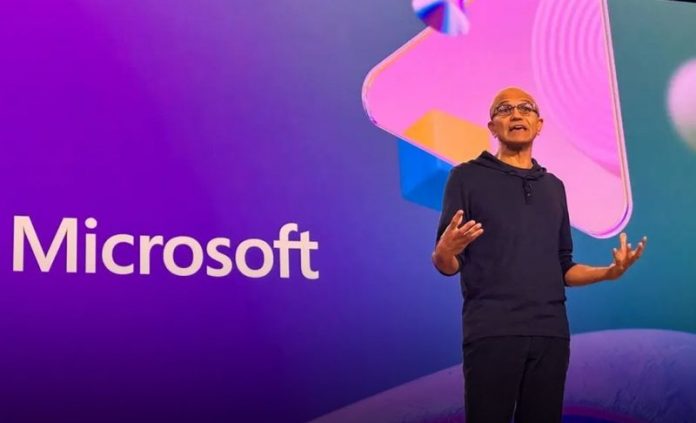
While Microsoft insists these layoffs are part of its routine fiscal-year-end reevaluation, this year’s timing and scale suggest something more structural. With AI driving both innovation and disruption, the company is realigning its workforce to meet what CEO Satya Nadella calls “the AI age.”

The company’s fiscal year closes on June 30 and traditionally brings performance reviews, organizational changes, and business model updates. But this year’s changes come with added urgency as Microsoft races to stay ahead in an AI arms race that’s transforming the economics of Big Tech.

In a market where compute power and infrastructure scale define success, Microsoft is betting big on automation—and that means fewer humans in traditional roles. The company is not alone, but as one of the most powerful players in the industry, its strategy sends a message that AI will not just change the way people work—it will change who gets to work at all.

Trump Grants Third Extension for TikTok as Divestment Talks Drag On, Raising Legal and Political Stakes

0

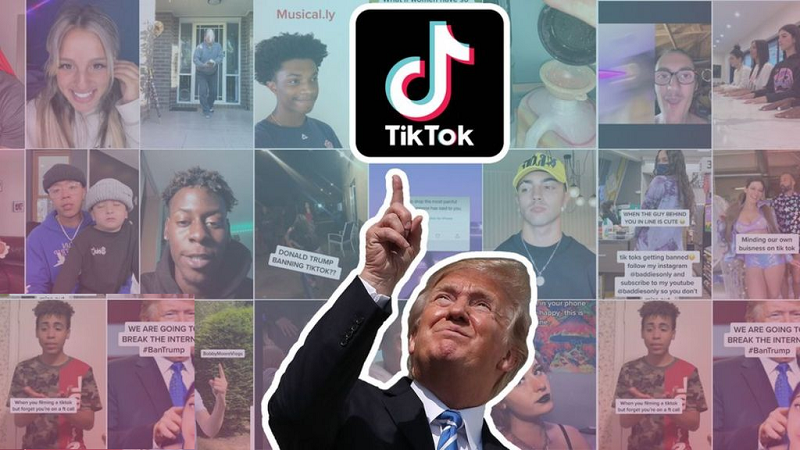
President Donald Trump has once again delayed enforcement of the divestment order against TikTok’s U.S. operations, marking the third time since assuming office in January that the administration has moved the deadline.

The new 90-day extension, confirmed by White House Press Secretary Karoline Leavitt on Wednesday, pushes the cutoff to September 17, 2025, offering China’s ByteDance more time to negotiate the sale of TikTok’s American business.

“President Trump will sign an additional Executive Order this week to keep TikTok up and running,” she said. “As he has said many times, President Trump does not want TikTok to go dark. This extension will last 90 days, which the Administration will spend working to ensure this deal is closed so that the American people can continue to use TikTok with the assurance that their data is safe and secure.”

The reprieve comes just days ahead of the original June 19 deadline mandated under a national security law that the U.S. Supreme Court upheld shortly before Trump’s second inauguration. The law, passed in April 2024 with bipartisan support, requires ByteDance to divest its U.S. TikTok assets or face a ban, with penalties extending to app store operators like Apple and Google and internet service providers that support the app.

Political, Legal, and Market Friction

The extensions have already provoked strong reactions on Capitol Hill, especially from Senate Republicans who argue the law was explicit in allowing only one 90-day reprieve.

Legal experts say Trump’s action could open the door for lawsuits challenging executive overreach.

Despite the legal ambiguity, Trump has been consistent in stating he does not want TikTok shut down entirely. Speaking to NBC News last month, he reiterated that while data security is a legitimate concern, banning the app outright could hurt younger people who use it regularly.

There is also strategic political calculus behind the decision. TikTok played a key role in social media outreach during the 2024 campaign. Though Trump has been vocally critical of the platform in the past, his current stance seeks to balance national security fears with user base sensitivities and diplomatic considerations with Beijing.

Several entities, including Oracle, AppLovin, and Frank McCourt’s Project Liberty, have expressed interest in acquiring TikTok’s U.S. assets. However, negotiations have stalled amid ongoing uncertainty about whether the Chinese government would approve such a sale. Observers believe the stalemate reflects broader trade and diplomatic tensions between Washington and Beijing.

Notably, a previous TikTok shutdown in January led to the app being briefly removed from the Apple App Store and Google Play. It returned only after Trump’s initial executive order granted a delay. The same scenario could recur if no concrete sale agreement is reached by the new September deadline.

Trump’s administration has privately hinted that tariffs or other trade levers could be adjusted to break the deadlock with Beijing.

TikTok remains one of the most popular social media platforms in the United States, boasting over 170 million users and generating $10.4 billion in ad revenue in 2024 alone. Its user base, content creators, and advertisers have expressed relief at the extension, but uncertainty over the app’s long-term future continues to cloud business decisions.

According to a recent Pew Research survey, public sentiment against a TikTok ban is declining. Only about one-third of Americans now support removing the app, compared to nearly half in 2023.

Analysts say rivals like Meta (owner of Instagram and Facebook), Snap, and Reddit could benefit from prolonged ambiguity, possibly absorbing creators and ad budgets that might otherwise remain with TikTok.

A Crucial Three Months Ahead

The Trump administration insists the additional 90 days will be used to finalize a deal that secures American user data and ensures operational independence from China. National Security Adviser Michael Waltz and Vice President JD Vance are reportedly spearheading negotiations with potential acquirers.

In the background, ByteDance is also managing litigation and lobbying. Legal experts point out that the Supreme Court’s ruling upholding the law puts pressure on ByteDance to act swiftly.

Some legal experts have argued that there’s no fourth extension authorized by law, and if this deal isn’t closed by September, enforcement becomes inevitable unless Congress rewrites the statute.

However, TikTok will remain online and fully functional in the United States, with its fate hinging on the outcome of high-stakes talks between tech giants, lawmakers, and diplomats. The next three months are expected to determine the future of the embattled short-form video app.