
DD
MM
YYYY

PAGES

DD
MM
YYYY

spot_img

PAGES

Home Blog Page 112

How to Start Crypto Mining? 6 Best Cloud Mining Sites for Fast and Easy Profit

0

Starting crypto mining in 2025 has become far more accessible thanks to legal, easy-to-use cloud mining sites that remove the need for hardware, high electricity bills, and technical setup. If you’re searching for how to start crypto mining or the best cloud mining sites for fast and easy profit, this guide walks you through the essentials and highlights the most trusted platforms to begin earning.

What Is Cloud Mining and Why It Matters in 2025

Cloud mining allows you to rent computing power from professional mining farms. Instead of running your own machines, you purchase a plan, and the platform delivers daily crypto rewards directly to your wallet.
With Bitcoin’s rising difficulty and hardware costs, cloud mining offers a simple entry point for beginners who want quick setup, predictable payouts, and passive income.

How to Start Crypto Mining: Quick Beginner Steps

1. Join AutoHash

Register on AutoHash, a Swiss-supervised cloud mining platform with transparent terms and renewable-energy farms.

2. Pick Your Mining Plan

Choose a short, AI-optimized contract that matches your budget and preferred hashrate.

3. Activate and Earn Daily BTC

Start your plan and receive automated daily payouts—no hardware, no setup, fully managed by AutoHash.

6 Best Cloud Mining Sites for Fast and Easy Profit

Below are the most reliable platforms offering strong performance, transparent terms, and beginner-friendly dashboards.

1. AutoHash — Swiss-Supervised, AI-Optimized Cloud Mining

AutoHash stands out for its Swiss oversight, renewable-energy mining farms, and AI engine that allocates hashrate for maximum output. It is one of the few platforms offering clear legal compliance plus a $100 bonus for new users.

? Click to visit AutoHash and start mining for free now!

AutoHash monetization plan example:
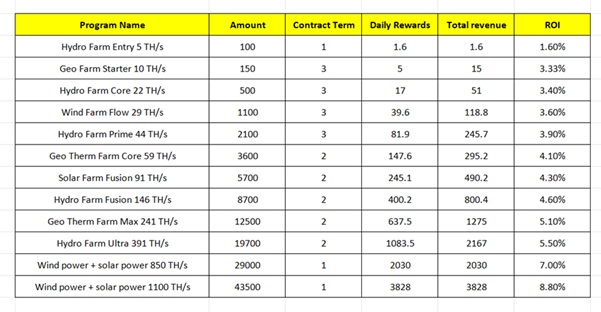
Why users choose it:

  • AI-enhanced mining efficiency
  • Swiss regulatory environment
  • Fast Bitcoin payouts
  • Renewable energy farms
  • User-friendly mobile dashboard
  • Supports BTC, DOGE, LTC

2. BitDeer — Institutional-Grade Mining Infrastructure

BitDeer operates some of the largest industrial mining facilities in the world. Contracts range from beginner-level to high-power plans suitable for advanced users.

Highlights:

  • Transparent hosting costs
  • Long-term BTC contracts
  • Access to diverse mining pools
  • Reliable, stable infrastructure

3. ECOS Mining — Regulated Mining in Armenia’s Free Economic Zone

ECOS delivers consistent performance backed by a regulated environment. Its simple plan calculator and clear pricing make it popular for users starting crypto mining.

Highlights:

  • Operates legally within a government-supervised zone
  • Beginner-friendly contract options
  • Low minimum entry cost
  • Stable, predictable BTC output

4. NiceHash — Buy Live Hashpower with Full Flexibility

NiceHash is different from fixed-contract platforms. Instead, you buy live hashpower on a marketplace, making it ideal for users who want strategy and flexibility.

Highlights:

  • Real-time pricing
  • Switch mining algorithms anytime
  • No long-term lock-ins
  • Supports multiple crypto assets

5. Hashing24 — Simple BTC Hosting for Long-Term Miners

Hashing24 focuses on straightforward Bitcoin hosting with reliable output. It’s a good entry-level choice for users who want minimal setup and stable daily earnings.

Highlights:

  • Clear BTC-only plans
  • Stable long-term payouts
  • Easy onboarding
  • Transparent fee structure

6. ViaBTC Cloud — Multi-Coin Mining With Large Global Pools

ViaBTC is a well-known global mining pool offering cloud contracts for multiple crypto assets. It’s a strong option for users who want diversification beyond Bitcoin.

Highlights:

  • Supports BTC, LTC, BCH, and more
  • Competitive pool performance
  • Good for multi-asset mining
  • Proven operational history

Is Cloud Mining Still Worth It in 2025?

Yes—when using legal, transparent cloud mining sites. Platforms that rely on real data centers and publish clear costs can provide stable earnings, especially for users who want passive income without running hardware.

Final Thoughts: Start Crypto Mining the Smart Way

If you’re wondering how to start crypto mining or looking for the best cloud mining sites for fast and easy profit, the key is choosing trusted services with clear legal standing and transparent operations. Platforms like AutoHash, BitDeer, ECOS, NiceHash, Hashing24, and ViaBTC make it possible for beginners to earn daily crypto with minimal effort.

Start small, choose short-term plans, and scale as you gain confidence—smart cloud mining can become a steady passive-income stream in 2025.


Africa’s Tech Ecosystem: Early, Not Broken — A Data Driven Reality Check

0

Africa’s tech ecosystem is often judged by the standards of fully mature markets, from billion-dollar exits to deep growth-stage capital, and a constant stream of IPO headlines. By these metrics, it appears to be lagging.

But on a closer look, the data reveals a very different reality. Africa is not lagging; it is simply early. Too often, the continent is judged using the playbook of the U.S. in 2025 rather than the realities of an ecosystem still in its formative stages. In truth, Africa is progressing through the same foundational phases that every resilient innovation economy has experienced on its path to maturity.

Entrepreneur and seasoned investor Ido Sum, formerly a partner at TLcom Capital, has shared a data-driven reflection on the true state of Africa’s tech ecosystem. In his analysis, he explains that while it may be tempting to compare Africa’s progress to the fully mature venture capital environments, doing so paints an inaccurate picture.

Instead, he argues that Africa today mirrors what the U.S. looked like in the 1970s–80s, and Europe and India in the early 2000s, ecosystems that were still young, experimental, and slowly building trust with capital providers.

Sum notes that early-stage markets everywhere are characterized by small funds, modest rounds, very few unicorns, and exits usually ranging between $25 million and $300 million. This is a universal pattern seen in the early days of every major tech ecosystem, including Silicon Valley, China, India. Africa’s present trajectory, he asserts, fits perfectly into this historical pattern. The ecosystem is not underperforming; it is simply in its early chapters.

To illustrate this, Sum examines the “conversion funnel” of startups advancing through funding rounds. In the United States, for example, roughly half of the companies that raised Seed funding between 2008 and 2010 went on to Series A, and about 30% achieved an exit within ten years. Africa’s data, however, tells a different story. Between 2019 and 2022, 582 African startups raised pre-seed or seed funding.

Only about 26% secured any follow-on round, 16% reached Series A, 4.5% reached Series B, and less than 1% made it to Series C and beyond. When an additional 500 companies with later-stage starting points are included, the overall outcomes remain similar. The funnel tightens dramatically after Series A, mostly due to the limited availability of growth-stage capital on the continent.

The exit landscape supports this trend as well. From 2015 to 2025, Africa recorded just over 20 tech exits valued above $50 million, totalling around $5 billion in disclosed value. These companies raised an average of $250 million in equity and debt before exiting, with a typical journey taking around 10.5 years.

Most exits were strategic acquisitions, while IPOs remained rare. The majority of outcomes sat within the $50 million–$150 million range, with a few notable exceptions such as Paystack, DPO, and InstaDeep. Sum emphasizes that these numbers are not signs of a failing ecosystem. Instead, they reflect what early-stage markets everywhere experience before breakout success stories become routine.

He argues for a realistic, yet optimistic, approach to venture investing in Africa. Fund managers, he suggests, should align their expectations with the market’s current stage. Rather than designing strategies around billion-dollar IPOs, they should build funds sized between $20 million and $75 million that can thrive on $100 million–$200 million exits outcomes far more likely in the near term.

He further points out that Africa lacks the non-equity support frameworks that helped other regions grow, such as R&D grants, working-capital instruments, and large-scale venture debt. Many African startups face a financing landscape where equity angel rounds, VC series, and the expectation of dilution carries an outsized share of growth capital.

That happens because complementary, non-equity instruments that grease other ecosystems (direct R&D grants, generous R&D tax credits, predictable working-capital facilities, large-scale venture debt, credit guarantees and long-term local institutional capital deployed to SMEs) are limited or uneven across the continent. The result, a steeper funding funnel, risk-intolerant investors, and slower commercialization of capital-intensive innovation.

In Sum’s view, none of this is cause for discouragement. Instead, it is a call for investors, founders, and policymakers to treat Africa as “early, not broken”, and to design capital structures, exit pathways, and market expectations that match the continent’s current stage of development.

“How can I co-own some of Tekedia Capital Portfolio Companies?”

0
You asked: “how can I co-own some of these companies?”
Our response: Simply, via Tekedia Capital Syndicate, Africa’s leading investment syndicate and the most active with hundreds of professionals, entrepreneurs, corporates, investment clubs, and citizens.
 
Through the Syndicate, you will own a piece of some of the world’s most promising startups, typically reserved for venture firms and high-net-worth investors.
 
Membership covers four investment cycles and is priced at $1,000 or ?1,000,000, depending on your preferred currency. Join us and begin co-investing alongside a global community of innovators and builders; we do two cycles in a year.
 
To learn more about and join, visit here
 
Tekedia Capital >> funding global prosperity and empires of the future

Tekedia Capital Welcomes Veritus Agent, A Pioneer in AI-First Loan Servicing and Collections

0

Tekedia Capital is pleased to announce our investment in Veritus Agent, a startup building AI agents for loan originations, servicing, and collections, in the United States. Largely, Veritus is reinventing how lenders manage the full lifecycle of credit. Its AI-powered agents handle inbound and outbound calls, maintain context across SMS, email, and chat, negotiate repayment plans, process payments, and automate follow-ups.

This is a space we understand well. Our earlier investment in Corgi, the world’s first AI-insurance and AI-reinsurance company, with actual insurance licenses, validated how AI can transform regulated financial operations, when you create AI systems and also use those to invent new business models, over just selling software. Corgi is one of the fastest growing startups in the world right now!

Veritus Agent follows a trajectory: licensing its technology while building toward operating as a licensed collections agency nationwide, creating recurring software revenue with significant long-term upside. The opportunity is massive: $4 trillion in annual U.S. credit originations, $18 trillion in outstanding loans, and $400 billion in delinquent debt. Yet outreach and collections remain dominated by manual phone calls and physical mail. Veritus replaces these outdated processes with scalable, intelligent software that improves recovery rates while reducing cost.

We proudly welcome Veritus Agent to the Tekedia Capital family.

Top 5 Cryptos Under $0.50 That Could Outperform Ethereum (ETH) and Solana (SOL) This Cycle

0

On our list of five names to watch, Little Pepe (LILPEPE) is at the top of coins under $0.50, to trade above $3 before the end of 2026. Little Pepe is priced at $0.0022 and has signaled that it will even outperform coins priced above $1, even at its presale stage.

Little?Pepe (LILPEPE): Meme Power Meets Real Utility

Little?Pepe is the standout underdog here. Currently in its presale at $0.0022 in Stage?13, it has already raised over $27 million and sold more than 16.4 billion tokens. Early stage?1 buyers are already sitting on more than 120% gains. If the token lists at $0.003 as projected, current stage buyers could see about 36% upside before the launch. LILPEPE isn’t just a meme coin. It’s building its own Layer?2 chain optimized for memes, low-fee trading, and anti-bot protection. CertiK has audited the project and is now listed on CoinMarketCap, adding credibility for cautious investors. Its community engagement is remarkable, with a $777k giveaway and a “Mega Giveaway” rewarding top presale buyers (Stage?12–17) with over 15 ETH in prizes. Social buzz is off the charts. Between June and August 2025, LILPEPE peaked at 100 in ChatGPT memecoin?question volume, surpassing PEPE, DOGE, and SHIB. That kind of viral momentum, combined with real infrastructure, gives it a shot at substantial percentage gains in the next cycle.

Avalon Labs (AVL): A Utility-Driven Underdog

Avalon Labs is a competitor with significant usefulness under $0.50, now trading at about $0.17. Its platform focuses on providing BTC-backed financing, connecting DeFi with conventional banking, and tokenizing real-world assets. It has the potential to surpass larger, slower-moving cryptocurrencies like ETH and SOL if its acceptance increases due to its blend of blockchain innovation and practical utility. Avalon Labs has a fundamentally solid narrative that strikes a balance between risk and plausible use applications, even though it lacks the viral meme buzz of LILPEPE.

Boost (BOOST): Speculative Potential in Early Stages

Boost is trading at $0.0189 and has surged over 4.62% in the past 24 hours. The token is showing momentum, and its development could push it by 21x, beating ETH and SOL this cycle.

Marina Protocol (BAY): A DeFi Infrastructure Contender

BAY is stabilizing around $0.13 after that huge wick to $0.188 and deep flush to $0.081. Price is slowly grinding back up and holding the mid-range. BAY could target $4.07 and is set to outperform ETH and SOL.

Overtake (TAKE): Peer-to-Peer Digital Asset Trading

Overtake is currently trading around $0.320. It has a resistance hovering around $0.40. The recent bullish momentum could break above the resistance, potentially pushing the price to $1.20.

Why These Tokens Could Outperform ETH and SOL

Entry price is key. Tokens under $0.50 offer far greater leverage than ETH or SOL, which already have high market caps and slower percentage gains. LILPEPE’s combination of social virality, technical infrastructure, and presale incentives shows how smaller tokens can scale quickly. Boost and Marina Protocol’s DeFi potential add fundamental strength, giving investors multiple avenues for upside.

Final Thoughts

If you’re willing to swing for significant gains, Little?Pepe stands out right now. Its presale is nearly sold out, infrastructure is solid, and community momentum is immense. Early buyers are already enjoying strong returns, and the remaining presale stages still offer 36% upside, before a post-launch ride to $2.1. Boost and Marina Protocol provide alternative strategies for those seeking exposure to utility and DeFi.

For more information about Little Pepe (LILPEPE) visit the links below:

Website: https://littlepepe.com

Whitepaper: https://littlepepe.com/whitepaper.pdf

Telegram: https://t.me/littlepepetoken

 Twitter/X: https://x.com/littlepepetoken

 $777k Giveaway: https://littlepepe.com/777k-giveaway/