DD
MM
YYYY

PAGES

DD
MM
YYYY

spot_img

PAGES

Home Blog Page 1148

Moody’s Downgrades U.S. Credit Rating, Citing Soaring Interest Rates, Leadership Dysfunction

0

In a concerning development for the world’s largest economy, Moody’s Ratings downgraded the United States’ sovereign credit rating from Aaa to Aa1 on Friday, erasing the nation’s last bastion of top-tier fiscal credibility.

The decision, announced as markets closed Friday, completes a trifecta of downgrades among major rating agencies, following Standard & Poor’s in 2011 and Fitch Ratings in 2023. With a $36 trillion federal debt casting a long shadow, Moody’s pointed to a perilous combination of soaring interest costs, ballooning entitlement programs, and a Congress paralyzed by partisan rancor.

“The United States retains exceptional credit strengths,” Moody’s acknowledged, citing “the size, resilience, and dynamism of its economy and the role of the U.S. dollar as global reserve currency.”

However, these advantages are no match for the fiscal storm brewing. The agency forecasts federal deficits surging to nearly 9% of GDP by 2035, up from 6.4% in 2024, fueled by “increased interest payments on debt, rising entitlement spending, and relatively low revenue generation.” The debt-to-GDP ratio, already at 98% last year, is projected to hit 134% by 2035, a trajectory Moody’s deems unsustainable.

The downgrade landed like a thunderclap in a capital already reeling from political turmoil. Hours earlier, House Republicans watched their flagship tax and spending package, the “One Big Beautiful Bill Act,” implode in the Budget Committee. The 16-21 vote exposed fractures within the GOP and hardened Democratic opposition, offering a vivid snapshot of the gridlock Moody’s warned about.

The bill, a linchpin of President Donald Trump’s economic agenda, sought to cement the 2017 tax cuts, exempt tips, overtime, and certain auto loans from taxation, and raise the standard deduction to $32,000 for joint filers. It also dangled a temporary $500 hike to the child tax credit, bringing it to $2,500, while funneling $350 billion toward deportation efforts and Pentagon priorities.

But the package’s aggressive spending cuts, slashing over $1 trillion from health care and food assistance over a decade, ignited controversy. Proposed work requirements for Medicaid, demanding 80 hours of monthly work, and expanded SNAP restrictions for ages 55 to 64 drew fierce pushback.

Five GOP rebels, led by Reps. Chip Roy of Texas and Ralph Norman of South Carolina joined Democrats to sink the bill, demanding steeper Medicaid reductions, immediate welfare reforms, and the axing of Biden-era green energy tax credits. New York Republicans, meanwhile, clamored for a beefier State and Local Tax deduction, pitching $62,000 for single filers and $124,000 for joint filers against the bill’s $30,000 cap for joint filers earning up to $400,000.

Democrats pounced, branding the legislation a betrayal of the vulnerable. “This is one big, beautiful betrayal,” declared Rep. Pramila Jayapal, a progressive firebrand.

Rep. Morgan McGarvey of Kentucky warned of shuttered nursing homes, shuttered hospitals, and hungry children, citing Congressional Budget Office estimates that the bill would strip health insurance from 7.6 million people and cut 3 million monthly SNAP recipients. The defeat, played out in real-time on Capitol Hill, laid bare the dysfunction Moody’s flagged as a central driver of the downgrade.

Moody’s didn’t mince words about the fiscal fallout of current policies. Extending the 2017 Trump tax cuts, a top Republican goal, would pile an additional $4 trillion onto the primary deficit over the next decade, excluding interest, the agency calculated. This, coupled with reluctance from Republicans to raise taxes and Democrats’ resistance to spending cuts, has left Washington “unable to tackle America’s huge deficits,” as the Associated Press reported.

The downgrade threatens to jack up borrowing costs for the government, potentially rippling through to consumers grappling with mortgages, car loans, and credit card debt.

“This downgrade is part of a long trend of fiscal irresponsibility,” warned Spencer Hakimian, CEO of Tolou Capital Management, predicting higher costs for both public and private sectors.

Jay Hatfield, CEO of Infrastructure Capital Advisors, foresaw market jitters, especially as Trump’s tariff policies—already stirring fears of inflation and slowdown—compound vulnerabilities. Still, Hakimian noted that the U.S. dollar’s safe-haven status might cap spikes in Treasury yields.

Moody’s maintained a stable outlook, a nod to the U.S.’s economic heft and the dollar’s global dominance. But the warning signs are unmistakable.

“This downgrade adds to the evidence that the U.S. has too much debt,” said Darrell Duffie, a Stanford finance professor and former Moody’s board member. “Congress needs to either get more revenues or spend less.”

The announcement sparked a flurry of reactions, each tinged with political spin. Stephen Moore, a Heritage Foundation economist and former Trump advisor, decried the downgrade as “outrageous,” asking, “If U.S. government bonds aren’t a triple-A asset, then what is?”

White House communications director Steven Cheung took a swipe at Moody’s economist Mark Zandi, hinting at partisan motives. Senate Democratic Leader Chuck Schumer called it a “wake-up call” for Republicans to ditch their “deficit-busting tax giveaway,” adding dryly, “I’m not holding my breath.”

Moody’s verdict underlines a warning by economists that without a course correction, America’s debt burden risks becoming an anchor, dragging down an economy still buoyed by its global clout but increasingly tested by its own divisions.
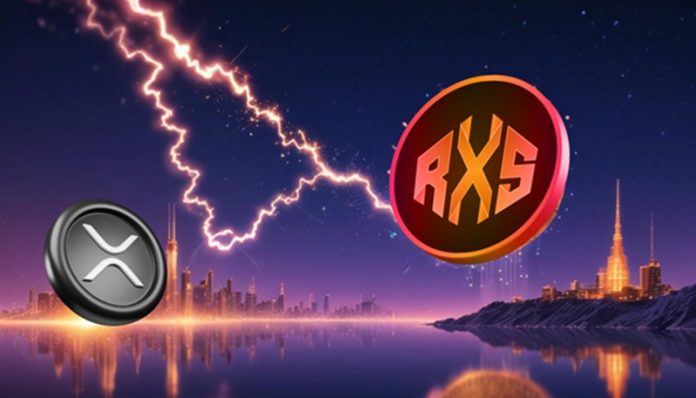

Ripple (XRP) Crypto Chart Confirms Huge Movement Coming for XRP, So Why is Rexas Finance (RXS) the One Trending?

0

Technical analysts and investors are closely watching Ripple (XRP), a well-established cryptocurrency. XRP’s crypto chart shows volatility decreasing, volume rising, and historical resistance levels being tried again. A massive price shift is expected, say many. Although Ripple is receiving the most attention, Rexas Finance (RXS) is also attracting savvy investors. Why is investor interest shifting? What’s making the Rexas Finance trend harder than XRP, despite the breakout? The answer rests in utility, innovation, market timing, and explosive growth potential.

XRP Chart Suggests Breakout, but Investors Want More Than Hype

For weeks now, XRP’s chart has been forming a classic symmetrical triangle—a pattern that typically precedes a significant price move. Bulls think that a breakout over $0.70 could send XRP flying toward $1.00 and beyond, especially as legal clarity regarding Ripple’s dispute with the SEC steadily emerges. XRP fundamentals are improving, and excitement is rising. However, even with the potential gain, many investors are going beyond chart patterns and classic altcoin trades. As cryptocurrency matures, investors now prioritize real-world utility and practical innovation, which Rexas Finance excels in.

The Real Crypto Disruptor: Rexas Finance (RXS)

Rexas Finance (RXS) is revolutionizing blockchain technology by tokenizing real-world assets (RWAs). It allows investors to break down things that cannot easily be converted into cash, including real estate, commodities, and art, into fractions that exist as digital tokens on the blockchain. Why does it matter? Tokenization opens up new investment frontiers, making high-net-worth assets accessible to the global public. This is wealth democratization, and Rexas Finance is leading the way.

A Smooth Ecosystem Driven by Innovation

Rexas Finance prioritizes usability and accessibility. It simplifies asset tokenization with Rexas Token Builder and QuickMint Bot. Users without blockchain or coding skills may easily create, manage, and trade tokenized assets.  Rexas Finance’s AI Shield ensures transactions are transparent, tamper-proof, and secure. Blockchain-AI fusion provides unequaled confidence and reliability.  The network also uses Decentralized Finance (DeFi) to allow yield farming, staking, and wealth growth in a decentralized, user-governed environment.


An Unexpected Presale

Rexas Finance has experienced exponential growth since its September presale. At Stage 12, the project has sold 461.44 million tokens, raising $48.29 million in proceeds. The sixfold increase in Rexas Finance’s pricing, from $0.03 to $0.20, indicates investor confidence and rising demand. This presale is noteworthy because Rexas Finance opted for a public-first approach rather than a venture capital approach. This eliminates VC token dumps, promotes a fairer distribution mechanism, and builds community loyalty from the start.

Trust, Transparency, and Global Visibility

Rexas Finance has worked hard to gain investor trust. The platform passed a Certik audit, proving its security and reliability. Its early listings on CoinMarketCap and CoinGecko have increased its visibility and global user base.

These milestones demonstrate a roadmap of transparency, long-term growth, and user-focused development, rather than merely box-checking.

Deflationary Model with Strategic Incentives

Deflationary tokenomics is another reason Rexas Finance is outperforming XRP. The limited supply and burn mechanisms of the Rexas Finance token ensure its appreciation. The active $1 million raffle, where 20 participants will each receive $50,000 in RXS, adds to the excitement. These efforts incentivize early adopters, captivate future users, and strengthen community dynamics.  Rexas Finance will be listed on at least three top-tier worldwide exchanges for $0.25 after the presale. A substantial post-listing rise may result from this move’s tremendous liquidity and accessibility.

Rexas Finance to Grow 50x in Exploding Market.

While XRP struggles with regulations and market sentiment, Rexas Finance is expanding in RWA tokenization, a promising area in the blockchain space. Analysts expect the RWA tokenization market to grow from $50 billion in 2025 to $16 trillion by 2030. This puts Rexas Finance in a prime position to control a growing sector. Rexas Finance is a strong contender for 50x returns due to its first-mover advantage, robust infrastructure, user-friendly tools, and active community participation, particularly in a negative market.

Why RXS Outperforms XRP

XRP’s chart suggests a breakout, which could be exciting for short-term traders. Rexas Finance attracts long-term investors, builders, and institutions because of its real-world impact .XRP may ride a wave of speculation, but Rexas Finance is constructing a future of decentralized ownership, democratized investing, and universal value. Such innovation transforms, not trends. It’s evident why Rexas Finance is making headlines while XRP waits to burst. Rexas Finance isn’t just blockchain-ready; it builds the blockchain itself.


For more information about Rexas Finance (RXS) visit the links below:

Website: https://rexas.com

Win $1 Million Giveaway: https://bit.ly/Rexas1M

Whitepaper: https://rexas.com/rexas-whitepaper.pdf

Twitter/X: https://x.com/rexasfinance

Telegram: https://t.me/rexasfinance

Tekedia Crypto and Blockchain Weekend Roundup

0

The Saudi Central Bank reportedly disclosed an investment in MicroStrategy ($MSTR) stock, with posts on X claiming a purchase of 25,656 shares. Given MicroStrategy’s significant Bitcoin holdings, this move is widely interpreted as indirect exposure to Bitcoin. The investment aligns with growing institutional interest in crypto but has sparked debate, with some viewing it as a strategic diversification and others as a risky bet with public funds.

The Central Bank of Russia has reported Bitcoin as the top-performing investment asset in 2025, with a 38% return over the past 12 months, outperforming traditional assets like gold, stocks, and bonds. Since 2022, Bitcoin’s cumulative return has reached 121.3%. Its year-to-date performance in 2025 shows a 17.6% return, and in April 2025 alone, it gained 11.2%. This recognition marks a shift in Russia’s stance, as the Central Bank has also included Bitcoin in its financial overview and plans to launch a crypto exchange for qualified investors. However, Bitcoin’s volatility remains notable, with a reported 17.6% drop in Q1 2025.

The Economist published an article on May 17, 2025, titled “Crypto meets the swamp: Why it won’t end well,” labeling cryptocurrency as the “ultimate swamp asset.” It argues that the U.S. crypto industry has shifted from its decentralized ideals to a tool for rent-seeking, particularly benefiting political figures like Donald Trump and his associates. The piece criticizes crypto for facilitating fraud, money-laundering, and financial crime on a large scale, deviating from its original promise of financial freedom.

Abu Dhabi’s sovereign wealth fund, Mubadala Investment Company, disclosed a $408.5 million investment in BlackRock’s iShares Bitcoin Trust (IBIT) ETF, as per a 13F filing with the SEC. This stake, comprising 8.7 million shares as of March 31, 2025, positions Mubadala as one of the largest holders of IBIT, reflecting growing institutional adoption of cryptocurrency. Some reports suggest the investment may have increased to around $461 million, elevating Mubadala to the seventh-largest IBIT holder. This move signals a significant shift, as sovereign wealth funds rarely invest directly in crypto assets, potentially influencing broader market confidence.

The next FTX distribution of over $5 billion to eligible creditors is scheduled to begin on May 30, 2025. Payments will be processed through BitGo or Kraken, with funds expected to reach creditors within 1 to 3 business days. The Ethereum Foundation announced the “Trillion Dollar Security” (1TS) initiative on May 14, 2025, aiming to enhance Ethereum’s security infrastructure to support trillions in onchain assets. The initiative focuses on improving wallet safety, securing smart contracts, enhancing user experience (UX), and strengthening protocol layers.

Key features include smart accounts (ERC-4337), social recovery, spending limits, and advanced key management like MPC and biometrics. This ecosystem-wide effort seeks to boost trust and enable secure mass adoption for both individual and institutional users, positioning Ethereum as a robust global digital asset management platform.

JPMorgan Chase has completed its first public blockchain transaction, settling tokenized U.S. Treasuries outside its private network. The transaction, facilitated by Ondo Finance and leveraging Chainlink’s interoperability technology, marks a significant step for the bank, which has traditionally relied on its private blockchain, Kinexys Digital Payments (formerly JPM Coin). The settlement involved a cross-chain transfer of tokenized short-term Treasuries on Ondo’s public ledger, demonstrating JPMorgan’s move toward integrating with public blockchain infrastructure. This development is seen as a milestone in bridging traditional finance (TradFi) with decentralized finance (DeFi), with potential implications for tokenized real-world assets (RWAs).

Mastercard has partnered with MoonPay to launch stablecoin payment cards, enabling users to spend cryptocurrencies like USDC, USDT, and DAI at over 150 million merchants worldwide. The service converts stablecoins to fiat at the point of sale, powered by MoonPay’s Iron infrastructure.

This expands Mastercard’s crypto push, competing with Visa, despite regulatory uncertainties. The rollout follows Mastercard’s earlier stablecoin payment capabilities announced in April 2025, involving partners like Circle, Nuvei, and Paxos for merchant settlements.

Doodles, a next-generation entertainment company, launched Take Your Medicine, a London-based creative music studio and label, last week. The studio specializes in original music and sound for commercial recording, bridging the gap between commercial and artistic worlds. It has already worked with major brands like Coca-Cola, Samsung, Adidas, Disney, and TikTok, with an EP in development. This follows Doodles’ earlier launch of a namesake record label in July 2024, featuring artists like Lil Wayne and Lil Yachty.

The Infinite Node Foundation (NODE), a nonprofit focused on preserving digital art, acquired the intellectual property (IP) of the CryptoPunks NFT collection from Yuga Labs on May 13, 2025. Yuga Labs, which had purchased the IP from Larva Labs in 2022, transferred it to NODE for an estimated $20 million, though some sources note the amount was undisclosed.

NODE also received a $25 million fund to support its stewardship, which includes preserving the collection, engaging the community, and launching a museum-partnership program to integrate CryptoPunks into leading art institutions.

The acquisition led to a 40% surge in CryptoPunks NFT sales and a 170% increase in trading volume to $2.8 million within 24 hours. Yuga Labs described the transfer as a “full-circle moment” to ensure the collection’s permanence, with Larva Labs founders Matt Hall and John Watkinson returning as advisors.

The Uniswap DAO is currently voting on a proposal to fund the integration of Uniswap V4 on Ethereum and add Unichain support within the Oku platform. This initiative, proposed by GFX Labs, aims to enhance Uniswap’s reach and encourage liquidity migration to Uniswap V4, solidifying its position as a leading decentralized exchange. The proposal includes funding for GFX Labs to integrate these features, develop analytics, and build liquidity tools on Oku. Voting is ongoing and set to conclude on May 18, 2025.

Messari Releases Solana’s Q1 Performance Report, Showing Ecosystem Growth

0

Solana (SOL) is an integrated, open-source Layer-1 network with the goal of synchronizing global information at the speed of light. Solana optimizes for increasing bandwidth and reducing latency. It accomplishes this through features such as its novel timestamp mechanism called Proof-of-History (PoH), a block propagation protocol Turbine, and parallel transaction processing. Since mainnet launch in March 2020, several network upgrades have brought further network performance and resilience, including QUIC, stake-weighted Quality of Service (QoS), and local fee markets.

Development and growth of the network and its ecosystem are supported by the non-profit Solana Foundation, for-profit Solana Labs, and various third-party organizations, including Anza, Colosseum, Helius, and Superteam. Solana Labs has raised over $335 million in private and public token sales. Solana features a growing ecosystem of projects across many sectors, including DeFi, consumer, DePIN, and payments. To stay up-to-date with all things Solana, visit the Solana Portal.

Chain GDP is defined as the total application revenue generated on a network. In Q1 2025, Solana’s Chain GDP grew 20% QoQ from $971 million to $1.2 billion. January was the highest-earning month, bringing in $699 million in revenue to applications on the protocol. The leaders by application revenue in Q1’25 were as follows:

Pump.fun: $257 million (10% QoQ increase)

Phantom: $164 million (25% QoQ increase)

Photon: $122 million (13% QoQ decrease)

BullX: $87 million (19% QoQ increase)

Jupiter: $80 million (79% QoQ increase)

These applications’ revenue is directly correlated to increases in speculation as they facilitate the trading of assets. This was especially apparent when TRUMP and MELANIA launched. Average daily DEX volume (USD) in January grew to $8.3 billion, a 153.4% increase from the average in Q4’24.

App Revenue Capture Ratio (App RCR)

A network’s App Revenue Capture Ratio (RCR) is the ratio of revenue generated by its apps to its Real Economic Value (REV). REV is defined as the sum of base transaction fees, priority fees, and MEV tips paid to validators. App RCR reflects the efficiency with which applications capitalize on the economic activity taking place on the network. The higher the app RCR, the more effectively apps capture the economic activity being generated on the network, suggesting a mature ecosystem with monetizable applications. A low App RCR may signal untapped potential for app developers or inefficiencies in revenue capture. Alternatively, it may signal a nascent ecosystem not yet ready for monetization.

If App RCR equals 20%, this implies that for every $1 of REV generated by the network, $0.20 is captured as revenue by apps. In Q1 2025, App RCR on Solana was 142.8%, a 21% QoQ increase from 117.6% in Q4’24. This can be interpreted as when $100 is spent in transaction fees (and/or Jito tips) to interact with Solana, applications earn $142.80 in revenue.

A network’s App RCR can be greater than 1 when its applications are successful in monetizing activity, driving revenue streams for project teams and potentially, tokenholders. For example, DEXs charging swap fees or NFT marketplaces imposing marketplace fees in excess of transaction fees paid to Solana.

Stablecoin market cap expanded 145.2% QoQ to $12.5 billion. USDC grew 148.4% to $9.7 billion, and USDT grew 154.2% to $2.3 billion. Average Daily DEX volume grew by 40.8% QoQ to $4.6 billion, fueled by renewed memecoin speculation after the TRUMP token launch. Solana Foundation will host the Accelerate conference in May in New York City, featuring two events: Scale or Die, focused on developers, and Ship or Die, focused on product and application teams.

Development and growth of the network and its ecosystem are supported by the non-profit Solana Foundation, for-profit Solana Labs, and various third-party organizations, including Anza, Colosseum, Helius, and Superteam. Solana Labs has raised over $335 million in private and public token sales. Solana features a growing ecosystem of projects across many sectors, including DeFi, consumer, DePIN, and payments. To stay up-to-date with all things Solana, visit the Solana Portal.

DeFi

DeFi TVL (USD) on Solana fell 64% QoQ to $6.6 billion. Still, it ranked second among networks after surpassing TRON in November 2024. DeFi TVL (SOL) grew by 18% QoQ to 53 million SOL. Kamino: Took the lead in TVL, ending with $1.6 billion and a market share of 24% despite its TVL falling 13% QoQ. On Dec. 5, 2024, Kamino introduced Kamino Swap, an intents-based exchange platform that offers zero slippage, fees, and MEV. The beta version first launched with SOL and USDC as the first available tokens, but has since added support for all SPL tokens.

Jupiter Perps: Claimed the second spot, though its TVL decreased 18% QoQ, ending with $1.4 billion and a 21% market share. Raydium: Fell to the third spot with its TVL decreasing 46% QoQ, ending with $1.1 billion and a 17% market share.

DEXs

Average daily spot DEX volume (USD) grew 41% QoQ to $4.6 billion in Q1 2025. This growth can be attributed to the memecoin craze being reignited following the November 2024 U.S. presidential election and continuing into the launch of the TRUMP token in January 2025. On Jan. 18, Solana DEXs did $36 billion in volume, which puts it at about 10% of Nasdaq’s daily volume.

Raydium’s average daily volume increased by 5% QoQ to $2.0 billion with a 43% market share. Read more about Raydium’s recent developments in our State of Raydium Q4 2024 report. Orca saw a 45% increase ($904 million) QoQ in average daily volume, with a market share of 20%. Meteora became the DEX with the third-highest quarterly volume after increasing 3047% QoQ to $839 million and a 18% market share. This was mainly led by the TRUMP, MELANIA, and LIBRA tokens, which launched directly on Meteora.

PumpFun dropped to the fifth-largest DEX by quarterly volume on Solana after decreasing by 11% QoQ in Q1 to $187 million. On March 20, 2025, the team launched PumpSwap. PumpSwap replaced Raydium as the sole trading venue of PumpFun tokens that graduate past their bonding curve. In the last week of the quarter, Pump.fun and Pumpswap averaged $279 million in average daily volume, compared to Raydium at $334 million.

The Jupiter team acquired SonarWatch, Moonshot, Ape Pro, and Drip in Q1’25, aiming to become the Solana DeFi super app. However, Jupiter fell to being the secondary trade source by Q1 spot DEX volume on Solana, with 24% of Q1 spot DEX volume being initiated via the protocol. Raydium took over as the primary trade source on Solana, accounting for 31% of Q1 spot DEX volumes. In March, Titan unveiled its Meta DEX Aggregator which claimed their algorithm beats competitors 80% of the time. Titan’s private beta is now live.

Collect and stack this altseasons 9 most controversial and offensive meme tokens while they are cheap!

0

OffensiveMemeTokens owns each of the tokens mentioned in this press release. This is not investment advice; this is entertainment information if childish, sarcastic, inappropriate and vile humor is your thing. If not, stop reading!

These tokens can be traded on XPMarket and Magnetic decentralized exchanges. All the mine tokens are on the XRPLedger. Token descriptions along with links to each token where additional information can be found:

$xrPOO– “Honoring, celebrating, worshiping and sharing the satisfaction of a nice complete emptying of one’s bowels. However, fleeting that $xrPOO can be! Also, how we feel about XRP currently. These are not mutually exclusive. ;-)”

$TWAT– “The War On Terror ($TWAT) is a global military campaign initiated by the United States following the September 11 attacks in 2001. If you are against terrorism and love freedom show it by owning your own $TWAT. Show off and share your $TWAT to your friends and family. Sell your $TWAT if things get tight buy more $TWAT when things loosen up…..financially. Just make sure you get your hands on fingers in some $TWAT.”

$CUNT– “Carbon Uranium Nanotubes ($CUNT) are hollow cylinders made of C with exceptional properties including high tensile strength and conductivity. U a heavy metal can be adsorbed onto $CUNTs and this interaction has various apps including water purification and electrode materials. Specifically, $CUNTs can act as a filter to remove U from water and can also be used in hybrid nanostructures for ultracapacitors. The $CUNT token utility will further enable develop off this technology and its deployment.”

$TRIOS– “Are you one of the lucky ones? You have had a Ménage à $TRIOS (devils Ménage à $TRIOS does not count!) or maybe you are not “allowed” to have a Ménage à $TRIOS, maybe you don’t have the baller game to pull it off. Whatever the case maybe it doesn’t matter anymore because we all can have a Ménage à $TRIOS now with the XRP Ledger, the $TRIOS token and yourself! What the hell might as well make it a foursome and buy $TRIOS with XRP!”

$MILFY– “The Heidi aka $MILFY Token is in honor of the Mommy I Like to Frolic with and when I say Frolic I mean F@&K! Let’s honor Heidi and make $MILFY explode starting today; Mommy Day 2025! She has asked for a Market Cap of over $1mm (100,000,000 $MILFY = only .01 USD per $MILFY); I believe we can do it. She gets what she wants so let’s PUMP $MILFY Up UP and Up!”

$JTT– “Just The Tip aka $JTT requires no description other than let’s penetrate with $JTT and pump this token up and deep into Altcoin season! Always, remember Just The Tip : “I Promise” ;-)”

$CUMUR– “The Cum As U R (“$CUMUR”) token is here to represent a cummunity that welcomes all. Our motto at the $CUMUR cummunity is “Once you $CUMUR together you stick together!” $CUMUR’s enjoy cumming together multiple times each gathering. We $CUMUR’s enjoy large and small cummunity events. The $CUMUR’s pass ion when cumming together is having a very deep and penetrating experience that only $CUMUR’s cumming together can have. This cummunity definitely is a sticky one; once you are in is hard to pull out!”

$xRAW– “$xRAW Dog live your best life and “Take Your Shot!!!”

$BOOBS– “The token name says it all. I Love $BOOBS!!! This token is for anyone and everyone who loves $BOOBS. Doesn’t matter what kind of $BOOBS because we do not discriminate! Big $BOOBS, tiny $BOOBS, firm $BOOBS, droopy $BOOBS, perky $BOOBS, heavy $BOOBS, side $BOOBS, bouncing $BOOBS, down blouse $BOOBS, natural $BOOBS, fake $BOOBS, lopsided $BOOBS, cold $BOOBS, sweaty $BOOBS, even the word $BOOBS on an upside down calculator!!!! We love and honor $BOOBS at I Love $BOOBS!”

Follow us @OffensiveTokens on X. Drop us a DM if you want us to add an offensive token to the list or to tell us what you think about these tokens.
OffensiveMemeTokens owns each of the tokens mentioned in this press release.